Japanese Television Shows No Anger Toward China: NHK Reporting and the Senkaku Intrusions Reveal Japan’s Weakness
2020, this article criticizes Japanese television reporting, especially NHK, for showing almost no natural anger toward China during the Wuhan virus disaster while repeatedly broadcasting demands for compensation from the Japanese government. It discusses Chinese government vessels around the Senkaku Islands, reporting on the Constitutional Democratic Party’s approval rating, and the structural problems of NHK as Japan’s public broadcaster.
April 13, 2020
There is something I find deeply strange when watching television news programs, mainly NHK.
Even though we are experiencing a catastrophe of this magnitude, the entirely natural anger toward China, which spread the Wuhan virus, is not expressed from the screen at all.
But when one thinks about it, every interview and every item broadcast on television has been edited.
As is clear from the Yomiuri Shimbun editorial, it is no exaggeration to say that almost all media are under Chinese influence.
And the leading example of this is NHK, which has allowed a Chinese state-run broadcaster into its own building.
In Japanese broadcasting, anger toward China does not appear at all.
As a result, incredibly, what NHK and others broadcast are only voices demanding “compensation, compensation” from the Japanese government.
In truth, there should be a great chorus demanding that China pay compensation.
Moreover, far from offering even a single word of apology, that China is repeatedly approaching and entering the territorial waters around the Senkaku Islands day after day.
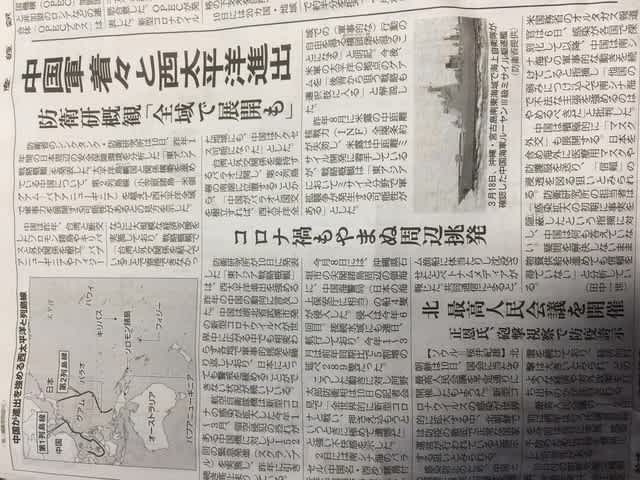
The Sankei Shimbun dated the 11th reported that four vessels of the China Coast Guard entered the waters on the 8th of this month, and that this was the sixth intrusion this year.
The Japanese mass media, which mistakenly believe that criticizing the government is what makes one a journalist, show no atmosphere whatsoever of trying to determine the true nature of this virus.
The conduct of most of the Japanese media is as grotesque as it could possibly be.
Yet the structure of the Japanese mass media is, exactly as it is, the structure of the United Nations and the international community.
Only the United States, only the U.S. government and President Trump, are pursuing the corruption of the WHO and the responsibility of China.
It is true that President Trump has somewhat toned down his criticism of China, because China, a country of bottomless evil and plausible lies, has taken advantage of the grave mistake by which America came to depend on China for most of its production of medicines, masks, protective clothing, and other medical supplies, and because urgent import decisions for medical-related goods had to be secured in exchange.
The approval rating of the Constitutional Democratic Party fell by 2.3 percentage points and stood at only 4 percent.
As this column has continued to point out, NHK makes absolutely no comment on this fact.
Even though it clearly announces, in a firm voice, the ridiculous item that sounds as though it was devised by China or South Korea, namely that the top reason for not supporting the government is that “Prime Minister Abe’s personality cannot be trusted,” NHK does not announce at all that the approval rating of the Constitutional Democratic Party is 4 percent.
That such a broadcasting station is Japan’s public broadcaster is one of Japan’s great problems.
It is one of the greatest weaknesses, indeed one of the worst defects, of the nation called Japan.
It is only natural that China, even at such a time, calmly repeats intrusions into Japan’s territorial waters day after day.
Why?
Because this public broadcaster does not report that fact even once, day after day.
The dictators of the Chinese Communist Party know this reality perfectly well.
In other words, because Japan is in the palm of their hand, they openly commit every kind of evil.
The following is from the Sankei Shimbun dated April 11.