Was the Korean Peninsula an “Actor” in History? Junko Miyawaki on Geopolitics, External Forces, the Theory of Autonomous Development, and Postwar Japan–Korea Relations
Published on August 26, 2020. Drawing on the work of East Asian historian Junko Miyawaki, this article examines the Korean Peninsula through the distinction between a historical “theater” and an “actor,” critiques the postwar theory of autonomous development, considers the geopolitical influence of neighboring great powers, and discusses how Japanese politicians and the mass media affected postwar Japan–Korea relations.
August 26, 2020
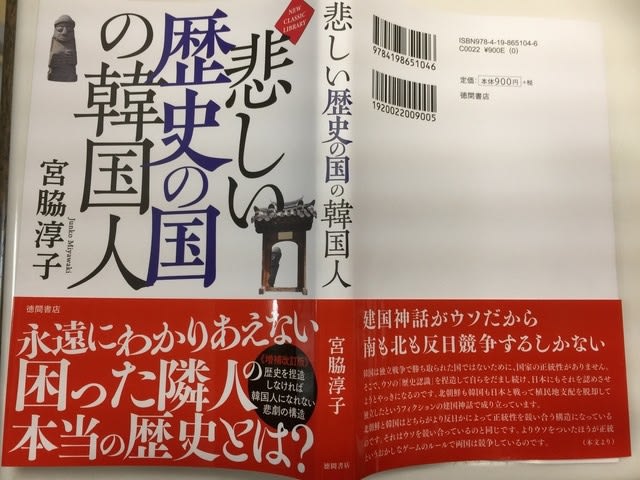
The following is from a book that a friend of mine, one of the most avid readers I know, strongly recommended that I purchase.
It is a work by Junko Miyawaki, one of the world’s leading scholars of East Asian history.
It was Masayuki Takayama, the unparalleled journalist of the postwar world, who first made me aware of her.
Her late husband, Hidehiro Okada, was one of the greatest historians in the world, as Professor Hiroshi Furuta, a great scholar whose existence the Asahi Shimbun never informed the public about, has repeatedly stated.
I also think that Junko Miyawaki is one of the people who has lived one of the happiest lives in the world.
Her extraordinary insight goes without saying.
Alexis Dudden, whom I regard as nothing other than an agent of Korea dominating the American historical establishment, and John Dower, who made a name for himself as an anti-Japanese scholar after freely playing with Japanese women in Japan immediately after the end of the war, ought to boil the dirt from beneath her fingernails and drink it.
Her clear and lucid writing, and consequently the extreme readability of her work, also prove that she is a scholar of the very highest rank.
This is a book that not only the Japanese people but people throughout the world must read.
Japanese people should immediately go to their nearest bookstore, Amazon, or elsewhere and purchase it.
All the more so because a book filled with the scholarly achievements of such a genuine scholar costs only 900 yen.
There Was Never a Period in Which the Korean Peninsula Established an Independent History of Its Own
There was never a period in which history developed solely within the Korean Peninsula, and both its territory and its ruling classes have continually changed.
As Mitsuru Kurayama writes in A Modern History of Japan and Korea Full of Lies (Fusosha Shinsho), the Korean Peninsula was a “Theater,” but it was not an “Actor.”
It did not itself act as the subject that moved history and transformed society.
However, postwar Koreans and Japanese leftists influenced by Marxism argue that Korea developed autonomously.
They interpret the present-day Korean Peninsula as having gone through its own independent process of development, but when history is examined, no such facts exist at all, and the theory is nothing more than complete fantasy.
Because of its geopolitical conditions, the Korean Peninsula has only a history in which states were formed by external factors—the rise and fall of powers within relationships with neighboring great powers.
The fact that postwar Japan failed to understand this historical formation and the contradictions of the Korean Peninsula has also complicated the situation.
Politicians confronted with unreasonable demands from them did not properly rebut those demands, but instead merely compromised in order to calm the situation.
Furthermore, with the Asahi Shimbun at the forefront, the Japanese mass media adopted anti-government and anti-authority positions and encouraged anti-Japanese sentiment.
The deterioration of Japan–Korea relations today is therefore also the result of seeds Japan itself sowed.
To be continued.