Is China Influencing Japan’s Airwaves? Media Power, Political Deals, and the Erosion of National Sovereignty
An investigative critique of Japan’s broadcasting media, examining allegations of Chinese influence, political deals over public airwaves, and the growing erosion of national sovereignty and public trust.
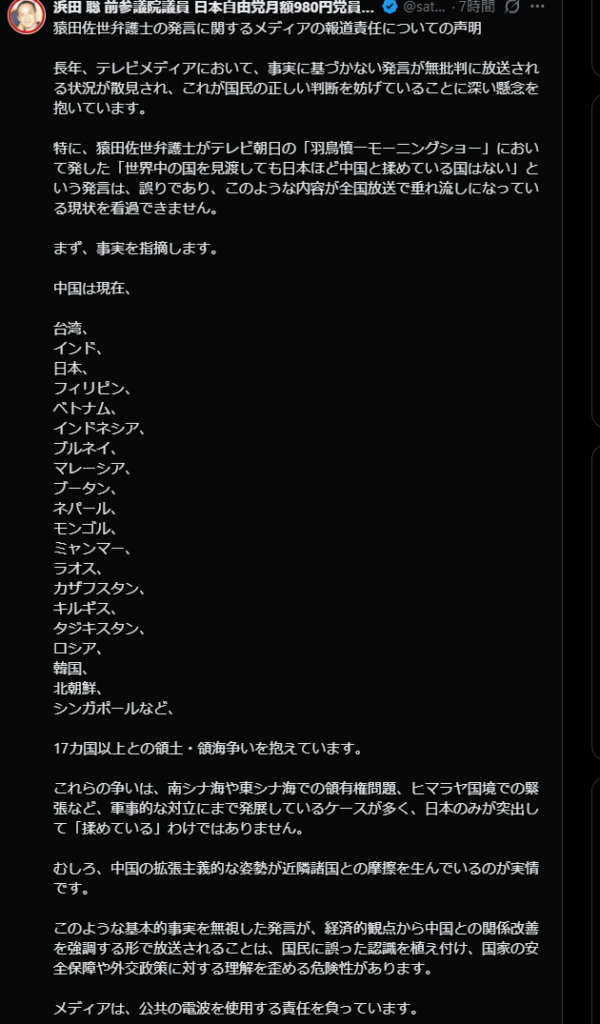
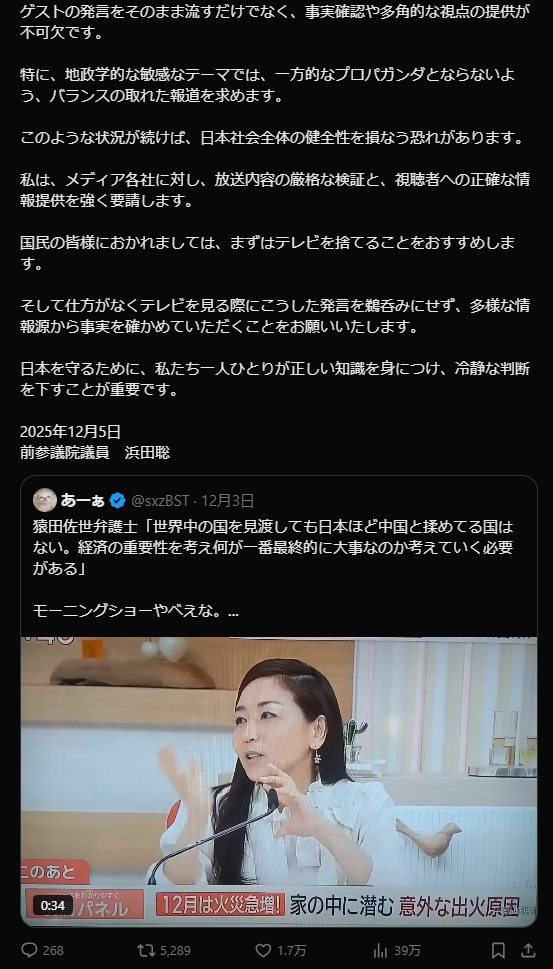
In retrospect, it has become clear to me that the lawyer in question, whom I described as extremely foolish, was Sayo Saruta.
As I have written before, anyone who searches this column for the name “Sayo Saruta” can see what kind of figure I believe her to be.
In my view, TV Asahi, which features a commentator like her on its public broadcasts, is not merely skating on thin ice with respect to the Broadcast Law, but behaves more like a broadcaster aligned with Beijing’s interests than a truly Japanese television station.
I believe that the current situation, in which such broadcasters are allowed to use the airwaves—national assets belonging to the people—at a bargain price, must be corrected without delay.
It was Kakuei Tanaka who, hoping to keep newspapers like the Asahi and other old-guard media on his side, arranged for state-owned land to be sold to them at a discount as sites for their head offices.
Yet having done this, he was ultimately brought down by those very same media.
In my view, that policy was the worst of failures.
I am convinced that reversing such misguided measures at once would be the quickest remedy for putting Japan back on the right track.
In no advanced country will you find a landscape dominated by broadcasters who, as I see it, run down their own nation while taking the side of hostile states.
Nor, to my knowledge, do such broadcasters exist even in the poorer countries—many of them facing dictatorship, civil strife, and countless other problems—that make up a large share of the United Nations membership; calling them “nation-states” at all is sometimes a stretch, yet even there you do not see quite this pattern.