Japan Alone Has Fallen into the Sleepwalking Delusion of “U.N. First.”The Reality of International Politics over the Senkakus, U.S. Forces, Korea, and China.
2020-12-30
Not only the Japanese people but also the German people must read this.
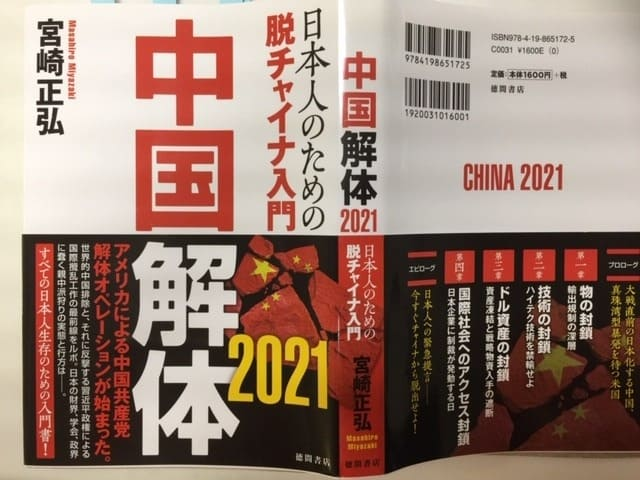
Masahiro Miyazaki’s book below is essential reading not only for the Japanese people but for people all over the world.
Pages 261 through 263 are required reading not only for the Japanese people but also for the German people.
The Sleepwalking Delusion of “U.N. First”
If China were to militarily occupy the Senkaku Islands, would the U.S. military actually respond.
Successive U.S. administrations had long kept this point ambiguous, but since the Obama administration they have at least stated that the Senkakus fall within the scope of the security treaty.
However, they have never said they would “defend” them, and in the end Japan itself would have no choice but to retake them if invaded.
The Northern Territories remain stolen by Russia, and Takeshima remains stolen by South Korea, and China, seeing this situation, would clearly move to seize the Senkakus the moment it found an opening.
Even Xi Jinping, who talks so much about Japan-China friendship, has continued to evade the Senkaku issue.
Kent Gilbert’s The History of the Korean Peninsula That Japanese Do Not Know speaks frankly about what Americans really think.
Mr. Gilbert has also written about Confucianism and is well versed in the history of the Korean Peninsula.
The conquest of the Three Han, the Battle of Baekgang, Hideyoshi’s Korean campaigns, the Korean embassies to Japan.
Then the late Tokugawa calls for subjugating Korea, the assassination of Hirobumi Ito, the annexation of Korea, the Sino-Japanese War, and the Russo-Japanese War.
Whenever Japan becomes entangled with that peninsula, nothing good happens.
Japan’s real feeling is that it does not want to be dragged in, and many Japanese recognize South Korea as nothing more than a “stalker state” and North Korea as a “cult state.”
Mr. Gilbert’s perception is close to this as well, but when it comes to detail, there is of course an American worldview behind it, and he advances his argument from a geopolitical perspective on Northeast Asia, which makes his book quite different from similar works.
That is why it felt as though I had heard the real voice of America.
America’s real intention is to withdraw from South Korea.
It is fed up with the behavior of that stalker state, its double standards, and its extreme irresponsibility that cares nothing about the trouble it causes others.
Yet although it demands that South Korea pay more for the costs of U.S. forces stationed there, America still finds it difficult to make the decision to withdraw, and he says this is for three reasons.
The first is the enormous sacrifice of the Korean War.
There remains, deeply lodged and impossible to shake off, something like a psychological compulsion that America cannot simply leave the peninsula in the face of the bereaved families of the tens of thousands of American soldiers who died there.
Second, because the Korean Peninsula still retains geopolitical importance affecting security.
Third, because for the United States, it serves as a geopolitical buffer zone between China and Japan.
In Mr. Gilbert’s view, the Middle East can be written off, but Northeast Asia, though withdrawal may exist as an option in theory, is in reality not a place America can leave.
If so, then how long does America intend to keep its military bases in Japan, which is treated as an ally under the Japan-U.S. Security Treaty.
Kent Gilbert is pro-Japan, but in international politics he judges from the standpoint of cold strategic realities, and he frankly, calmly, and rigorously speaks for American national interest when he says, “U.S. forces are not in Japan in order to protect Japan. America sees Japan as a buffer zone. That is why American forces continue to be stationed in Japan.”
In this passage, one catches a glimpse of the real American mind.
Trump championed America First, but the great powers that criticize him also, while displaying the signboard of “international order,” are in substance putting their own countries first.
It is only common sense to prioritize one’s own country’s rights.
Yet Japan alone, unable to understand the common sense of international society, is afflicted not with “Japan First” but with the sleepwalking delusion of “U.N. First”…