The True Nature of China and Japan’s Dangerous Complacency.Junko Miyawaki’s Warning on Sinographic Rule and the Threat of Totalitarianism.
Published on April 17, 2019.
Based on the preface to the revised edition of Junko Miyawaki’s China Necrosis, this piece examines China’s deepening surveillance state, its colonial-style domination of Uyghurs, Tibetans, and Mongols, the nature of Chinese society shaped by sinographic rule, and the dangerous naïveté of Japanese perceptions of China.
It also points to the failure of the Asahi Shimbun and groups such as IMADR to speak out forcefully against China’s grave human-rights abuses, and asks what resolve is required to defend Japan’s national interest.
2019-04-17
One hears absolutely nothing of the Asahi Shimbun, Kenzaburo Oe, Haruki Murakami, or the officers of the International Movement Against All Forms of Discrimination and Racism, IMADR, forcefully denouncing discrimination against this China at the United Nations.
The chapter I published on 2018-12-10 under the title,
“Why are Chinese people so coarse? As I explained in this book, I believe it is because of the communicative tool called Chinese characters,”
was in goo’s top ten searches this morning.
I believe it was Masayuki Takayama who made me aware of the existence of Junko Miyawaki.
Those who graduated from Ise High School, Kyoto University, and the Graduate School of Osaka University ought to be greatly proud that Junko Miyawaki, who specialized in Mongolian studies there, possesses scholarship of a world-class level.
The following is the preface of a book that I learned about the other day from a newspaper advertisement at the bottom of the page and immediately began reading.
The emphases in the text are mine.
Preface to the New Edition.
Junko Miyawaki.
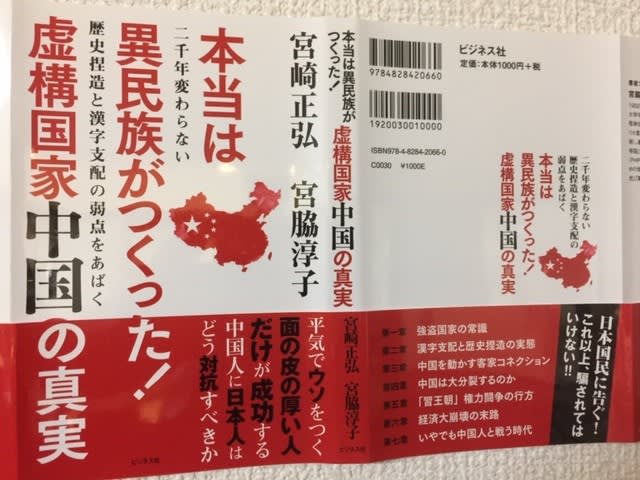
When the original edition of this book was published by Business-sha in December 2015, I was astonished to see the jet-black cover and the large title, China Necrosis.
Was what I discussed with Professor Miyazaki really that eerie?
When I saw the phrase, “The end of one hundred years of unchanged corruption,” I thought, I had been talking about the essence of China, unchanged for two thousand years, and about how the Chinese are historically a fragmented people.
However, the line on the obi, “The terror of historical falsification and rule through Chinese characters. Like it or not, the age has come when we must fight the Chinese,” was exactly right, and now, three years later, China has become an even greater threat to Japan.
Not a single good piece of news comes from China.
The surveillance system over the population using IT such as smartphones is only becoming harsher, and minority peoples such as the Uyghurs, Tibetans, and Mongols are suffering under colonial domination in the true sense of the term.
It has become ever clearer that China itself is the imperialist power they revile as though it were venomous vermin.
In August 2018, the U.N. Committee on the Elimination of Racial Discrimination reported that “there are numerous reports indicating the existence of large-scale secret detention camps in the Xinjiang Uyghur Autonomous Region,” and expressed concern that “more than one million Uyghurs and others are being detained.”
At first the Chinese government denied this as “a complete fabrication,” but once satellite photographs and other evidence made the camps undeniable, it brazenly admitted that it was forcing Muslims to undergo patriotic education.
The logic is this: this is China, so Chinese alone is enough, the very use of strange non-Chinese-character writing is outrageous, and if they do not stop being Muslims they will be regarded as terrorists.
One foreign journalist has even called the entire Xinjiang Uyghur Autonomous Region an “open-air concentration camp.”
And yet one hears absolutely nothing of the Asahi Shimbun, Kenzaburo Oe, Haruki Murakami, or the officers of the International Movement Against All Forms of Discrimination and Racism, IMADR, forcefully denouncing discrimination against this China at the United Nations.
As for why Chinese people are so coarse, as I explained in this book, I believe it is because of the communicative tool called Chinese characters.
By as early as the ninth century, the Japanese had already invented katakana and hiragana, and having acquired scripts with which they could write as they spoke, they then made convenient use of the ideographic script of Chinese characters.
That is why they do not truly understand the Chinese, who until the twentieth century possessed only Chinese characters, whose pronunciations varied wildly.
Fine nuances do not work with the Chinese.
They think that if the outward appearance is the same, that is enough, that it does not matter if one lies so long as it passes, and that after the strong have won, one need only explain it by saying that Heaven’s mandate descended upon them.
Japanese people have overestimated China, but it is merely a group of worshippers of power.
Even so, because the Chinese have accumulated the wisdom needed to survive in a society of fierce competition for survival, I cannot help worrying lately about Japanese complacency.
This is no time merely to vent by speaking ill of China.
Reading this book, one must ask what should be done to build a strong Japan that will not lose to such a China.
I will think about it seriously myself, but I hope readers as well will not leave unchallenged those Japanese who lend a hand to Japan’s weakening, and that each of you will do your utmost in your own place for the sake of Japan’s national interest.
Written in October, Heisei 30.