The Bond Between Emperor Showa and the Japanese People — The Imperial House Law, GHQ Occupation Policy, and the Deep Structure of Postwar Indoctrination
Written on 2019-05-21.
This chapter argues that the GHQ’s revision of the Imperial House Law and the removal of the former princely houses weakened the foundations of the Imperial House, while also examining the national devotion shown during Emperor Showa’s postwar tours and the impact that postwar war-guilt propaganda by Asahi Shimbun and the Japan Teachers’ Union had on Japanese historical consciousness.
It is an essay that questions the unity of the Imperial House and Japanese history, as well as the spiritual structure of postwar Japan.
2019-05-21
But in the postwar years, before Emperor Showa passed away, what kind of indoctrination was imposed on the Japanese people?
Surely a major factor was that Asahi Shimbun and the Japan Teachers’ Union relentlessly propagated Japan’s war responsibility.
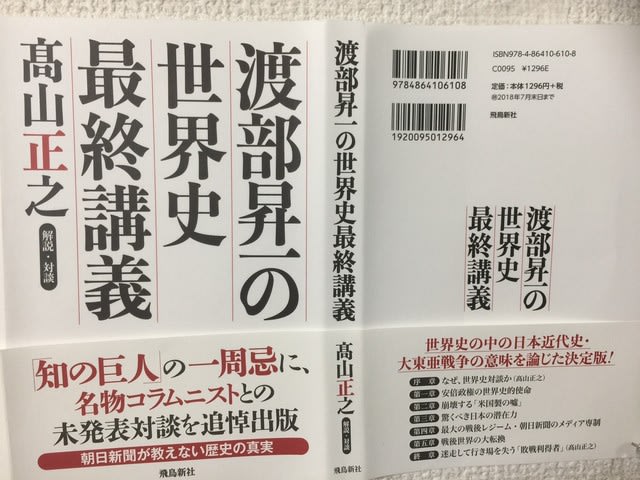
The following chapter is the exact opposite of the shallow foolishness of the Asahi Shimbun’s Tensei Jingo that Kadota Ryusho pointed out yesterday in the Sankei Shimbun.
It is a chapter that every Japanese citizen must read.
The Unity of the Imperial House and Japanese History
Takayama
Next to the Constitution, another problem that MacArthur tampered with and that still has not been corrected is the Imperial House Law.
After the war, under the new Imperial House Law and Constitution, the princely houses were removed from the imperial register all at once, and of the 14 princely houses that once existed, only 3 remain today.
The kazoku peerage system was also abolished, and the five regent houses — Konoe, Kujo, Takatsukasa, Ichijo, and Nijo, descended from the Northern Fujiwara line and eligible for appointment as Sessho and Kanpaku — as well as the tenjobito, the ranks of nobles permitted to ascend into the Emperor’s presence and serve at his side, were all abolished.
At the very least, the former princely houses must be restored at once, and unless Japan quickly recovers from the wound inflicted by MacArthur, the matter will become truly grave.
The Imperial House Law was changed in order to reduce the princely houses, and that was done to sever the roots of the Imperial House.
Things have now reached the point where it is being left to decline and perish.
Watanabe
Yes, the princely houses kept decreasing, and the Imperial House was left exposed and bare.
Takayama
Even now, people remain tossed about by what MacArthur decided and say, well, there is nothing to be done now, perhaps we should have a female emperor.
I cannot understand that mentality.
Why do they not go back to the origin of the matter and see MacArthur’s malice?
Like the Constitution, the Imperial House Law too must not merely be amended but abolished.
What GHQ did was illegal, so should not a decision be made quickly?
Watanabe
I think so too.
In Meiji 22, the occasion for creating the original Imperial House Law was that until then there had been no formal law concerning the Imperial House, so they decided to put even the family law of the Imperial House into written form.
Ito Hirobumi, Inoue Kowashi, and court nobles knowledgeable in court precedents and usages gathered together and studied how the imperial succession could be stabilized.
If you look into it, you find that when Ito Hirobumi secretly left Japan at the end of the shogunate and crossed over to London, he brought with him Rai Sanyo’s Nihon Seiki.
It was a chronicle-style history running from Emperor Jimmu to Emperor Goyozei, and he was the kind of diligent student who read it closely.
Inoue Kowashi, meanwhile, was called a genius.
Originally he had entered scholarship through French studies, but once he became involved in law, and under instructions from Iwakura Tomomi, he thoroughly studied Japanese history under outstanding scholars of kokugaku.
When such men drafted the original plan, and when under the presence of Emperor Meiji each clause of the Imperial House Law was decided one by one, it cannot be permissible for people ignorant of history to tamper with it lightly.
Takayama
That is the mindset of Western colonialism.
Owen Lattimore, mentioned earlier, who served as an adviser to Chiang Kai-shek after he had defected to the white side and had the Nationalist Army hinder the Japanese military, strongly argued that the Emperor must be abolished and said that His Majesty and the male members of the Imperial House should be exiled to China.
If you look at history, when Britain conquered India, it exiled the aged Mughal emperor Bahadur Shah II to Burma.
Then, when Burma was destroyed in the Anglo-Burmese War, the last king and queen of the Konbaung dynasty, Thibaw and his consort, were exiled to Bombay, present-day Mumbai, and confined there.
When France made French Indochina into its colony, it exiled Emperor Ham Nghi, the eighth emperor of the Nguyen dynasty who had resisted to the last, to Algeria.
To pull out the central pillar of a nation and exile the king, who serves as the symbol of the country’s unity, is an effective way to weaken the people’s cohesion.
But even MacArthur, foolish as he was, had enough sense to know that if he tried that in Japan, terrible consequences would follow.
Watanabe
Yes, when the Emperor traveled all around Japan after the war, once one saw those cries of joy, even the occupation forces must have understood that if they laid a hand on him, the consequences would be grave.
Perhaps the Asian kings who were exiled were not beloved by their people.
But the Japanese were different.
Takayama
What stunned GHQ seems to have been the sight of the Japanese people when His Majesty began his nationwide tours without delay in the year after defeat.
Starting in February 1946 with visits to Kawasaki, Yokosuka, and Shinjuku, as he traveled around the country, wherever he went it was a great welcome, with cries of “Long live His Majesty.”
In Hiroshima, as many as 70,000 citizens crowded into the atomic-bomb ruins and roared “Banzai,” to such an extent that frightened military police accompanying him fired their pistols into the air and dispersed the gathered crowd.
Until then, GHQ had believed that when His Majesty visited various places, the people, influenced by war-guilt information propagandizing Japan’s war crimes, would become angry and shower “the short man with glasses” with abuse and stones.
That is why they attached MPs for his protection.
But the exact opposite happened, and the imperial tours were suspended for about half a year as a result, from the Ibaraki visit in November 1946 until the Osaka visit in June 1947.
Watanabe
I still remember very well when His Majesty came to Tsuruoka City in Yamagata Prefecture in August 1947.
Since it was summer, we were swimming in a tributary of the Mogami River.
Then on the embankment on the far side, 3 or 4 cars we had never seen before appeared, coming from the direction of Yamagata into Tsuruoka City.
I remembered, “Ah, this is the day His Majesty is coming.”
Those of us who had been swimming hurriedly threw on only our jackets and ran to the next bridge, greeting him almost naked, and I remember stretching out my hand and touching the car in which His Majesty was riding.
What surprises me in retrospect is that there was no guard escorting the motorcade.
There was no need for one.
Takayama
Is that so?
So the MPs were attached only at first, and after the tours resumed they were no longer there.
Watanabe
When Emperor Showa died, however, security became necessary for the state funeral, and the Tokyo Metropolitan Police had to mobilize to protect it.
In fact, a small bombing incident targeting the funeral procession occurred.
When I saw that, I thought, what an enormous change.
When I was a mischievous boy, together with just a few others, I welcomed His Majesty without any guards, touched his car, and no one stopped us.
He was loved by the people to such an extent that there was truly no need to protect him at all.
But in the postwar years before Emperor Showa died, what kind of indoctrination was carried out on the Japanese people?
Again, a major factor was that Asahi Shimbun and the Japan Teachers’ Union thoroughly propagated Japan’s war responsibility.
Takayama
There is an episode from the serial corporate bombing incidents by the East Asia Anti-Japan Armed Front that left a strong impression on me during my time as a newspaper reporter.
In 1974, black-helmeted men calling themselves “Wolf” placed a bomb outside the Mitsubishi Heavy Industries building in Marunouchi and detonated it.
The Sankei Shimbun beat everyone with the scoop on the arrest of the perpetrators.
I vividly remember what I was told by the man who had led the reporting team.
He said that Masashi Daidoji, who planted the bomb, had originally intended to target His Majesty’s imperial train returning from the Nasu Imperial Villa.
He had entered the area and prepared from two days in advance.
But one midnight he went to plant the bomb and stopped halfway, and the following night he also went and gave up.
Each time, he testified, he somehow felt that someone was watching him, and for that reason he simply could not plant the bomb.
This was the failed “Rainbow Operation” of August 14.
In the end, they changed the target to the Mitsubishi Heavy Industries building in Marunouchi, and 8 people were killed in the “Diamond Operation” of August 30, with 376 injured.
Watanabe
So originally they had been aiming at His Majesty.
Takayama
That is right.
When I heard that story, I felt that in some way I understood it very well.
The reason Masashi Daidoji tried twice and both times gave up, saying “someone is watching,” was probably that some Japanese consciousness still remaining somewhere inside him caused him to do so.
I again felt that Japan is somehow different.
This does not happen with other royal houses.
It is truly a rare existence.
Even when MacArthur himself stood at the height of his power, His Majesty remained the center of the nation in the consciousness of the people.
MacArthur tried to destroy that through his petty schemes, but the people’s reverence for His Majesty and the Imperial House remains sound even now.
You great fool, writer of Tensei Jingo = Asahi Shimbun, who hardly seems even to be a Japanese citizen — know shame!