Shoichi Watanabe’s Victory in the Forty-Year War Against the Asahi Shimbun and the Falsehood of Japan’s Postwar Media Space
Written on May 18, 2019, this article traces how Shoichi Watanabe fought without yielding to the Asahi Shimbun’s attempts at silencing and personal destruction, while sharply questioning how Japan’s postwar media suppressed historical truth and reinforced the Tokyo Trial view of history.
2019-05-18
According to Hanada Kazuyoshi, former editor-in-chief of Monthly Hanada and formerly of Bungeishunju, the company president reportedly said at a certain gathering, “We must not allow the present administration, which is a lump of the extreme right, to run wild any further,” so it has reached a state that can be mistaken for the Asahi.
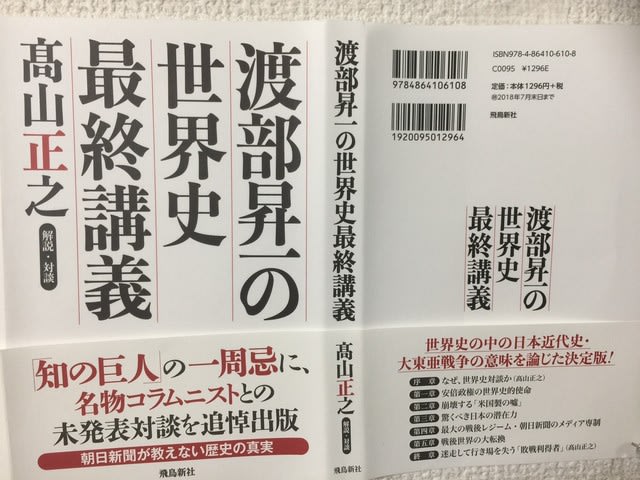
I am sure that all readers keenly felt that every chapter proves that the following book is the most important book in the postwar world.
Victory in the “Forty-Year War” Against the Asahi.
Takayama.
Even so, Professor Watanabe, it was you who, for a long time and all by yourself, blazed the trail in the struggle against the Asahi Shimbun.
Watanabe.
Originally, I had no intention of criticizing the Asahi.
It all began when they arbitrarily launched a personal attack against me.
At that time, the Asahi still possessed enormous authority, and when it attacked someone, that person could lose his social standing, but I never apologized and struck back.
Even within the university, there were people who, wielding the authority of the Asahi, began saying, “Why does the university keep someone with ideas like Watanabe’s?” and there were also groups that came riding on that authority to obstruct my classes, so it was very difficult.
Takayama.
The controversy with Ohnishi Kyojin itself was fabricated by the Asahi Shimbun.
They laid it out as if it were a dialogue printed on the page.
In the morning edition of October 15, 1980, “Mr. Ohnishi Kyojin vs. Mr. Watanabe Shoichi,” the headline read: “[Do not give birth to children of inferior heredity. Mr. Watanabe names names in essay. Almost like praise for Hitler. Mr. Ohnishi enraged].”
That was terrible.
Watanabe.
That is right.
I was having a conversation on the page with a man I had never met and never read.
I had no idea they would do something so dreadful.
The very fact that it was reported in more than a full quarter of the social affairs page in a six-column spread was itself complete fiction, and it was not as though Mr. Ohnishi had actually rebutted me in print.
They created a malicious page with a fabricated article and denounced me as a person holding ideas the Asahi disliked.
What I had said was twisted, and in a five-column spread I was turned into “a praiser of Hitler’s eugenic thought,” to the opposite effect.
In my serialized column in Weekly Bunshun, I expressly stated, “He is a man who stands in the opposite position from Hitler,” and quoted Alexis Carrel, winner of the 1912 Nobel Prize in Physiology or Medicine.
Because Carrel, from a Catholic standpoint, firmly denied state intervention, I wrote that “there is an ethical difference as great as heaven and earth between the state coercing or handling the sterilization of the abnormal or inferior by law, and concerned persons, or the individuals themselves, doing so by their own will,” and that it should be left to the individual’s ethical judgment.
Naturally, he stood in the opposite position from Hitler, yet the Asahi Shimbun reporter deliberately pretended not to notice and treated this sentence as if it were an article praising Hitler.
It is a terrifying thing to use newspaper reporting to beat down a person in order to pressure his opinions.
Reporting, which ought to be fact, is distorted by false reporting, and a newspaper, which ought to be an institution of freedom of speech, becomes an institution that censors opinions it dislikes.
The standards of censorship are left-wing, anti-Japan, pro-China, and pro-Korea, and speech that runs counter to these is mercilessly exposed.
What they aim at is expulsion from the world of public speech and social obliteration.
The deed of trying to bury a single teacher at a private university through fabrication can only be described as vicious.
Having nearly been socially killed, I resolved, “From now on, I will speak the truth bluntly and criticize the Asahi thoroughly.”
After the Asahi lit the fire, those who exhausted every insult in criticizing me always ignored the sentence, “Life that has ‘already’ been born is the will of God, and my view of life is that the preciousness of that life is no different from that of an ordinary person,” and handled the other parts in the manner of censors, which was totalitarian as well.
Because I was a child of earlier times, I recalled at that time Kusunoki Masashige’s Chihaya Castle.
Even though the Hojo shogunate, which possessed absolute authority, sent a great army, when a period continued in which Chihaya Castle would not fall, circumstances could suddenly overturn all at once.
I thought, “I will become Chihaya Castle.”
There were two times when every class I was in charge of was obstructed.
For about half a year, including the summer vacation, I was blocked from entering the classroom for my lectures.
I would push my way through the obstructing people to get in, but if I used my hands they would say I had shoved them, so I pushed through using only my body and not my hands.
Before long, the students themselves began saying, “Get out!” and those people came to wait in the corridor during class.
At that time I was teaching six class periods a week, but I never missed a single one.
When I went home, I felt sick. In a Chinese classic I had learned long ago, there was the line, “The geese cross the cold pool, and when the geese depart, the pool retains no shadow. Therefore the gentleman, when affairs come, only then does his heart appear, and when affairs go, his heart follows and becomes empty” (Caigentan).
The geese passed over the clear pond.
When the geese were gone, their shadows were no longer reflected.
It means that a gentleman, in this way, moves his heart when something happens, but once it is over, he returns his heart to emptiness and does not cling to it forever.
So I would go home repeating over and over, “The geese cross the cold pool, the geese cross the cold pool……”。
Thanks to that, even though I had suffered class obstruction for half a year, my wife, who shared my bedroom, did not realize that I was being subjected to such persecution.
Takayama.
So you were able to remain very calm.
Watanabe.
If they came to my house, it would become a police matter.
They knew that, so they did not come to the house.
The school would not appeal to the police, so they came to obstruct my classes.
Takayama.
What kind of people came?
Watanabe.
Even left-wing groups that were not students came and entered the classroom on their own.
There was no way that the people in wheelchairs had read my papers.
So when I stepped down from the podium, took the hands of the people in wheelchairs, and spoke with them, they smiled and were delighted.
When I said, “The person pushing your wheelchair is a bad person,” since the pretext was that people with disabilities had come to criticize me, the activist pushing the wheelchair could say nothing in reply.
As I repeated this sort of thing, they stopped coming (laughs).
At that time, Editor-in-Chief Ando Mitsuru of Monthly Bunsei Shunju let me write a leading article titled “The Asahi Shimbun as a ‘Censorship Organ,’” so I was able to rebut them.
This editor-in-chief was of the old type, someone who knew the tradition that “Bunsei Shunju says things different from the Asahi Shimbun and NHK,” and so he let me write a rebuttal.
I also fought thoroughly on the textbook issue.
In 1982, the mass media all at once reported the groundless lie that, in the screening of history textbooks, Japan’s “invasion” of China had been rewritten as “advance,” so when I pursued that false report in an article in Shokun! titled “The Textbook Issue in Which Ten Thousand Dogs Barked at a Phantom,” the Asahi fell silent from that point onward.
Even when I published open letters of inquiry in Shokun! twice, naming them directly, there was no response.
No matter how much they tried to manipulate the impression that I was a person with ideas like Hitler’s, it became increasingly clear as time passed that it was baseless fraud.
In the end, there was no reply or rebuttal from the Asahi side to my criticism that they were thought censors.
Their attempt to drive me out of the university failed, and an example was created that even if the Asahi attacked an individual in a banner article, it was of no use.
There had been case after case of people committing suicide or resigning when malicious articles appeared in major newspapers, so the appearance of a teacher who remained unshaken no matter how much the Asahi attacked him was, I believe, indeed epoch-making in the postwar media world.
What is regrettable is that in recent years Bungeishunju has lost its former journalistic tradition of “saying things different from the Asahi Shimbun and NHK.”
People who had been imbued with the consciousness that Japan had done bad things became central, and it became liberal.
According to Hanada Kazuyoshi, former editor-in-chief of Monthly Hanada and formerly of Bunshun, the company president reportedly said at a certain gathering, “We must not allow the present administration, which is a lump of the extreme right, to run wild any further,” so it has reached a state that can be mistaken for the Asahi.
It is dangerous that people such as Hando Kazutoshi, who praises MacArthur, and Hosaka Masayasu, who have been absorbed into the Tokyo Trial view of history, hold the tone of its historical outlook.
The fact that the “henohenomoheji”-like figures who seem to be representative MHK announcers hosting NHK’s Close-up Gendai place such importance on Hosaka Masayasu also proves that NHK is a traitorous, anti-national state broadcasting station no different at all from the Asahi Shimbun!
They went around earnestly listening to the people who had been the targets of the Tokyo Trials, but that only tells you the Japanese side’s movements.
If you compile stories of how the Japanese military was beaten in individual battles, you end up with a conclusion that merely retraces the Tokyo Trial.
What the Allied side had been doing before that, and why Japan was driven into war and battle under such limited conditions in the first place, is information that they shut out.
Takayama.
Yes, it lacks international perspective.
One must look down from above at the movements of both Japan and the United States, see how each moved, and view the war as the result.
Watanabe.
They have no viewpoint of what the other side was doing and how it was moving.
One characteristic thing is that they hardly use the testimony of Tojo-san, who in his sworn affidavit at the Tokyo Trial argued, “Japan most certainly did not wage a war of aggression. It fought a war of self-defense,” and “To rise for the self-defense of the nation was the only path left.”
If a person studying modern German history found that Hitler had left diaries and trial records, there is no way he would not use them.
Moreover, Tojo-san’s records are testimony in court, so they contain no lies.
If he lied and distorted facts, the prosecutors would have gone after him.
As long as they do not use that, one can see how one-sided their view is.
Later on, MacArthur himself endorsed Tojo-san’s way of seeing things. In 1951, before the संयुक्त States Senate Armed Services and Foreign Relations Committee, he testified that Japan fought the war “primarily for security.”
Japan had no resources to support modern industry except silkworms for making silk thread. All other resources, oil, rubber, tungsten, and so on, were in the Southeast Asian region. But we cut off the supply of these raw materials to Japan. As a result, Japan suddenly faced the danger of producing some 12 million unemployed people, and so it embarked on war “for security.”
This is a historical view that says Japan rose up and fought in self-defense because measures had been taken that would have stopped its very breath.
Most of that MacArthur testimony appears in the Asahi Shimbun’s reduced-size edition, but only the crucial part about “security” is missing.
As expected, they are making sure not to let the Japanese people know the truth.
There should be no lies in direct interviews with the parties concerned, but that does not necessarily mean truth either.
For example, if one looks back on the Nomonhan Incident using only the testimony of the Japanese side’s participants, it appears to have been a crushing defeat for Japan.
But unless one also considers the Soviet side’s losses, one cannot know the truth.
At Nomonhan, Japan’s tank losses were 30 vehicles, but the Soviets lost 400.
There is even a theory that it was 800.
Aircraft losses were 180 for Japan, while the other side lost 1600.
Japan had 17,000 dead and wounded, while the other side had 26,000, so Soviet losses were far greater than Japan’s.
But if one sees only the Japanese side’s losses, since they amounted to almost an entire division disappearing, it can be called a major defeat.
Takayama.
In fact, as a result of Nomonhan, the commander Zhukov was so frightened by the strength of the Japanese military that afterward he did not dare challenge them again.
He waited until the defeat of Germany and Japan had been decided, and until preparations were complete to mobilize a force four times the strength of the Kwantung Army, and only then invaded in one sweep.
We must write about this cowardice of Zhukov.
And then the Battle of Shumshu Island is important.
When the Soviet army began a surprise landing on August 18 after Japan’s surrender, troops that had once disarmed, under the order of Lieutenant General Higuchi Kiichiro, commander of the Fifth Area Army, immediately began a counterattack and drove the Soviet forces back.
The true image of the Japanese military, which fought and won to defend the homeland even after the war had ended, has hardly been spoken of.
If we dig up this history that the Asahi has sealed away, Japan will change even further.
The age has arrived in which the Asahi Shimbun is struck back by the truth of history.
Watanabe.
Recently there have come to be mountains of people criticizing the Asahi Shimbun, and I think that is a good trend.