Shoichi Watanabe’s Enduring Work in Exposing Asahi’s Great Crimes and the Peril of Historical Warfare
Written on May 18, 2019, this article criticizes the distorted historical consciousness that American media and the Asahi Shimbun helped implant in postwar Japan, and, drawing on the lesson of Spain’s defeat in historical warfare, argues for the lasting importance of Shoichi Watanabe’s long struggle to restore a sound view of history.
2019-05-18
I believe that Professor Watanabe, who recognized this at a very early stage and went on compiling a Japanese history beneficial to Japan, accomplished an immortal work.
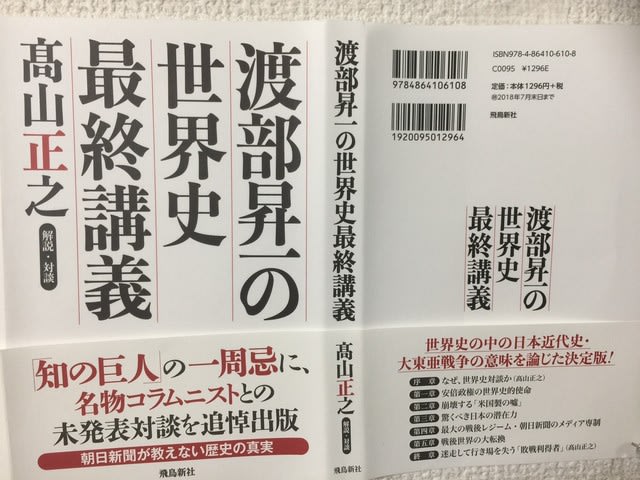
The following book is one that not only all Japanese citizens but people throughout the world must read.
Prologue: Why a Dialogue on World History? — Masayuki Takayama.
“A Brief Account of the Destruction of Asia by Japan.”
What surprised me most after I went to the United States in 1992 as bureau chief in Los Angeles and began reading the American newspapers every morning was that criticism of Japan always appeared.
Even in a short editorial of about forty lines, whenever Korea appeared, it would invariably be followed by a comma and the explanation, “Korea, once Japan colonized.”
After the 1994 U.S.-North Korea negotiations brought repeated discussion of freezing nuclear development, famine broke out again and again in the North, but all that increased was reporting that “famine is occurring in North Korea, once colonized by Japan.”
I became so furious that I telephoned the editorial board room of an American newspaper and protested that whenever they referred to the Philippines, they should always write, “once occupied by the United States, which killed 400,000 people.”
Another thing that angered me was that whenever American newspapers referred to Southeast Asia, they also, almost without fail, inserted the phrase, “South East Asia, once Japan occupied and conducted atrocities].”
They brought up Japan every single time.
Up until the 1990s, this style of writing had become routine.
Recently, the method has changed, and as locally sourced news, reminding readers of “Japanese atrocities” has become a yearly ritual.
The Nanjing Massacre from Beijing, the Bataan Death March and the Manila Massacre from Manila — in season, they unfailingly had local correspondents write about them every year.
A recent favorite is Unit 731.
For example, The New York Times had Jonathan Tepperman, an editor of Foreign Affairs, write that “Japan brutally exploited Korea and northern China to solidify its own foothold. Unit 731 is its symbol, and whenever the occasion arises, neighboring countries revive the memory of this brutality.”
The trigger was simply that the aircraft number of the Blue Impulse plane in which Abe took a trial seat was “731.”
It was nothing more than forced and empty agitation over that alone.
Even before Obama visited Hiroshima, they had carefully run a series on Japanese atrocities.
In short, in order to prevent the atomic bombing and the Tokyo air raids from being condemned as American atrocities, the American mass media, even seventy years after the war, continue to work in advance to crush such criticism by saying, “Japan too did things this terrible.”
At the same time, they crush the Japanese people with historical consciousness, sap their morale, and make sure they can never rise again.
Those who carried the spear of such postwar brainwashing within Japan were left-wing intellectuals and the Asahi Shimbun.
The foremost figure who, from the early 1970s onward and for more than forty years, continued without yielding the fight to call to account their great crimes and draw Japan back to a correct historical view was Professor Shoichi Watanabe.
This is the first time that a dialogue between Professor Watanabe and myself has been published.
About five months before his passing, I had the opportunity to speak with him at length on the theme of Japan’s proper place within world history.
At the historical turning point called the Trump era, we discussed a “Japan First” way of viewing world history.
Professor Watanabe named the masochism that judges the last great war to have been a war of aggression the “Tokyo Trial view of history,” and raised the alarm sooner than anyone else.
That his sense of crisis was correct was proven by Jiang Zemin’s instruction that “the historical issue should be repeated against Japan.”
The tall tale by Bates, who said at the Tokyo Trial that 300,000 were killed in Nanjing, was revived by the Asahi and Katsuichi Honda, and furthermore Seiji Yoshida’s falsehoods were treated as if they were true, with the result that China and South Korea came to use them as diplomatic strategy.
The harmful effects of China and South Korea forming a united front over the comfort women and conscripted labor issues are of an entirely different order from domestic masochistic historical disputes.
As Professor Watanabe cited Kazutomo Wakasa in Chapter Three, the lesson of Spain becoming a loser in historical warfare is immense.
Once Britain, France, the Netherlands, and Portugal, like Spain, all built vast colonial empires.
Spain, which possessed extensive colonies stretching across Central America, South America, the Caribbean, the Pacific, and Africa, lost the historical war because of a single slim pamphlet, A Brief Account of the Destruction of the Indies.
In 1542, Las Casas, a minor clergyman who himself had worked Indians as slaves on his own plantation, partly to atone for his own sins, submitted to the king a report describing how cruel other Spanish settlers were, mixing in fiction as well.
When this was printed in 1552 and spread throughout Europe and America, Spain was battered from all sides.
The ones who rejoiced were the other colonial empires.
All evil came to be attributed to the Spaniards, and Spain’s colonies kept shrinking one after another.
The United States exploited the decline of Spanish power and enclosed Central and South America and the Caribbean as its own “backyard.”
As this shows, the reason Britain and America were able to set out toward world domination was the result of skillfully reusing Las Casas’s book to utterly shatter Spain’s national consciousness and pride.
Before the Second World War, General Franco, who disliked America, tried to advise Hitler on Germany’s nuclear program, but Hitler paid him no attention whatever, saying, “What can a Spaniard have to say?”
No trace even of its former imperial image remained, and other countries no longer dealt with it as an equal.
Having lost their voice as a nation, the Spaniards turned inward and apathetic, and the country became so devastated, with such a high crime rate, that it was said one could be pickpocketed twice in walking a single block.
That is the terror of losing a nation’s prestige.
Sooner or later, through the schemes of the United States, China, and South Korea, there will surely be written “A Brief Account of the Destruction of Asia by Japan.”
If one views world history in that way, one can see that the crimes committed by the Asahi are far greater than the Japanese people imagine.
Professor Watanabe, who recognized this at a very early stage and went on compiling a Japanese history beneficial to Japan, accomplished, I believe, an immortal work.
This article will continue.