Those Who Speak of Academic Freedom While Trampling University Autonomy.The Self-Contradictions of Takashi Uemura’s Supporters and Anti-Japan Activist Groups.
Written on May 3, 2019, this essay sharply examines the true nature of left-leaning forces that, while invoking academic freedom and university autonomy, in reality fall into censorship and self-contradiction, through the anti-“anti-China/anti-Korea” movement, the campaign supporting Takashi Uemura, and the controversy surrounding Hokusei Gakuen University.
Citing Wang Fu’s Qianfu Lun, it sternly points out the disasters that arise when those lacking moral character and ability occupy positions of authority.
2019-05-03
An ancient said, if virtue [moral character] is not equal to the office, the calamity will surely be severe.
If ability is not equal to the position, the calamity will surely be great.
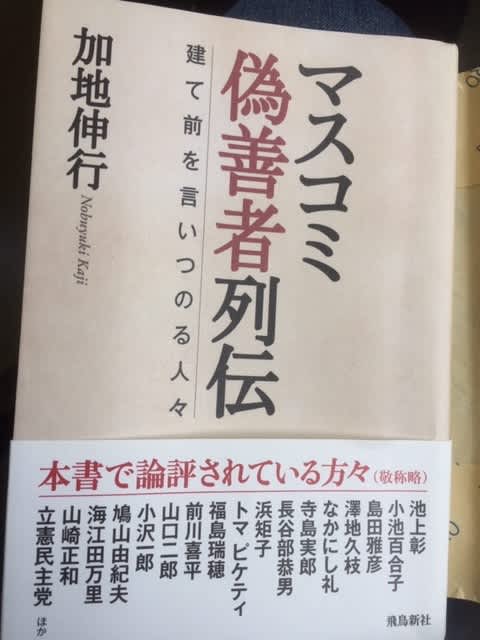
The following is from the book below.
It is not only a book that all Japanese citizens should read, but also one well suited to reading while traveling during the ten-day holiday.
Anti-Japan groups and supporters of Takashi Uemura who obstruct academic freedom.
It is said that publishing company employees, bookstore clerks, and freelance writers in Tokyo have gathered together to publish a book criticizing the various “anti-China, anti-Korea” books now being published, and to raise objections from within the industry.
The world is truly coming to an end.
Should it not be “speech against speech”?
The proper course, in response to “anti-China, anti-Korea” books, would be to publish “pro-China, pro-Korea” books, yet to say that “anti-China, anti-Korea” books must not be published lays bare the essence of the Left, namely the consciousness that opponents are to be purged.
One of them says, “I cannot stomach the fact that books like those [anti-China, anti-Korea books] are being published.
This cannot continue as it is,” and then says this.
“It is difficult to change things, but at the very least I want to keep saying, ‘This is strange’” (Mainichi Shimbun, October 27, 2014).
That is like declaring defeat from the very start.
There is no spirit in it.
That is only natural.
There is a reason why so-called anti-China, anti-Korea books are selling.
That is, the anger of the Japanese people is what drives them.
To put it plainly, they are the expression of efforts to arm oneself intellectually against the lawlessness of China and Korea.
It is fair to say that people buy them because they can obtain from them what they have been seeking.
Moreover, many of them are not mere books of abuse, but works that are carefully reasoned through.
For example, One Hundred Rebuttal Manual Topics on the Senkakus by Ishii Nozomu (Shūkōkoku, Fukuoka) is extremely empirical and persuasive.
The university teachers of the Left probably cannot rebut even one point of it empirically or logically.
It is an excellent scholarly work.
The reason the anti-“anti-China, anti-Korea books” movement lacks force is that many on the Left are doctrinaire and afflicted with a kind of infantile leftism, and what has been exposed is that they were, from the beginning, incapable of thinking with their own heads.
Something similar is happening in another case as well.
A part-time lecturer at Hokusei Gakuen University in Hokkaido, one Uemura, wrote fabricated articles on the so-called wartime comfort women during his days as an Asahi Shimbun reporter, and it is said that threatening letters demanding his resignation have been sent to the university.
In response, the university appears to be moving in the direction of not renewing Uemura’s contract for the next academic year, that is, of terminating it at the end of this year.
Against this, some faculty and staff members of the same university are opposing the move.
That is fine.
Naturally, there may be debate within the university.
However, something bizarre occurred not internally, but externally.
So-called intellectuals formed a support group called “Do Not Lose, Hokusei! Association,” held a symposium, and supported Uemura.
Its slogan was, “Protect university autonomy and academic freedom.”
This is self-contradictory.
For if one speaks of “university autonomy,” that means the autonomy internal to that university.
That is precisely why it resists outside interference.
Accordingly, with regard to what is decided within the university, even if there is opposition, once there is a formal institutional decision, the outside has no right to complain.
If Hokusei Gakuen University, by a formal institutional decision, ends Uemura’s contract upon the expiration of his one-year term, then outside opposition to that would itself constitute an infringement on university autonomy.
In other words, does not the slogan of the “Do Not Lose, Hokusei! Association,” “Protect university autonomy,” become an act that infringes upon university autonomy?
If he has objections, then Uemura should file suit, whether for preservation of status, damages, defamation, or anything else.
The “Do Not Lose, Hokusei! Association” should support him in that.
That at least would make sense.
And then it would be best for him to lose the case without fail and weep.
They speak of “academic freedom,” but falsehood is not included within that “freedom.”
Uemura wrote various texts on the basis of Yoshida’s fabricated testimony, and is nothing more than a fiction writer unrelated to scholarship.
When he was appointed, even as a part-time lecturer, there must have been a review of his achievements and educational experience.
If so, then the very fact that there were fraudulent achievements is sufficient to disqualify him, and that is precisely the university autonomy that protects academic freedom.
An ancient said, if virtue [moral character] is not equal to the office, the calamity will surely be severe.
If ability is not equal to the position, the calamity will surely be great.
If moral character is not equal to the office, the calamity will surely be severe.
If ability is not equal to the position, the calamity will surely be great.
Wang Fu, Qianfu Lun, “Zhonggui.”