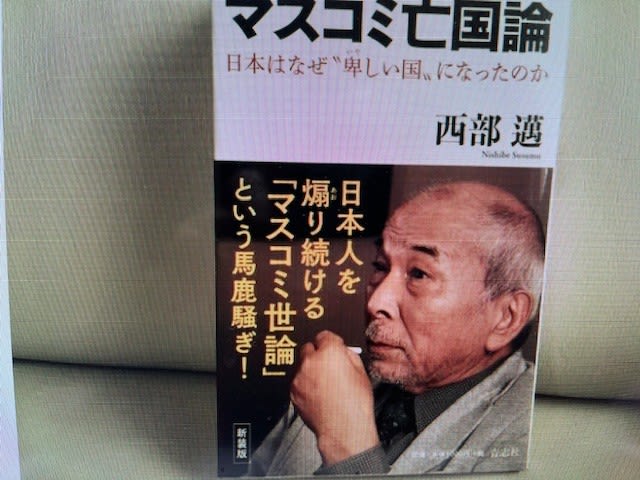
Nikkyoso Education That Implanted Mimetic Democracy in the Japanese People.—The Mental Structure of Postwar Japan Exposed in Susumu Nishibe’s The Media and National Ruin—
Written on June 26, 2019, this passage, based on the late Susumu Nishibe’s The Media and National Ruin, sharply examines the “mimicry” of democracy and the mental structure of postwar Japan.
It shows how lofty slogans such as peace, equality, and welfare, filtered through Nikkyoso education and the language system of the mass media, conditioned the Japanese people into reflexive conformity.
2019-06-26
That righteous cause, for example, took the form of egalitarianism over money in the Recruit affair, and human-rights-ism over women in female scandals.
In other words, the stock phrases within the democratic conceptual system were once again put to use.
The following is from the late Susumu Nishibe’s book Mass Media National Ruin Theory.
All Japanese citizens who can read printed text should at once head to the nearest bookstore to purchase and read it.
People all over the world, through my translation, will come to know that the mass media in your countries are the same.
The following is a continuation of the previous chapter.
Nikkyoso education that implanted mimetic democracy in the Japanese people.
I will not go so far as to assert that media people are possessors of base character.
They, too, were concerned that their populist line might bring about spiritual pollution, and so they sought a righteous cause.
That righteous cause, for example, took the form of egalitarianism over money in the Recruit affair, and human-rights-ism over women in female scandals.
In other words, the stock phrases within the democratic conceptual system were once again put to use.
What lies before our eyes may be a simulacrum of democracy, in other words, its “mimicry” and its “performance.”
Our interest is no more than voyeurism, yet it is choreographed with the gestures of egalitarianism.
Disguised democracy hangs over our minds.
It may also be said that “mimicry” is part of the very essence of democracy itself.
To regard the people as beings so excellent that they can possess sovereignty is, so to speak, nothing other than human beings performing an imitation of God.
That is why, from the very beginning of democracy, Plato and others feared its descent into mob rule.
That is why Tocqueville lamented the crushing of individuality by democracy as the “tyranny of the majority.”
There are several reasons why this element of mimicry inherent in democracy came to be ignored to such an extent in postwar Japan, but frankly speaking, the effect of education should be named first.
It cannot necessarily be said that many Japanese literally believe in and accept as prescribed the democratic education known as Nikkyoso education.
Many Japanese feel a sense of emptiness toward the high-sounding phrases uttered within democratic education, such as peace, equality, and welfare.
However, over the long span of sixteen years—elementary school, junior high school, high school, and university combined—they have had such empty phrases stuffed into their heads, examinations have been conducted accordingly, and Japanese people have grown accustomed to a democratic linguistic system in which the possibilities of each person’s life are determined according to examination results.
Therefore, have they not acquired, as it were, a mental Pavlovian reflex, by which, so long as one follows mimetic democracy, one can pass through life safely and at times even be rewarded?
Newspaper reporters are the very masters of such reflexive behavior.
It is not that they criticize the dubiousness of those in power out of some intense feeling.
They simply understand that if they criticize the dubiousness of those in power on the basis of a democratic linguistic system, that alone makes for safe journalism and, moreover, increases circulation.
To be continued in this section.