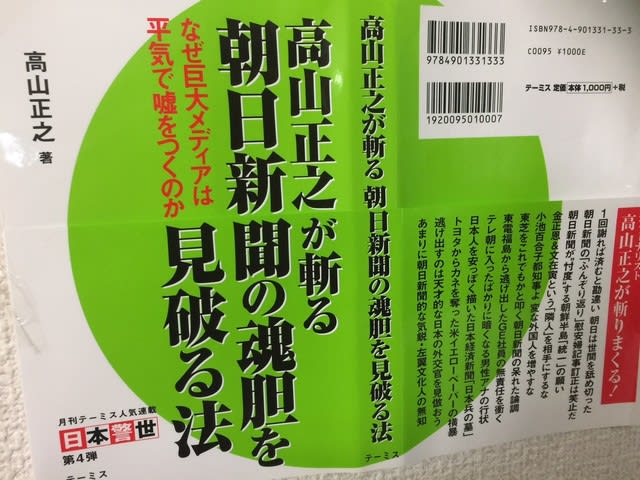
Masayuki Takayama’s New Book Reveals the True Nature of the Asahi Shimbun
Published on July 14, 2019. After beginning Masayuki Takayama’s new book, the author is struck by its sharpness and historical insight, and introduces its essential criticism of the Asahi Shimbun. Through topics such as postwar Japan’s media space, GHQ, comfort women reporting, the poison-gas photograph controversy, and the coral incident, the essay questions the true nature of the Asahi Shimbun.
July 14, 2019.
When I asked a friend of mine, who is an extraordinary reader, whether he had already finished reading it, thinking that he surely must have done so long ago, sure enough, he had already bought it and finished reading it.
Yesterday, I introduced Masayuki Takayama’s new book, which had appeared in the book review section of the Sankei Shimbun, and when I asked a friend of mine, who is an extraordinary reader, whether he had already finished reading it, thinking that he surely must have done so long ago, sure enough, he had already bought it and finished reading it.
Strongly urged by him, I too went to a bookstore to buy it.
Last night, I read only the first few chapters, but books this exhilarating and this sharply incisive are rarely encountered.
As expected, it is a book by Masayuki Takayama, whom I declare to be the one and only journalist in the postwar world.
It is no exaggeration to say that, as a journalist, he possesses an extraordinary breadth of learning and memory.
Especially when it comes to the true history of Japan and the world before, during, and after the war, there are surely few people anywhere in the world who know it better than he does.
Middle-aged and older people who, like me until August four years ago, subscribed to and carefully read the Asahi Shimbun, those people who call themselves university professors while in fact having mastered no real scholarship and seeming to regard fawning upon the Asahi Shimbun as their role, and the people in NHK’s news division who clearly subscribe to and carefully read the Asahi Shimbun and produce news programs in accordance with it, must immediately go to their nearest bookstore and buy this book.
If, even after reading this book, the scales do not fall from your eyes and nothing happens to you, that will only prove that you are truly low-intelligence.
I had intended to introduce the first few chapters to Japan and the world, but the opening preface is also magnificent.
Therefore, I will begin by introducing the preface.
When I became a newspaper reporter and first met Asahi Shimbun reporters as colleagues in the same profession, I had no particular impression of them.
They always seemed busy.
For example, even when there was an informal meeting between the press club and the prefectural police chief, they would not show up, saying something like they had work to do.
At first, I felt uneasy, wondering whether they were perhaps preparing some scoop.
If we were scooped, the bureau chief would nag us endlessly.
However, I was never once scooped by the Asahi.
In the club, when we had free time, we played mahjong or hanafuda, but they never joined in.
Compared with the Mainichi Shimbun reporter who taught me go, the Yomiuri reporter who taught me the procedures of the job, and the Tokyo Shimbun reporter with whom I often went out to eat, the Asahi reporters were hard people to approach.
One day, those Asahi Shimbun reporters came to interview me.
Reporters came to interview a reporter.
I was quite surprised.
At the time, I was interviewing veteran pilots of All Nippon Airways and writing a serial article for a certain magazine.
In that series, one prewar-generation veteran, speaking of his impression when he flew the new Boeing 727, said, “The age when one could control an airplane entirely at one’s own will and fly freely through the sky is over.”
Even if one tried to control it, today’s aircraft are extraordinarily large and possess extraordinary horsepower.
The age when there were at most ten passengers had now entered an age of 300 passengers.
The sky was no longer the old sky he had known.
As an example, he cited the crash into Tokyo Bay of the same 727 model in Showa 41.
The aircraft involved in the accident canceled instrument flight and took a shortcut under visual flight rules.
“When that aircraft accelerates, it pushes your back like a fighter plane.”
“Its rate of descent also had responsiveness that could not be compared with conventional aircraft,” he said.
One must not try to fly it with the feeling of the old days.
I had become outdated, and therefore I decided to retire—that was the story.
So what part of that story did the Asahi want to hear about?
When I asked as the writer, the point was that “the Asahi had treated the cause of that accident as a theory of aircraft defects,” and that the story was “content that went against that,” and therefore it was unforgivable.
I answered that surely there may be various opinions, but a few days later, on the top of the general news page of the Asahi Shimbun, with a photograph, a critical article appeared saying that “an outrageous statement has emerged.”
Is going against the Asahi’s claim such an evil thing that one must be attacked in the newspaper?
This newspaper looked to me like a mass of self-righteousness, insisting that it alone was justice and that no other opinions were needed.
I suddenly remembered the bateren of the Middle Ages, who worshipped Jesus and went around smashing Shinto shrines and Buddhist temples.
Perhaps I was terribly incompatible with the Asahi, because two years later, when I was a city desk editor, I again came into confrontation with the Asahi Shimbun.
That day, when I sat at my desk as the duty editor, roving reporter Ishi kawa Mizuho brought me a verification article saying that the photograph that had appeared recently on the front page of the Asahi Shimbun under the headline “This Is a Poison Gas Operation” was fake, and that it was “a smoke screen set during a river-crossing operation.”
The Asahi article also included an explanation by Professor Fujiwara Akira of Hitotsubashi University, in the manner of Shimura Ken, saying, “Yes, this is poison gas.”
But Ishikawa’s article was far more convincing.
To begin with, poison gas crawls along the ground.
Yperite, first used in Belgium, crawled along the ground and flowed into trenches, killing soldiers.
If it had risen billowing into the sky as in the Asahi photograph, it would have killed only crows.
We ran Ishikawa’s article at the top of the city news page.
The next morning, while I was sleeping in the nap room, I was awakened by a telephone call from Asahi Shimbun department chief Satake Akimi, who said, “You have done something outrageous. After the evening edition is closed, I am coming over there. Tell your managing editor too”—a warning of an attack.
When we waited, he really did come storming in alone, and in the middle of the editorial office he roared, “We will crush the Sankei Shimbun.”
Our claim was correct.
The Asahi issued a correction several days later, but I could not understand Satake’s state of mind.
If an error is pointed out, an ordinary newspaper person rechecks it.
If the point is correct, he apologizes.
But he was not angry about the truth or falsehood of the article; he was angry that someone had complained about the Asahi.
“You have a lot of nerve to defy the Asahi,” he said.
He spoke as if we had committed lese-majesty.
Through this uproar, I began to think that perhaps Asahi Shimbun reporters were sociopaths, a group with antisocial personality disorder characterized by narcissism and collective self-righteousness.
The Asahi Shimbun also rode on Yoshida Seiji and spread the lie of the comfort women for thirty years, continuing to degrade the Japanese people.
During that time, it also damaged coral and vilified the Japanese people with phrases such as “poverty of spirit” and “a desolate heart.”
It spoke as though it itself were not Japanese.
At this point, sociopathy alone cannot explain it.
When one reopens the history of the Asahi Shimbun, there is the suspension incident by GHQ in September of Showa 20.
The Asahi Shimbun had properly denounced America’s brutality in a way that reflected how the Japanese people felt.
It had Hatoyama Ichiro point out that the atomic bombing was an inhumane act surpassing even poison gas, and regarding the Manila massacre by the Japanese army, which GHQ had forced upon Japan, it wrote the sound argument that “there is no way the Imperial Army would do such a thing” and that “it should be verified.”
GHQ is said to have ordered a two-day suspension in response.
However, there is a persistent view that in fact it was an order to abolish the paper.
The United States took paper media lightly.
In Japan, radios of extremely high performance were widespread.
The United States intended to carry out postwar brainwashing through NHK broadcasting alone.
It did not need newspapers that defied it.
In the first place, restricting paper was one of the basics of colonial rule.
Alarmed by this, the Asahi pledged loyalty to the United States and was allowed to survive.
Thereafter, the Asahi Shimbun forgot even shame, became a running dog of the United States, and led the way in proclaiming in its pages that “Japan was an aggressor nation” and “the Japanese army was brutal,” while at the same time writing up lies such as the Warner List, claiming that the U.S. military protected Kyoto’s cultural assets, and venerating white people as if they were gods.
It also shouts, as if acting as MacArthur’s agent, that Japan must “obey” the MacArthur Constitution, which renounces both armed forces and the right of belligerency so that Japan will never again become a threat to white nations.
Even now, it has set up the Article 9 Association and criticizes the trend toward constitutional revision.
Looking at that posture, it closely resembles the overseas Chinese who, during the age of colonial imperialism, entered Asian colonies under white rule, became the agents of the white rulers, and managed the local governments and peoples.
It places itself above the Japanese people.
That also explains why it favors a tone that looks down on the Japanese, as in the coral graffiti incident.
When Toyota was falsely accused of unintended acceleration, Asahi Shimbun chief editor Funabashi Yoichi wrote on the front page that “in the United States, Toyota is synonymous with defects.”
The truth does not matter.
They believe that degrading Japan and preventing its revival is the duty of Asahi people.
That also explains their tone.
In this book, I have taken up that Asahi Shimbun from various angles.
I would be happy if it helps readers understand the ugliness of today’s frenzied Morikake reporting.
An auspicious day in May 2018.
Masayuki Takayama.