The Fight Against Fake News Enters a New Dimension | Shinzo Abe and the Defeat of the Asahi ShimbunEnglish
Originally published on October 19, 2019.
A retransmission of an article first published on May 17, 2019.
This essay discusses the Asahi Shimbun’s fake-news nature over the comfort women issue, the Yoshida Seiji testimony, the Yoshida Report, and the Moritomo-Kake issues, and examines Shinzo Abe’s struggle against it.
It argues that if the Asahi Shimbun became normal and began reporting the truth, Japan would change greatly for the better in less than six months.
October 19, 2019.
If the Asahi Shimbun were to become normal and begin conveying the truth, Japan would change greatly in a good direction in less than half a year.
I am retransmitting the chapter originally published on May 17, 2019, under the title: Then Abe Shot Back, “Isn’t It Because Your Newspaper Spread the Story of a Swindler Named Yoshida Seiji?”
The following is a continuation of the previous chapter.
The fight against fake news has entered a new dimension.
The person who began the fight against fake news before Trump was Shinzo Abe.
As was also touched on in the dialogue, at the Japan National Press Club leaders’ debate at the end of December 2012, on the eve of the birth of the second Abe administration, Hoshi Hiroshi of the Asahi questioned Abe about the comfort women issue.
Then Abe shot back, “Isn’t it because your newspaper spread the story of a swindler named Yoshida Seiji?”
When they tried to crush him just as they had done with the first Abe administration, this time Abe counterattacked by saying that the so-called military comfort women issue was fake news by the Asahi.
They could not help hating Abe.
But in the end, Yoshida Seiji’s lies could not be hidden, the Asahi was forced to retract its articles, and, as if to deliver a further blow, the Yoshida Report issue emerged.
With the Yoshida Report as well, the Asahi had defiantly insisted that, in its interpretation of the document, the mighty Asahi had read it as saying that the Fukushima Daiichi workers had withdrawn in violation of orders, and asked whether people had any complaint about that.
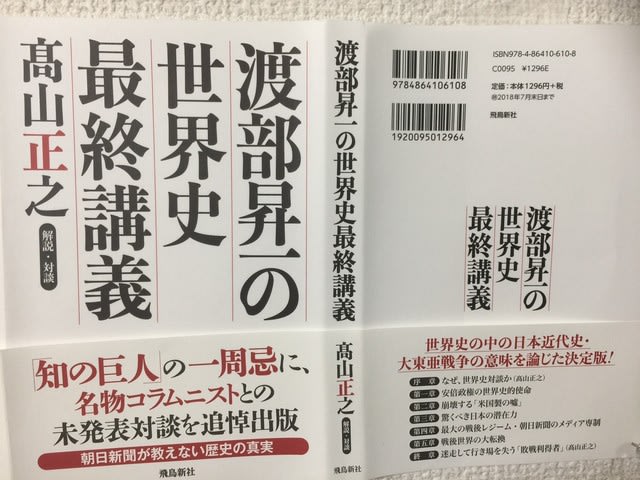
It showed the same arrogant and swollen face that had engulfed Professor Watanabe.
This time, however, each newspaper’s verification condemned the Asahi by showing that nowhere in the document was such a thing written, and as a result, President Kimura Tadakazu’s head rolled.
In the United States, the America of conspiracy mentioned above, and the globalism that would not hesitate to engage in destructive operations to overthrow states or even wars for the sake of money, reached an impasse, and as a result of voters seeing through it, Hillary lost the presidential election.
Trump was thoroughly abused by the New York Times and CNN, representatives of America’s sinister side, but he struck back by saying, “They are fake news.”
Abe quickly met that Trump and said, “I am the one who fought fake news before you and won.”
That was a declaration of victory over the Asahi.
The American media are desperately attacking Trump personally in order to make people realize that they still have influence.
However, in the end, American journalism cannot survive unless it follows the movements of the government, and so it is destined to support the international order and wars created by the United States.
The Asahi, which looks up to such American media as its teacher, accelerated its Abe-bashing single-mindedly, like a kite with its string cut.
Then it dragged out the Moritomo and Kake issues, but Abe shot back by asking whether people believed the fake Asahi, and he provoked them by saying he would resign if there were any involvement on his part.
After a great uproar, in the general election, the Liberal Democratic Party won seats far exceeding a single-party majority.
The Asahi was defeated again.
I had thought that only old people of the prewar generation believed that Abe was the only politician in today’s Japan capable of conducting proper diplomacy.
I had thought that the rest were the anti-Abe baby-boomer generation and their juniors, but, unexpectedly, surveys showed that the younger people were, the more they supported Abe.
I was a little pleased.
As the Abe administration achieves results, Japan is changing.
The younger the generation, the more able it is to perceive fake news as fake.
This is a major change.
Abe himself must also be feeling a definite response on this point.
Meanwhile, the Asahi continued to fail in creating political crises over the State Secrets Protection Act, the security legislation, the conspiracy legislation, and the Moritomo and Kake issues.
Even on constitutional revision, it has been forced to recognize the results of its own public opinion polls, in which support and opposition are becoming nearly equal.
Until now, the Asahi has tried to create political crises through manipulation of public opinion, and it has succeeded.
However, under the second Abe administration, voters have seen through this, and no matter how much it manipulates public opinion, it continues to lose.
Is this not proof that the Asahi’s postwar method has reached its limit?
Even looking at its pages, the Asahi Shimbun is changing.
Apart from anti-Abe, anti-nuclear power, and anti-Japan content, it has begun to resemble a health magazine.
It has become a paper whose pages look like a collaboration between a health magazine and a women’s magazine, with topics such as how to cure constipation.
When I asked someone inside the company, I was told that the decline in circulation has not stopped, reporting expenses have also been restricted, and in 2016 taxi tickets were abolished.
Furthermore, salaries were to be cut by an average of 1.6 million yen from April 2019.
If newspapers are destined to die as they are, the nature of the fight against fake news will also change.
If the Asahi Shimbun were to become normal and begin conveying the truth, Japan would change greatly in a good direction in less than half a year.
This essay continues.