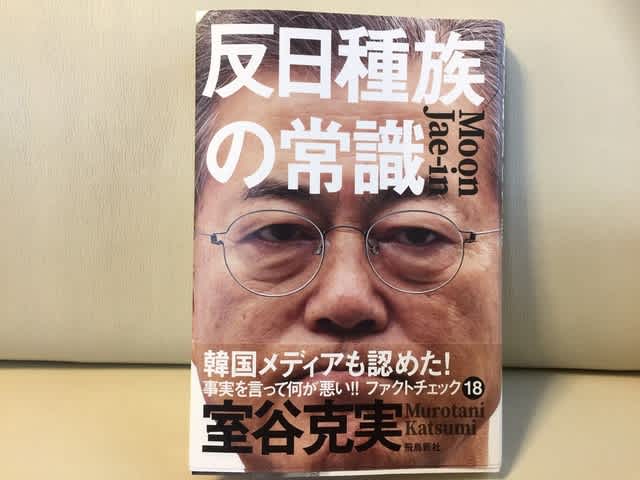
Katsumi Murotani’s The Common Sense of the Anti-Japanese Tribe Exposes the Abnormal Realities of South Korea’s Political Culture
This article introduces passages from Katsumi Murotani’s The Common Sense of the Anti-Japanese Tribe, describing extreme protest actions in South Korean society, political harassment involving excrement, turmoil surrounding Kukkiwon, and the reality of the Korean Confederation of Trade Unions. It argues that Japanese newspapers, NHK, opposition politicians, human-rights lawyers, and civic groups have long avoided reporting these realities.
March 17, 2020
A martial art established through what should be called the “national art” of copying is itself made into a “national sport,” and at its headquarters, every time there is an election for chairman, perhaps the throwing of human excrement and the splashing of filth should also be called a “national sport.”
The following is from The Common Sense of the Anti-Japanese Tribe, a must-read book not only for the Japanese people but for people throughout the world, written by Katsumi Murotani, a true journalist and one of the foremost experts on South Korea.
These are numerous truths that people all over the world, like myself, will be learning for the first time.
Countries of bottomless evil and plausible lies also lie about their own realities.
In other words, they hide the realities of their own countries.
Newspaper companies such as the Asahi Shimbun, television media companies such as NHK, opposition-party political operators, so-called human-rights lawyers, and civic groups that have long been connected with South Korea have continued to hide the realities of South Korea revealed in this book of truth.
Opening section omitted
Pouring Excrement on a President’s Grave and Scattering Leaflets
In 2011, during the National Assembly session for the ratification of the Korea–United States FTA, an opposition lawmaker detonated a tear-gas grenade in the chamber.
Was this also part of the same tradition?
A tear-gas grenade is equipment used by police to suppress demonstrations and, of course, is not sold commercially.
How did he obtain it?
In November 2010, a man poured excrement over the grave of former President Roh Moo-hyun, located in the mountains of Bongha Village, South Gyeongsang Province, and scattered leaflets.
The leaflet bore the title, “Roh Moo-hyun, as I pour sewage water on your grave,” and accused the former president of crimes, saying that he had helped create countless left-wing forces disguised as democratic forces, such as the Korean Teachers and Education Workers Union, the Korean Government Employees’ Union, and the Korean Confederation of Trade Unions, making the entire nation tremble with anxiety, and that pro-North Korean leftist forces had plunged the national identity into chaos.
Even after “the hated opponent” has died, he is still degraded.
Bodies are pulled from graves and whipped.
The corpses of executed criminals are cut to pieces and thrown into rivers.
Seen against such a history, perhaps offering excrement from above a grave may be, in civilizational terms, progress.
The man is said to have collected human excrement in the toilet of his home for a week, placed it in a 10-liter bucket, put it into a backpack, and climbed the mountain with it.
What extraordinary obsession.
I thought this man might have been charged with a minor offense, but he was reportedly arrested on suspicion of property damage and insulting a corpse.
Taekwondo is regarded as South Korea’s national sport, and in Seoul there is a central headquarters dojo called Kukkiwon.
In May 2013, two men calling themselves “representatives of a civic group” appeared at the scene of the Kukkiwon chairman election, threw a bucket containing excrement, and forced the election to be suspended.
Kukkiwon controls the authority to conduct promotion examinations for ranks and dan grades.
The examination fees alone amount to 8.5 billion won a year.
The chairman election is a struggle over vested interests, and the demand of the “civic group representatives” was also personnel renewal.
The JoongAng Ilbo, reporting this on June 4, 2013, contained, as usual, a smoothly written falsehood: “Taekwondo, a martial art native to South Korea.”
Taekwondo was established in 1955.
It does not even have a history of 100 years.
Moreover, it is nothing more than a copy of karate.
The effort continues to pass off this taekwondo as “a martial art native to South Korea.”
In June 2016, at another Kukkiwon chairman election, human excrement was again thrown, and the board meeting was adjourned.
A martial art established through what should be called the “national art” of copying is itself made into a “national sport,” and at its headquarters, every time there is an election for chairman, perhaps the throwing of human excrement and the splashing of filth should also be called a “national sport.”
The Appearance of the “Direct Defecation Attack”
Flush toilets have spread even to homes in rural areas.
That being the case, the raw material for throwing and splashing has become harder to procure.
Perhaps for that reason, the “direct defecation attack” appeared.
In January 2012, a rally opposing layoffs was held at the Poongsan Holdings Building in Chungjeong-ro, Seoul.
One union member belonging to the Korean Confederation of Trade Unions, a radical national center that follows an extreme left-wing and pro-North Korean line, defecated beside the front of the second-floor lobby.
He then threw the feces at the entrance and smeared it on the surrounding window glass.
In April 2012, a member of the Jeonju City Bus Labor Union, also under the umbrella of the Korean Confederation of Trade Unions, defecated in front of the entrance to city hall.
The Chosun Ilbo, on April 25, 2012, reported the scene in detail with a photograph, with the crucial part blacked out.
Let us quote it.
At around 10:16 a.m. on the 23rd, while the leadership of the Jeonju City Bus Labor Union was staging a strike on the lawn plaza in front of Jeonju City Hall and fiercely denouncing the company, the city of Jeonju, and North Jeolla Province while shouting “life-or-death struggle,” a union member, Mr. K, aged 55, suddenly ran out from among the group and walked toward the entrance of city hall.
Then, as his comrades looked on, Mr. K lowered his trousers in front of the entrance and sat down.
When a police officer standing beside the shuttered entrance rushed over and tried to make Mr. K stand up, Mr. K shouted things such as “You city hall people are dirtier than feces,” shook off the officer’s hand, and relieved himself in an instant.
After cleaning himself with tissue handed to him by a fellow union member, Mr. K returned to the group.
The whole episode lasted only about two minutes.
Mr. K’s feces were cleaned up by city hall staff.
Mr. K also appeared at the rally held from 10 a.m. on the 24th and took the microphone.
The moderator introduced Mr. K as “the person who took brave action yesterday.”
This is a digression, but let us also touch on the “struggle” of the Jeonju City Bus Labor Union.
The demands of the bus union were: first, that union members equal in number to city officials be allowed to participate in disciplinary committees; second, a reduction in the number of working days; and third, an expansion of allowances.
In response to the long strike by the city bus union, Jeonju City had been operating leased private buses.
The union, however, caused harm by throwing metal objects at buses while they were running and breaking their windows, and also set fire to a bus parked in the garage of one bus company, burning it completely.
They also stormed the wedding venue of the eldest daughter of the governor of North Jeolla Province, hurled abuse at the governor and some guests on the road in front of the entrance, tried to kick them, and punctured the tires of parked cars.
Near the site of the rally, five people, including a female public servant who had been photographing a flower bed, were assaulted.
It was, indeed, doing whatever they pleased.
This Korean Confederation of Trade Unions is a powerful support group of the Moon Jae-in administration.
Executives of the KCTU have said, “Moon Jae-in owes us a debt because we helped him establish his administration.”
Daewoo Shipbuilding & Marine Engineering continues to survive through injections of public funds because it is a major stronghold of the KCTU.
An Abnormal Man Appears at an Airport
On the night of January 4, 2018, in the departure lobby of Phuket Airport in Thailand, a young man suddenly stripped naked and began shouting loudly.
When security guards rushed over, the man squatted down on the spot, defecated, picked it up with his hands, and threw it at security guards and passengers.
After that, still shouting loudly, the man went around breaking equipment in shops in the departure lobby, until police officers finally subdued him.
According to the Korean-language site Korea Daily on January 9, 2018, the man was a 27-year-old Korean living in New York, and he reportedly stated that it was “because I had taken a large amount of Viagra.”
Viagra in one’s twenties.
Moreover, it seems that Viagra may also have laxative effects and effects that drive people into abnormal behavior, so beware.
By the way, what is the etymology of engacho?
According to my high school teacher, Yoshihiko Amino, it means “cutting off en,” that is,縁 or 穢.
It is only natural that more and more Japanese people wish to perform engacho against anti-Japanese forces.
This article will continue.