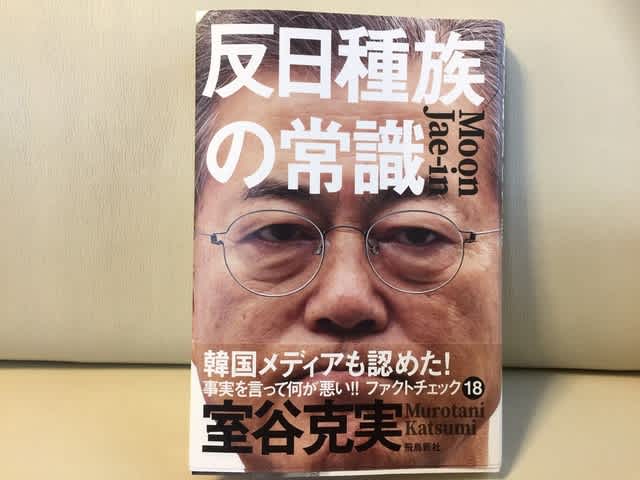
Katsumi Murotani’s The Common Sense of the Anti-Japanese Tribe Reveals South Korea’s “Baby Export” Industry
This article introduces passages from Katsumi Murotani’s The Common Sense of the Anti-Japanese Tribe, examining the realities of international adoption from South Korea, adoption brokers, the sending of babies overseas, and the fact that South Korean media itself described the system as “industrialized adoption.” It argues that Japanese newspapers, NHK, opposition politicians, human-rights lawyers, and civic groups have long avoided reporting this dark side of South Korean society.
March 17, 2020
Incidentally, the headline of this article is “Industrialized ‘Adoption’: The Mistake of a Country That Helps from Beginning to End.”
South Korea’s export of babies is an “industry.”
The following is from The Common Sense of the Anti-Japanese Tribe, a book by Katsumi Murotani, a true journalist and one of the foremost experts on South Korea.
It is a must-read not only for the Japanese people but for people throughout the world.
It is a book that reveals the realities of South Korea, realities that people all over the world, like myself, will be learning for the first time.
Countries that pile up bottomless evil and plausible lies also lie about their own realities.
In other words, they conceal the realities of their own countries.
Newspaper companies such as the Asahi Shimbun, television media companies such as NHK, opposition-party political operators, so-called human-rights lawyers, and civic groups that have long been connected with South Korea have continued to hide the realities of South Korea revealed in this book of truth.
The following is a continuation of the previous chapter.
Adoption Brokers Who Buy Babies with Money
“It had maintained fourth place by country, but in 2013 it temporarily fell to fifteenth place…… However, in 2014 it returned to its usual level at fifth place, and last year it rose to third.”
One might think this was a report on world table-tennis rankings by country, but it is from an article in the Chosun Ilbo, dated May 6, 2016, under the headline “Adoptions to the United States: South Korea Ranks Third after Ethiopia.”
According to the article, the United States accepted 5,648 adopted children from around the world in 2015.
The breakdown was 2,354 from China, 335 from Ethiopia, and 318 from South Korea.
The United States accounts for 60 to 70 percent of the destinations for adopted children sent out from South Korea.
Therefore, if the total number of adopted children South Korea sent out to the world in 2015 was around 500, it had decreased considerably compared with the period when it was said that the number was “increasing by about 2,000 every year.”
However, China’s population is more than twenty times that of South Korea.
Leaving aside Ethiopia, where war and turmoil have continued, South Korea remains one of the world’s leading “baby-exporting countries.”
Some may ask, “Why use the word export when we are talking about human beings?”
There are adoption brokers in South Korea.
Among them are religious organizations and groups qualified as “social welfare corporations.”
South Korean newspapers call such organizations “adoption agencies.”
Some may therefore misunderstand them as government organizations, but what they are doing behind the scenes is the work of adoption brokers.
In exchange for a written pledge stating, “From now on, I will have no relationship whatsoever with this child,” they buy babies from their birth parents with money.
Then they obtain family-register documents stating that the child is an orphan whose biological parents are unknown, arrange the child for foreigners who want children, and collect fees.
It is, indeed, human trafficking.
It is “the export of babies.”
If no foreign applicant is found, there is no choice.
The fee becomes lower, but the baby is sold to domestic applicants.
The Hankyoreh newspaper cited earlier reported the contents of the website of a South Korean welfare corporation described as a human-rights organization.
“The cost that an American family must pay in order to ‘adopt’ a South Korean child is listed.
It is 17,215 dollars.
In the ‘adoption market,’ South Korean babies are the most expensive.
They are rumored to be intelligent and are highly popular among foreign applicants.
Registration fees, document-preparation fees, escort fees, and so on are separate.”
Incidentally, the headline of this article is “Industrialized ‘Adoption’: The Mistake of a Country That Helps from Beginning to End.”
South Korea’s export of babies is an “industry.”
This article will continue.
*This chapter also proves that the comfort women issue is a lie.*