From Perpetrator to Victim: South Korea’s Shouting Culture and the Radar-Lock Incident
This article introduces Katsumi Murotani’s analysis of South Korea’s culture of demanding apologies, its so-called shouting culture, and its response to the radar-lock incident.
According to Murotani, in South Korean society, admitting fault is regarded as losing, while demanding apologies from others continues indefinitely.
This chapter examines the common structure behind the comfort-women issue, the so-called wartime labor issue, and the radar-lock incident: the rapid shift from perpetrator to victim.
March 18, 2020
The perpetrator who carried out the radar lock changed into a victim who had been subjected to threatening flight.
The speed with which South Koreans shift from perpetrator to victim is one of their specialties.
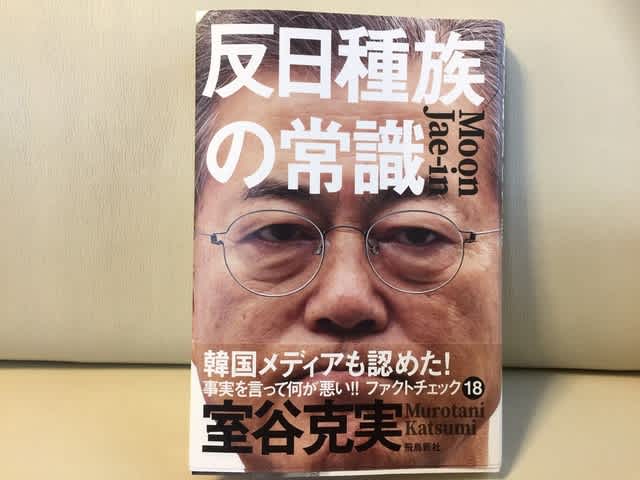
The following is from The Common Sense of the Anti-Japanese Tribe, a book by Katsumi Murotani, a genuine journalist and one of the foremost experts on South Korea.
It is a book that must be read not only by the Japanese people but by people throughout the world.
It is a book that reveals the reality of South Korea, a reality that people throughout the world, like me, are learning for the first time.
Countries of bottomless evil and plausible lies also lie about their own realities.
In other words, they conceal the truth about themselves.
Newspaper companies such as the Asahi Shimbun, television media companies such as NHK, opposition-party political operatives, so-called human-rights lawyers, and civic groups that have been in league with South Korea have continued to hide the reality of South Korea revealed in this true book.
The following is the continuation of the previous chapter.
Why do they demand “apologies” forever?
That is why, even in sports competitions, they cling endlessly to winning and losing.
There is no spirit of fair play.
Even in domestic junior-high and high-school tournaments, there is bribery of referees by parents and coaches.
They believe that as long as they win, any dirty method is acceptable.
At some point, South Koreans grew up within such a spiritual culture.
Perhaps this is influenced by a history completely steeped in Zhu Xi Confucianism.
For South Koreans, “admitting fault” is nothing other than “losing.”
That is why they cannot “apologize honestly.”
In Japanese society, if one admits one’s fault and apologizes sincerely, those around one will treat the matter as if nothing had happened.
But South Korea is different.
Once one apologizes, one is driven into a corner relentlessly.
Former President Park Geun-hye is a good example.
Because they live within such a spiritual culture, they themselves do not apologize, but they persistently demand apologies from others.
South Koreans are convinced that their own spiritual culture, what they call “morality,” is superior.
They believe that materially advanced countries all possess more or less the same kind of spiritual culture, but that those countries are inferior to them in morality.
That is why words such as “we, who have moral superiority over Japan……” come naturally from the mouths of South Koreans.
It may be called a self-important country, or a nation burdened with a massive national misunderstanding.
The reason they continue to demand “apologies” forever over the comfort-women issue and the so-called wartime labor issue lies largely in such self-righteous spiritual culture.
Therefore, even if a “morally backward country” such as Japan apologizes, they do not accept it.
No matter how much time passes, they say, “It is no good because it is not a sincere apology.”
They are an anti-Japanese tribe with whom one can no longer associate.
The specialty of switching from perpetrator to victim.
Returning to the story of the thief tribe, because they do not admit fault and therefore do not want to apologize, they answer back, “You are the one who stole my thing before.”
This takes the other person by surprise.
Then, by raising their voice and saying, “You are the one who……,” they shift from the weak position of having been caught stealing to the “equal position” of saying, “Because you did it, I did it too,” and brazen it out.
What wins is not the logic of the claim, but the louder voice.
This is what is commonly called “South Korea’s culture of verbal combat.”
When Japan said that it had been subjected to a radar lock and demanded measures to prevent a recurrence, many people misunderstand this point, but Japan did not demand an apology.
In response, the South Korean Ministry of National Defense initially said, “Our military was engaged in normal operational activity.
During that operational activity, we operated radar, but there is no fact that it was operated for the purpose of tracking a Japanese maritime patrol aircraft.”
This is from a Yonhap News article dated December 21, 2018.
In other words, they admitted the fact that radar had been used.
In terms of the thief tribe, they denied intent by saying, in effect, “I only borrowed it.”
At that point, why did the Ministry of National Defense, while saying that it was “engaged in normal operational activity,” not say that it “was engaged in rescuing a North Korean ship in distress”?
I think this is a point that cannot be overlooked.
After that, the South Korean Ministry of National Defense’s explanation changed to “we did not carry out a radar lock.”
When the Japanese side released video evidence, South Korea flew into a rage and came out with, “You are the one who made a threatening low-altitude flight.
Apologize.”
Exactly in accordance with the rule of life, “When called a thief……,” it became the response of a particularly vicious thief tribe.
The perpetrator who carried out the radar lock changed into a victim who had been subjected to threatening flight.
The speed with which South Koreans shift from perpetrator to victim is one of their specialties.
*This chapter makes clear that Haruki Murakami must continue apologizing to the Japanese people forever.*