How the Asahi Shimbun and Japan’s Foreign Ministry Degraded Japan over the Comfort Women Issue
Drawing on a dialogue between Masayuki Takayama and Masahiro Miyazaki, this chapter examines the Asahi Shimbun’s false reporting based on Seiji Yoshida, the Kono Statement, the Coomaraswamy Report, and the inaction of Japan’s Foreign Ministry. It questions the responsibility of both journalism and diplomacy in degrading Japan internationally.
2020-03-25
In Showa 57, 1982, the Asahi Shimbun published Seiji Yoshida’s false article and did not retract it for 32 years.
It is nothing but a third-rate newspaper.
The damage Japan suffered was enormous.
The Diet should at least have issued a recommendation that it cease publication.
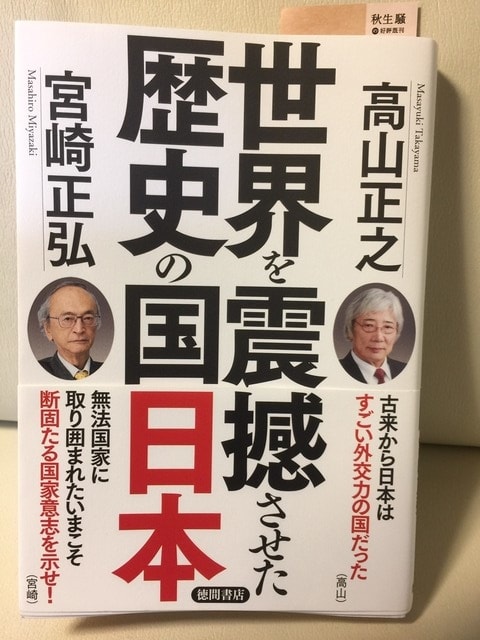
The following is from the wonderful book below, in which Masayuki Takayama, the one and only journalist in the postwar world, and Masahiro Miyazaki, one of the world’s foremost China experts, held a dialogue.
This is a book that the Japanese people must go immediately to the nearest bookstore to purchase.
It is also required reading for people around the world, and I will convey as much of it as I can.
The Foreign Ministry that teamed up with the Asahi Shimbun over the comfort women issue.
Miyazaki.
What clearly shows the incompetence of the Foreign Ministry is the comfort women issue.
Even on the comfort women issue, the incompetence of the Foreign Ministry is beyond imagination.
Takayama.
I always find it strange, but the comfort women issue is a problem found in the armies of every country.
Rather, armies without comfort women go around raping women, and this is what the U.S. military and others have done everywhere.
That is actually the far greater problem.
The United States enacted the “Amerasian Act of 1982.”
There were simply too many mixed-race children, Amerasians, born after American soldiers raped women in Asian countries.
The purpose was to grant U.S. citizenship in order to save fatherless children.
There were countless such children in Vietnam, Cambodia, Thailand, and the Philippines.
In fact, there are several thousand in Japan as well, but the U.S. State Department did not want to say to Japan, “This is a law to atone for rape by American soldiers,” and so mixed-race children in Japan were excluded from the application of this law.
Japanese newspapers have not written about this background.
Other than American soldiers, another well-known case is the mass rape by Korean soldiers in Vietnam.
The so-called Lai Dai Han.
There are countless examples of the rape of ordinary women by postwar Koreans, Russians, and others.
All of that is ignored, while only Japan’s comfort women are spoken of as if they were an unforgivable crime.
Apparently, they themselves seem to have thought that something was strange about what they were saying.
As they themselves had done, unless there was a preceding story of breaking into homes, dragging women out, abducting and raping them, it would be inconvenient.
The Asahi Shimbun seized on that point and turned Seiji Yoshida’s fabricated story into the forced taking away of comfort women on Jeju Island.
This would be worse than impulsive rape by American soldiers.
It would mean that the Japanese military were evil men who systematically abducted and raped women.
In any case, because there is an intention to make only Japan’s comfort women an issue, this is clearly a discriminatory controversy targeting Japan.
Miyazaki.
That is the reason why a matter from more than 70 years ago is still being made an issue today.
Takayama.
If they are going to make that an issue, they should first deal with the rapes committed by the armies of each country.
Miyazaki.
The culprit in the comfort women issue is again the Asahi Shimbun, but in Showa 57, 1982, a liar named Seiji Yoshida wrote a false confession in the Asahi Shimbun claiming that he had hunted comfort women.
Furthermore, in Heisei 4, 1992, the Asahi reported that the military had been involved in comfort facilities.
This was involvement in such matters as sanitation, and in a good sense, but the Asahi reported this military involvement while giving the impression that there had been forced abduction, something worse than rape.
What developed from that was the so-called Kono Statement of Heisei 5, 1993.
The problem at that time was that, even though the government had thoroughly investigated the comfort women issue and found that there had been no forced abduction, Chief Cabinet Secretary Yohei Kono stated in his remarks that there had been forced abduction.
Takayama.
And that Kono still has not withdrawn that statement.
Miyazaki.
Yohei Kono is a strange person, isn’t he?
Takayama.
There were women who were sold by their parents and became comfort women against their will.
One may feel sympathy for those women, but that is different from forced abduction, as if the military had been involved.
By making that point ambiguous and saying that there had been forced abduction, what pleasure could he possibly take, not in what Koreans would think, but in degrading the Japanese military or the Japanese people?
More than an incorrigible hypocrite, he is a disgrace to the Japanese people.
Miyazaki.
Regarding the extremely tangled “Kono Statement,” in Heisei 26, 2014, Nobuo Ishihara, who had been Deputy Chief Cabinet Secretary at the time the Kono Statement was prepared, made clear in the Diet that no evidence had been found in Japanese materials that women had been forced to engage in such work.
He also testified that, although hearings had been conducted with former Korean comfort women, “no corroborating investigation was conducted to confirm the factual relationships of their testimony.”
The content of this testimony was already well known, but the significance is great that the Deputy Chief Cabinet Secretary who had been involved in drafting the statement testified to it in the Diet.
It means that it became clear in the Diet that the Asahi Shimbun’s articles were false.
Takayama.
At that time, the activities of Hiroshi Yamada, then a member of the Japan Restoration Party, were splendid.
The Liberal Democratic Party showed reluctance to summon Kono, who had served as Chief Cabinet Secretary in an LDP cabinet and later as party president, to the Diet.
In the face of such an attitude by the LDP, Yamada negotiated skillfully, and although it was not Yohei Kono, he succeeded in having Deputy Chief Cabinet Secretary Ishihara summoned as an unsworn witness.
Then, in the House of Councillors election of Heisei 28, 2016, Yamada ran not from his old parties, the Party for Future Generations or the Party for Japanese Kokoro, but from the LDP, and was elected.
If so, I definitely want him to summon Yohei Kono to the Diet.
Miyazaki.
In any case, with the atmosphere heightened by Deputy Chief Cabinet Secretary Ishihara’s testimony, on August 5 and 6 of Heisei 26, 2014, the Asahi Shimbun retracted 16 articles related to Seiji Yoshida.
This was a major incident that shook postwar journalism.
Takayama.
I think that, after the testimony of Deputy Chief Cabinet Secretary Nobuo Ishihara, the Asahi Shimbun anticipated that it would be summoned to the Diet next, and so it made the first move and retracted the Seiji Yoshida articles.
Miyazaki.
In the end, the Asahi Shimbun published Seiji Yoshida’s false article in Showa 57, 1982, and did not retract it for 32 years.
Takayama.
It is nothing but a third-rate newspaper.
The damage Japan suffered was enormous.
The Diet should at least have issued a recommendation that it cease publication.
Miyazaki.
Since the main purpose of this book is not to attack the Asahi Shimbun, let us leave the criticism of Asahi at this point.
The problem is the Foreign Ministry.
Takayama.
That is right.
When the Asahi Shimbun’s lies spread around the world and Japan was being degraded, what did the Foreign Ministry do?
It did nothing.
On the contrary, in Heisei 8, 1996, when the so-called Coomaraswamy Report, which was based on the Asahi Shimbun’s lies and declared comfort women to be sex slaves, was submitted to and adopted by the United Nations Commission on Human Rights, the Foreign Ministry once prepared a rebuttal document but then withdrew its submission.
Why would it do such a thing?
Seiji Yoshida’s article was published in Showa 57, 1982, but by Heisei 4, 1992, it had become clear from the research of Ikuhiko Hata that it was false.
Nevertheless, for the 32 years until the Asahi Shimbun retracted it as false, the Foreign Ministry took no action to correct the false information about the comfort women issue.
Seishiro Sugihara said this, but while the principal offender in the comfort women issue that degraded Japan without limit was the Asahi Shimbun, there was another co-principal offender by conspiracy, and that was the Foreign Ministry.
If the Foreign Ministry had communicated the correct information to the world the moment it learned the correct information, the comfort women issue would not have become the problem it is today.
The Foreign Ministry’s guilt is grave.
Miyazaki.
From the standpoint of the Foreign Ministry’s role in spreading correct historical understanding, it was also terrible on the Nanking Incident.
Was that Heisei 9, 1997?
A Chinese-American named Iris Chang published a book slandering Japan, The Rape of Nanking: The Forgotten Holocaust of World War II.
Needless to say, the contents are nonsense.
At that time, even in Japan, those who insisted that “the Nanking Incident happened” still had influence, and there still remained a slight atmosphere in which a complete denial of the Nanking Incident could not be made.
But it had become common sense that what Chang was saying in America could not possibly be true.
Then, in Heisei 10, 1998, Ambassador to the United States Kunihiko Saito confronted Chang on American television.
However, Ambassador Saito merely emphasized that Japan had apologized, and did not say a single word in rebuttal to the contents of what Chang had written.
This made it appear that the Nanking Incident had occurred just as Chang claimed.
What astonished me when I went to the newly built Nanking Massacre Memorial Hall in Nanking was that a golden statue of Iris Chang stood in the courtyard.