The Asahi Shimbun’s Fake Narratives Brought Down Shinzo Abe.Reading the Decay of the Postwar Order, the Limits of the Suga Government, and the China Crisis.
This essay traces the achievements and decline of the Abe administration, the stagnation of constitutional revision, pressure from pro-China forces, the Asahi Shimbun’s fake reporting, and the Trump administration’s hardening China policy, exposing the crisis in Japanese politics.
2020-12-31
Media outlets such as The Asahi Shimbun, which had long grown complacent within the postwar system, fabricated one fake after another, and at last dragged down Abe.
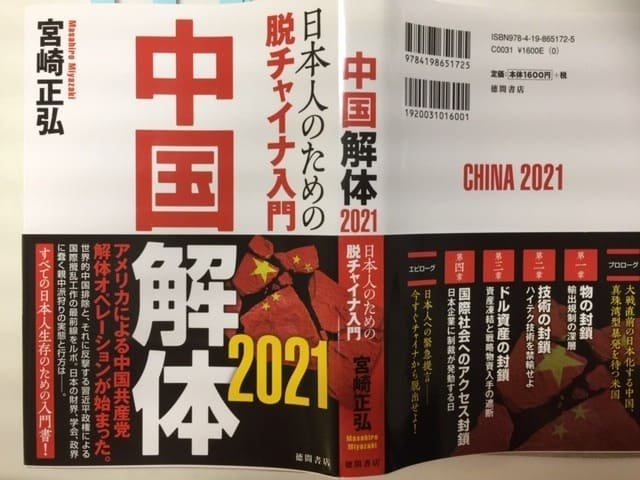
The following is from the eye-opening prologue of the book below.
Sentences beginning with an asterisk are mine.
Expectations for the Suga administration
On August 28, 2020, Shinzo Abe suddenly formally announced his resignation as prime minister.
The cause was said to be the worsening of his chronic illness.
Franklin Roosevelt, the 32nd President of the United States, did not relinquish power until the very end, even though he was aware that his life was nearing its end.
This may be called an ugly clinging to power, but he had too many diplomatic secrets as president to hand over the office immediately to Vice President Harry S. Truman.
Despite having deciphered the code related to the Pearl Harbor attack, he presented the impossible “Hull Note” and waited for Japan to attack, in order to drive public opinion all at once toward entering the war.
Roosevelt died without telling Truman anything about the process that had led to war, the secret agreement he had made with Stalin at Yalta, the final ultimatum in the form of the Hull Note, or the state of development of the atomic bomb.
Yet there was no major change in postwar strategy toward Japan, because Roosevelt’s close aides remained in place around Truman.
In Abe Shinzo’s case, however, his way of stepping down was the complete opposite of Roosevelt’s.
From the standpoint of international politics, whose axis is Machiavellianism, it must have appeared to be a strange sense of beauty, a purity unbecoming of a politician.
Thirteen years earlier, in 2007, the drama of Abe’s resignation from his first administration had also been attributed to illness.
At that time, the author happened to be speaking in the political department of a certain newspaper company with Professor Koichi Endo of Takushoku University, author of Consumed Men of Power published by Chuko Shinsho.
Then a political reporter rushed in and shouted, “This is bad. Abe is quitting.”
Professor Endo was terribly dejected, so the author said to him:
“When a mountain is high, the valley below is deep. Because you entrusted Abe with such lofty ideals, your disappointment is all the greater. Since I had not expected so much, my disappointment is less.”
Only a few years later, Professor Endo died suddenly.
A young scholar from whom so much had been expected for the future vanished without warning.
It was during the period when anti-Japanese riots were raging in China and public opinion in Japan was reacting fiercely that the second Abe administration was launched.
He was still young, and seemed likely to display strong leadership.
Abe exceeded expectations in both the economic and diplomatic spheres, and answered the hopes of the people.
With the shift to the monetary easing policy known as the “Kuroda bazooka,” stock prices soared, and GDP also returned to a recovery trend.
Abenomics achieved results beyond expectations.
Immediately after Donald Trump was elected president of the United States, Abe became the first to visit America and proclaim the reaffirmation of the Japan-U.S. alliance.
Without relying on the Foreign Ministry route for what should be the cornerstone of Japanese diplomacy, he spoke directly and intimately with the U.S. president, giving a sense of reassurance Japan had never before known.
Yet from around 2019, signs of distortion began to appear, and he increasingly gave rise to frustration.
Internal party circumstances and coalition partners must have become shackles weighing him down.
After all, LDP Secretary-General Toshihiro Nikai and coalition partner Komeito were both panda huggers, that is, pro-China forces.
Constitutional revision, which he had kept saying he would stake his political life on, made almost no progress, and he even said Japan would cooperate with the Belt and Road Initiative, turning his back on the American line of taking a hard stance against China.
When he stubbornly insisted on inviting Xi Jinping, whom the world condemns as a dictator, as a state guest, one could only wonder whether he was in his right mind.
Reading this passage, I was reminded of the period when Arima and Kuwako were hosting NHK’s Watch 9 and kept repeating “Mr. Xi, Mr. Xi.”
It seemed like conduct that nullified everything he had built up to that point.
There was also the sluggish response to the novel coronavirus, but without visiting Yasukuni Shrine, and by forcing through the 10 percent consumption tax increase, which conservative commentators had opposed in unison, thereby further worsening the economy, he appeared to have lost sound judgment.
Even though he returned to office bearing the hopes of the people, the stress was enough to trigger the recurrence of the very illness that was his inner enemy, and the aims of Abe’s politics were crushed.
A leader is someone who unifies the people, cherishes the values and traditions of ethnic identity, presents a vision for the future, and possesses both the power to lead and charisma.
He is a person whose willingness to fight for his convictions makes everyone want to follow him.
Kobayashi Hideo once said, when Shintaro Ishihara was said to be aiming to become a politician, something to the effect that the value of a politician is determined by how many people around him would die for him.
Since the Meiji Restoration, our country, having fought through the Sino-Japanese and Russo-Japanese Wars, had a national spirit aligned with the design of its leaders.
After the war, Nobusuke Kishi staked his political life on revising the unequal treaty, namely the revision of the Japan-U.S. Security Treaty, and this was an achievement equivalent to Jutaro Komura’s abolition of the unequal treaties.
Thereafter, however, beginning around Eisaku Sato and the reversion of Okinawa, “the realization of a welfare state through freedom and democracy” became the national goal, and politics was diminished.
Soon after taking office, Yasuhiro Nakasone put away his former position by saying, “There will be no constitutional revision during my administration.”
Thereafter came Kakuei-style lavishness such as “hometown revitalization,” then Noboru Takeshita, “Anpan Prime Minister” Ryutaro Hashimoto, the alien, the empty shell, and so on, until we had to wait for Shinzo Abe to once again place constitutional revision at the forefront.
The moment he called for overcoming the postwar regime, media such as The Asahi Shimbun, which had long lived comfortably within the postwar order, fabricated one fake after another, and at last dragged Abe down.
The deterioration of Nagatacho is astonishing.
As if everyone had forgotten the “grand plan for the nation over a hundred years,” hereditary politicians have no interest in the fundamentals of the state, and in elections they seek only women’s votes, “crying toward women’s lips and genitalia,” as Ishikawa Tatsuzo put it.
It is exactly like the officials of the late Tokugawa shogunate, flustered and unable to decide anything.
The major concern for Japanese politics now is how the Suga Yoshihide administration will respond to China.
An organization without a master is temporarily run by the chief clerk.
For some time, Japanese politics will likely be clerk politics, and not much can be expected of it.
Japan’s dullness in failing to notice an unprecedented crisis
On September 22, 2020, President Trump, on the international political stage of the United Nations General Assembly, spoke of the devastation caused by the China virus and said that China, the chief culprit in the spread of the infection, “must be held accountable.”
In response, China’s head of state Xi Jinping reviled Trump as a “schoolyard bully.”
The U.S.-China confrontation has involved neither firearms, nor artillery, nor missiles, but in effect it is already a state of war.
On June 17, 2020, a meeting between Secretary of State Mike Pompeo and China’s top diplomat Yang Jiechi, convened in search of a path toward resolution, lasted seven hours.
Yet not a single agreement was reached, and it ended in a breakdown.
The venue was Hickam Air Force Base in Honolulu, Hawaii.
For the United States, it was the symbolic site of the Pearl Harbor attack.
David Stilwell, Assistant Secretary of State who attended the Hawaii talks, a former Air Force pilot, said, “The Chinese side did not bring a single proposal for concession, and the talks collapsed.”
President Trump signed the Hong Kong Human Rights and Democracy Act, intended to sanction China for stripping Hong Kong of its autonomy, on November 27, 2019, and then signed the Hong Kong Autonomy Act on July 14, 2020, abolishing Hong Kong’s preferential treatment.
I want readers to pay attention once more to that first signing date.
November 27, with November 26 in U.S. time, was the date in 1941 when America thrust the Hull Note upon Japan.
Looking at this sequence of developments, China must well have understood them as hardline measures comparable to the prewar Hull Note.
Moreover, the date of signing itself carried a historical allegory.
The culmination came on July 23, 2020.
On that day, Secretary Pompeo delivered a speech at the Nixon Presidential Library in California, and its content confirmed an extraordinarily hostile line: “The Chinese Communist Party and the Chinese people are different. Fight Xi Jinping, the devotee of totalitarian ideology.”
That day was also the date on which the French Revolution broke out.
America’s diplomacy toward China began with Richard Nixon’s visit to China on February 21, 1972.
Even the choice of venue carried the powerful message that relations with China should be reset to zero, to the point before Nixon.
At the beginning of his speech, Pompeo said the following:
“I asked National Security Advisor Robert O’Brien, FBI Director Christopher Wray, and Attorney General William Barr to give speeches regarding China. And today, I wish to deliver the fourth speech.”
He then developed remarks that could be called a modern version of the Hull Note.
“Our objective is to make clear the threat posed to the American people by the Chinese Communist Party, which President Trump’s China policy seeks to address, and that a strategy to defend our many freedoms has already been set.”
In other words, he openly declared that America’s traditional China diplomacy was to be reversed 180 degrees, and that the China diplomacy of all previous administrations had been mistaken.
He also referred to Taiwan’s Tsai Ing-wen as “President,” despite the absence of diplomatic relations.
It was a message that, whereas China insists Taiwan is part of “One China,” America would treat it as an independent state.
Let us now confirm what the three senior Trump administration officials named by Pompeo had said about China.
National Security Advisor O’Brien:
“The Chinese Communist Party believes in totalitarianism. Exposing the conspiracy of this party is for the welfare of the people of the world.”
FBI Director Wray:
“The Chinese Communist Party has infiltrated democratic nations, built secret intelligence networks, and caused immeasurable damage to the American economy and national security through cyberattacks and other means. Economic espionage by the Chinese Communist Party has increased thirteenfold over the past ten years.”
Attorney General Barr:
“How to crush the Chinese Communist Party’s ambition for world domination is the most important challenge facing the United States and indeed the world, and companies cooperating with China are its accomplices.”
On careful rereading, one notices that while all of them explicitly named the Chinese Communist Party, they deliberately refrained from simply saying “China.”
They made a distinction, identifying only the Communist Party as the enemy.
If one translates Pompeo’s speech into a Japanese equivalent, its impact becomes easier to grasp.
It would be the equivalent of Japan’s foreign minister speaking at the Tanaka Kakuei Memorial Hall and saying:
“The half-century of Japan-China friendship has collapsed. The Chinese Communist Party is an enemy threatening Japan’s security, and ‘mutual benefit’ was a lie. Japanese citizens and Japanese companies cooperating with the Chinese Communist Party are its agents.”
It should again be pointed out that Pompeo sharply distinguished between “the Party” and “the Chinese people,” and although he referred to Xi Jinping as “General Secretary,” he did not call him “President.”
It will be explained in a later section that the adviser who suggested this distinction was an ethnic Chinese adviser.
A striking resemblance to the eve of the Greater East Asia War
The final stage of the U.S.-Japan clash that led to the Greater East Asia War was the so-called “ABCD encirclement,” that is, the embargo on strategic materials such as oil to Japan.
At that time, Japan imported 80 percent of its oil from California.
In the end, it was presented with the Hull Note, effectively a declaration of war.
Its demands were such that no matter how tolerant a country might be, even a defenseless state like Monaco would have had no option but refusal.
This was followed by the seizure of Japanese assets in the United States and the internment of Japanese Americans in camps.
If one compares that to the present, it would correspond to the suspension or prohibition of financing for China’s four major banks: Bank of China, Industrial and Commercial Bank of China, China Construction Bank, and Agricultural Bank of China.
The U.S. government also blacklisted Chinese companies involved in the repression of the Uyghurs, carried out a “study blockade” by tightening visa conditions for Chinese students, and in rapid succession moved to exclude Chinese nationals from companies, university laboratories, and graduate schools, arrest Chinese nationals on suspicion of espionage, and stop issuing visas to Huawei employees.
Ultimately, it is considering banning members of the Chinese Communist Party from entering the United States.
This is truly beginning to resemble the process by which the Franklin Delano Roosevelt administration methodically cornered Japan in the 1940s.
Professor Graham Allison of Harvard University said, “These five months of U.S.-China developments closely resemble the transition of the five months leading to war in 1941.”
Professor Allison is known for proposing the “Thucydides Trap,” according to which a hegemonic power and a rising power can fall into a state in which war becomes unavoidable, and he is also known for his book Destined for War.
The United States ordered the closure of the Chinese consulate in Houston, calling it a nest of spies, and China immediately retaliated by closing the American consulate in Chengdu.
The closure of consulates is an act close to a diplomatic break, an act of the eve of war.
On the eve of the Greater East Asia War as well, exchange ships were used to repatriate each side’s residents from the other country.
Many Chinese students and trainees returned home from America.
Omitted below.
I have recently become more and more convinced, day by day, that the Nihon Keizai Shimbun is a newspaper deeply affected by Chinese influence operations.