The Asahi Shimbun, the United States, and the Distortion of Japan’s View of China and the Spirit of Prewar Japan
Written on May 18, 2019, this article looks back on the national consciousness and external awareness of prewar Japan, while sharply arguing how Japan’s postwar view of China and of the outside world was distorted through the influence of the Asahi Shimbun and the United States.
2019-05-18
Until before Japan’s defeat, the Japanese had properly understood what the Chinese were, yet now there has been an unbelievable inversion. Asahi, which has done so much to distort and stupefy the Japanese people’s view of the outside world, has the United States behind it.
The following is a continuation of the previous chapter.
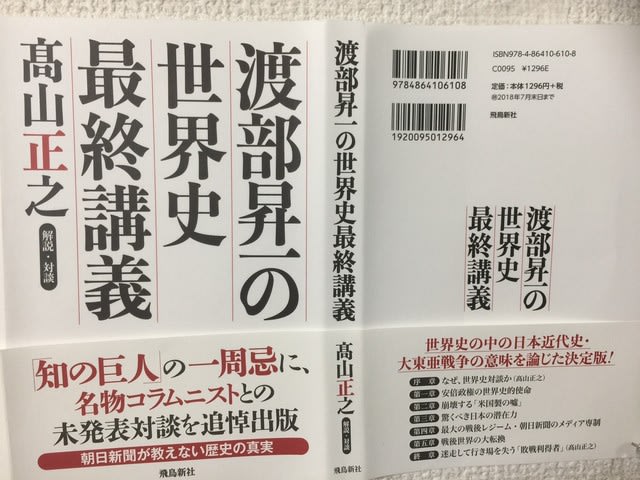
All those who, in response to my mention of it, went to their nearest bookstore to purchase this book must surely have strongly reaffirmed, merely by reading this prologue, that Masayuki Takayama is the one and only journalist in the postwar world.
They must also have recognized with astonishment that everything I have said about him has struck the mark exactly.
For example, on the centennial of the Russo-Japanese War, the Asahi positioned the two wars of the Meiji era as “the turning point that set modern Japan on the path toward colonial rule over Korea and aggression against China.”
Likewise, Ryotaro Shiba criticized the period after the Russo-Japanese War by saying, “Once Japan climbed to the top of the hill, all it did afterward was go downhill,” but that is wrong.
As readers know, NHK too sides with this Ryotaro Shiba.
Japan, having lost confidence through contact with the Western powers and still wandering even after the Meiji Restoration amid civil wars from the Boshin War to the Satsuma Rebellion, first united as an ethnic nation in the Sino-Japanese War, and established its identity as a state in the Russo-Japanese War.
Only after defeating the Russians did the Japanese first learn the meaning of their own existence.
That is precisely why, in the Greater East Asia War, every Japanese soldier down to the lowest rank fought to liberate Asia from white rule.
More than for its own economic gain, Japan’s common people were angered by the rejection of racial equality at the Paris Peace Conference, and further by the fact that the United States excluded Japanese immigrants on the basis of race.
Just as Emperor Showa was said to have spoken of the racial equality proposal issue at the Paris Conference as a remote cause of the later war, because even the farthest reaches of the nation knew of that injustice, Japan fought on without flinching even when every country except Ireland declared war on it.
Even in unbelievable losing battles such as the Imphal Operation, it was precisely because we believed we were living for a mission that we boldly went to the place of death.
Had the Japanese remained as they were in the days of the Meiji Restoration, they would probably have abandoned battle.
Professor Watanabe, who knew through direct experience the national consciousness of the prewar, wartime, and immediate postwar years, when one people was united in one will, repeatedly testifies in the third chapter of this book to the simple and unadorned character of the Japanese of that time.
To say it was a dog’s death is clever hindsight.
Japan stood against the white races of the world, and after defeat it made no excuses, nor did it ever boast sanctimoniously about the liberation of colonies.
What came to mind was the figure of Alberto Fujimori, driven out of Peru, returning to that country knowing he would be arrested.
When he took office as president, Peru was overrun by the terrorist group Sendero Luminoso, which, following Maoism, carried out one-village-one-killing practices, repeated looting and abduction, and abducted women to make them sex slaves.
He crushed that terrorist group in only two years and restored public order, but in the process civilians suffered collateral damage.
At trial, Fujimori offered no defense at all, took upon himself all the crimes of his subordinates, and received a guilty verdict.
I saw there the image of the Japanese as they had been before the war.
As Professor Watanabe says, the Japanese entered the war with a strong consciousness.
The kamikaze corps too were by no means something artificially forced into existence, but an expression of a strong desire to protect Japan.
It was the United States and the Asahi Shimbun that guided people away from holding such a viewpoint.
They brainwashed the Japanese into thinking that it was a good thing not to have self-respect, by persuading them that it had been a meaningless war, and they achieved a certain degree of success.
What showed this most clearly was the postwar confusion in Japan’s view of China and Korea.
In the wars of the Meiji era, Japan came to know through direct experience the cruelty of the Chinese.
Miyazaki Toten and Toyama Mitsuru desperately tried to teach the Chinese the way of humanity, but nothing changed, and it all ended in vain.
The hopelessness of the Koreans, whom Yukichi Fukuzawa supported and finally gave up on, was the same.
Yet after the war, the Asahi, directed by Tomoo Hirooka’s pro-China line, exalted Maoism and reported as if communist dictatorship were some kind of paradise, returning Japan’s view of China to the kind held by Confucian scholars of the Edo period, who had admired it as a “land of virtue.”
Until before Japan’s defeat, the Japanese had properly understood what the Chinese were, yet now there has been an unbelievable inversion.
Asahi has done so much to distort and stupefy the Japanese people’s view of the outside world, but behind it stands the United States.
A great deal of time was also devoted in my world-history dialogue with Professor Watanabe to America’s strategy toward Japan, which the Japanese people do not know.
This article will continue.