By Clinging to Its Postwar Line, The Asahi Shimbun Has Finally Isolated Itself from the International Community
Written on May 17, 2019, this article argues that by stubbornly clinging to its postwar anti-state editorial line, the Asahi Shimbun drifted away even from the scientific common sense of the international community, as seen in its reporting on the HPV vaccine and other issues, thereby degrading Japan while isolating itself.
2019-05-17
By clinging to its postwar line, the Asahi ended up becoming “isolated from the international community.”
The following is a continuation of the previous chapter.
If one looks at history, for the Japanese to rise again after a great transformation of the system such as the Meiji Restoration, it took national crises such as the Sino-Japanese and Russo-Japanese Wars before it could finally be accomplished.
But the Japanese are originally a decent people, and their civic standards have also risen, so perhaps the present great transformation of the postwar system does not necessarily require a war of national crisis.
For that, newspapers and the media must write the truth, for example what the true nature of the United States actually was.
On the January 28, 2018 feature page of the Asahi Shimbun titled “The Door of Culture,” there appeared an article titled, “A Different Theory Exists: Did the U.S. Foresee the Attack on Pearl Harbor?”
Referring to Charles A. Beard’s book (President Roosevelt and the Coming of the War), it introduced the theory that the United States cornered Japan and made it start the war.
If you ask me, such an article should have been introduced more than thirty years earlier, but more surprising than that was the fact that the Asahi, which had never admitted differing theories, introduced something different from its previous historical view under the heading “A Different Theory Exists.”
That said, it would hardly mean that the Asahi had “awakened to the truth.”
Rather, with anti-Japan and anti-Abe articles alone no longer able to retain readers and its circulation falling badly, this is probably a sign that it is floundering while trying all sorts of measures.
A good example showing the fact that, in its floundering, the Asahi even turned against itself the international opinion on which it had relied is its reporting on the cervical cancer vaccine.
First there is the postwar line that the state is doing something wrong.
As stated in the preamble to the Constitution, “so that the horrors of war will never again visit us through the action of government,” they file lawsuits under the State Redress Act in order to confirm that it is always the state that is bad.
It is the method spread by men such as Nambara Shigeru, asserting that the state is bad and thereby stimulating the meanness of the people.
When the Ministry of Health, Labour and Welfare approved Iressa, a special drug for 肺がん, ahead of schedule in response to patients’ demands, newspapers maliciously seized on the claim that there were side effects, made an uproar calling it drug-induced harm, incited the bereaved families, and had them fight all the way to the Supreme Court.
The result was defeat.
The same sort of thing happened in the lawsuits over abnormal behavior involving the influenza treatment Tamiflu.
Within this pattern of suing the state over drug-harm issues in order to get money, the next target of attack that surfaced was the cervical cancer vaccine.
It was said that vaccination disrupted the autoimmune system and caused brain damage.
Women who felt unwell filed lawsuits.
The Ministry of Health, Labour and Welfare, deferring to the media, stopped recommending the vaccine.
The vaccination rate fell to one percent.
This angered the WHO.
It replied that “the theory that the vaccine is the cause is doubtful.”
The reason the cervical cancer vaccine has been promoted throughout the world is that it became clear that human papillomavirus (HPV) is related to the rapid increase in throat cancer and colorectal cancer.
In the United States, vaccination has begun even for males.
Only Japan stopped the movement for the eradication of cervical cancer, which the WHO has been leading throughout the world.
The Asahi’s tone regarding vaccination, asking, “Can the state really go ahead with something this terrible?” and using it as material to pursue and attack government responsibility,
was shallow.
On an issue for which countermeasures were being advanced throughout the world, Japan alone dropped out.
The joint statement issued by the WHO, the CDC (U.S. Centers for Disease Control and Prevention), and the European health body, all three together declaring that the HPV vaccine has no side effects, was directed at Japan.
The next message from the international community was that the John Maddox Prize, named after the long-serving editor of Nature and awarded to individuals who contribute to promoting sound science and evidence, was given to the Japanese woman Riko Muranaka, who pointed out vaccine misinformation and argued for its safety.
The Asahi’s short-sighted campaign was finally defeated here, but the Asahi Shimbun did not report it until eighteen days after the first report.
By clinging to its postwar line, the Asahi ended up becoming “isolated from the international community.”
Is this not an episode that vividly shows the present reality in which even the Asahi itself no longer knows what direction it is working toward?
Reporting that portrays Japan as evil is, before even the Asahi notices it, damaging the country’s reputation.
Many Japanese are beginning to realize that to demean the nation is to demean Japan, but will the day ever come when the Asahi Shimbun understands this?
Sadly, until then, I wish to continue wielding the whip of love.
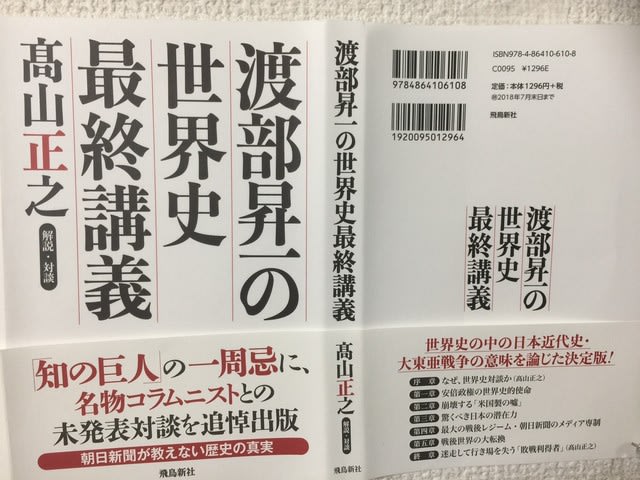
Surely that is also the path Professor Watanabe wished for.
On the first anniversary of Professor Shoichi Watanabe’s death.
Masayuki Takayama