Asahi Shimbun’s Media Despotism and the Structure of “Anti-Japan Impunity”
Written on May 15, 2019, this essay traces Shintarō Ryū, Takeo Ogata, Dulles, the 1960 Security Treaty protests, the Joint Declaration of the Seven Media Companies, and the structure of anti-Japan reporting by Asahi Shimbun, sharply criticizing the postwar media despotism in Japan and the warped discourse in which anything is permitted so long as it is anti-Japan.
2019-05-15
Interesting, isn’t it, this research into a bump that never disappears(笑)…
It would become a natural monument.
A World Heritage site(笑).
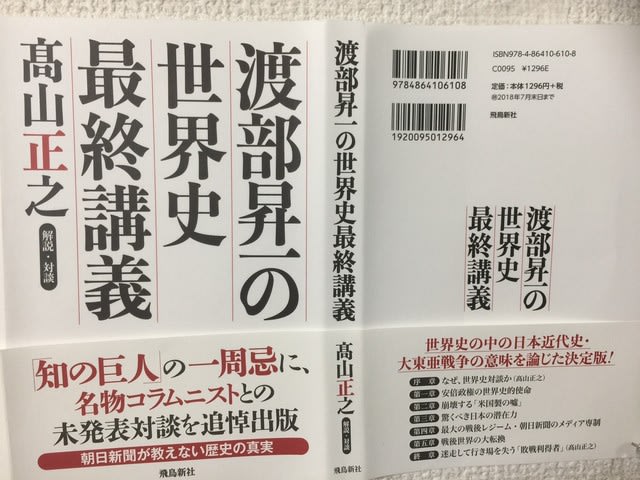
Below, I am reposting, with the paragraphs and such arranged, a chapter I originally published on 2018-05-25 under the title, “In Bern, Switzerland, in 1945, where Shintaro Kasa was staying as a European correspondent, he was connected with Dulles, who was then the head of the local branch of the U.S. OSS (Office of Strategic Services, predecessor of the CIA).”
What follows is a book that a friend, one of the most avid readers I know, strongly urged me to buy and read.
For every Japanese citizen who can read print, it is a book that is indispensable beyond all measure.
Readers should go at once to the nearest bookstore and buy it.
Because even chapter 4, p.146 of the same book, “Asahi Shimbun’s Media Despotism, the Greatest Postwar Regime,” makes perfectly clear why printed media such as Asahi Shimbun, and those who have lived by television media after growing up reading and studying it closely…
and why opposition politicians, as well as ruling-party political operators such as Shinjiro Koizumi, who make their living as members of the Diet…
have been doing what they have been doing for the past year and a half…
Emphasis in the text other than the headings is mine.
The Fading Dominion of Asahi.
Watanabe
I make a point of reading everything Takayama writes without fail, and it is truly exhilarating.
No one but Takayama has continued criticizing Asahi this thoroughly.
In recent years, Asahi Shimbun’s magical power has faded, and Japan’s commentators can no longer attain social standing merely by spreading talk of the Nanjing Massacre, comfort women, or anything else that attacks Japan.
Would it not be the case that any somewhat knowledgeable person now feels that unless he is reading Sankei rather than Asahi, he cannot speak out.
Takayama
Thank you.
Even now, Asahi continues to carry article after article that makes one think, this is strange.
If Japan is to recover, the media must recover first.
The United States is a good example.
The media still do not understand why Trump became president, and refusing to recognize reality, they continue their all-out assault.
The same thing is happening with the Abe administration.
Watanabe
Many people are beginning to realize that those who praise the Constitution and the Occupation policies are somehow strange, and that among the profiteers of defeat there seem to be no people who speak soundly.
The mass media and cultural figures who profited by attacking Japan have passed the same habit on orally to their successors, and Nikkyoso too taught children that “everything is Japan’s fault.”
The harmful influence of the profiteers of defeat still trails on, and those who built their status on anti-Japan discourse cannot now withdraw their views, even when new historical facts emerge, because they have their pride at stake.
Takayama
I think Asahi Shimbun is exactly that.
At the time that became the starting point of the postwar era, the core of Asahi was its extremely deep pipeline to the United States.
Take Takeo Ogata, former chief editorial writer and representative director of Asahi Shimbun.
And take Shintaro Kasa, former head of editorial commentary at Asahi Shimbun.
Ogata also entered politics, but he was a CIA collaborator and an agent of Dulles’s operations toward Japan.
What America feared most was the situation Mussolini worried about: if Japan were once again to gain strength as it had before the war, subdue China, and if Japan and China were to cooperate and join hands, who could say with certainty that they would not seize world hegemony?
This was the true substance of what they called the “Yellow Peril.”
To prevent that, the international situation in East Asia, Japan and its surrounding region, had to be kept constantly unstable.
The state of confrontation among Japan, Korea, and China had to be maintained, and Japan itself too had to be kept in confusion.
When Takeo Ogata, who was connected to Dulles, a believer in such a strategy, died suddenly in 1956, Shintaro Kasa succeeded him through the friendship they had maintained since Switzerland.
While staying in Bern, Switzerland, in 1945 as a European correspondent, Shintaro Kasa had formed ties with Dulles, then head of the local branch of the U.S. OSS, the Office of Strategic Services, predecessor to the CIA, through secret peace negotiations with the United States.
One piece of evidence that he was connected to the United States is the Joint Declaration of the Seven Media Companies during the 1960 Security Treaty protests.
In 1959, Asahi even launched Asahi Journal and stirred up opposition to the Security Treaty and the overthrow of the Liberal Democratic government.
In clashes between demonstrators and police, Michiko Kanba, a University of Tokyo student, died.
Then, with approximately 130,000 demonstrators according to the Metropolitan Police Department, or 330,000 according to the organizers, raging wildly, the situation became chaotic.
When the atmosphere became filled with a heat almost like that before a revolution, Shintaro Kasa gathered the Tokyo newspapers and news agencies and had them publish a joint editorial declaring, “Reject violence, protect parliamentary democracy.”
It is said that Dentsu arranged it, but I am convinced it was Shintaro Kasanobu.
Watanabe
I see.
That was like kicking away the ladder, was it not.
Takayama
It forbade a revolution from occurring at the final moment.
Including Asahi Journal, Asahi’s line had consistently been opposition to revision of the Security Treaty and the resignation of the Kishi cabinet.
They had incited the overthrow of the government and even the occupation of the National Diet Building, but if a real revolution had actually broken out at that point and Japan had gone beyond instability and truly become a socialist state, it would have gone beyond America’s intentions.
So they hurriedly took action.
Since Kyodo News was among the seven companies Shintaro Kasa gathered as America’s agent, the declaration was also distributed to local newspapers and printed as editorials there.
The demonstrators who had rampaged so violently over Michiko Kanba’s death on June 15 became perfectly quiet after June 18 because of the Joint Declaration of the Seven Media Companies on the 17th.
It was complete media despotism.
Watanabe
That is exactly right.
It had immense influence.
Takayama
How should we understand Asahi’s tone from that point down to the present?
Former Asahi men such as Hiroshi Hasegawa and Kiyoshi Nagasaka say that Asahi Shimbun is occupied by Marxism, and that its eyes for facts are clouded by a value system in which “Japan is bad.”
I do not think that is correct.
It is not because they are intoxicated with the ideology of Marxism, but because they have no restraint at all beyond the idea that “if it is anti-Japan, anything will do.”
Even so, until the era of Shintaro Kasa, under America’s control, the media disturbed politics and society and did not allow them to stabilize.
But there still existed a final line that would not permit revolution.
However, once Shintaro Kasa died, there was no one left to take over the role of liaison to the United States.
And so, like a dog that has been unleashed, Asahi Shimbun’s tone right down to the present has been barking anti-Japan and running wildly in every direction.
I do not think it has much to do with Marxism.
There is an article that serves as proof of that.
In the evening edition of September 11, 2010, in a serialized article titled “Leyte: The Aging Witnesses,” it says, “Francisco Diaz, who lives in a simple grass-roofed house in Leyte, is 95 years old.
As he rubbed the bump on the back of his neck, about the size of a small clenched fist, he traced back his memories.”
There is a photograph showing the back of the old man’s head.
“In 1943, under the Japanese occupation, Diaz was drawing water from a river with several companions at the request of Japanese soldiers.
Then another group of Japanese soldiers arrived.
A soldier struck Diaz on the neck with a gun.
The bump was formed at that time.”
In other words, the bump created by being struck with the butt of a gun had remained swollen for seventy years.
Watanabe
You do not get a lump like that on the back of the neck.
I could tell at a glance.
I myself recently fell down and got an enormous bump, but a bump goes down(笑).
There is no bump that does not go down for seventy years.
Takayama
They insist that a mere lipoma is a bump, print it in a large color photograph, and even the desk editor says nothing.
Then what, did Kim Il-sung also get a bump from being struck by the Japanese army?
Anyone can tell it is a lie.
Because they want to say that the Japanese army was cruel, they publish a ridiculous article saying it is living proof that had been hidden for more than half a century.
What this means is that both the reporter who wrote it without checking and his superiors know 100 percent that it is false.
They have no intention whatsoever, as newspaper reporters, of conveying the truth.
They are simply intent on degrading the Japanese people and the Japanese army.
It clearly shows a tone in which, if it serves to propagate the evil of the Japanese army, lies or anything else will do.
In 2016, the Chunichi Shimbun and the Tokyo Shimbun, in a serialized article titled “A New Tale of Poverty,” fabricated an episode about the poverty of a junior high school girl, and five months later admitted the lie, saying, “I imagined it in order to improve the article.”
At least they disclosed it.
Asahi has neither the self-cleansing capacity nor the ability to admit that a false article is false.
Watanabe
If they do not check outrageous articles, then what is the desk even for?
One gets the impression that sloppy people are making it while chanting anti-Japan and “Wasshoi, wasshoi.”
Takayama
It is a strange newspaper that exists only to preach anti-Japan innocence.
They write articles that anyone can see are lies, publish photographs with them, and feel no shame.
And the readers too read them believing, “The Japanese army was terrible.”
There is no helping it.
Watanabe
Interesting, isn’t it, research into a bump that never disappears(笑).
Takayama
It is a natural monument.
It will become a World Heritage site(笑).