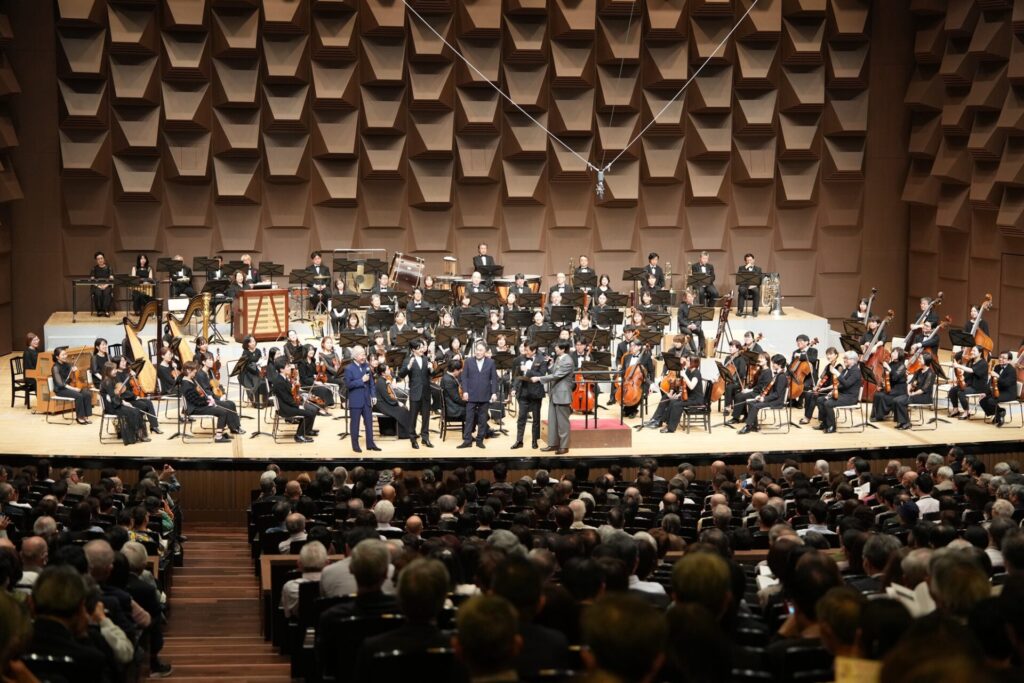
Osaka 4 Orchestras 2026 “The Four Orchestras Dance” — A Historic Concert That Proved Osaka Is One of the World’s Great Metropolises —
Held at Festival Hall on April 18, 2026, the 64th Osaka International Festival: Osaka 4 Orchestras 2026 “The Four Orchestras Dance” was a historic concert that once again proved that Osaka’s four orchestras are among the finest in the world.
What I felt upon hearing the Kansai Philharmonic Orchestra, The Symphony Orchestra Osaka, the Japan Philharmonic Orchestra, and the Osaka Philharmonic Orchestra was the undeniable fact that Osaka is one of the world’s great metropolises in musical culture as well.
At the same time, there was also a moment that made one strongly aware of the ideological background of a postwar cultural figure in connection with a work by Ikuma Dan.
The world will in time be astonished by Osaka’s cleanliness, civic standards, and the grandeur of its four orchestras.
Well, today’s Osaka 4 Orchestras 2026 “The Four Orchestras Dance,” held at Festival Hall, was extraordinary.
As I have already written, today was my first time ever seeing and hearing The Symphony Orchestra Osaka, but just as I had expected, it was, like the other three orchestras, one of the finest orchestras in the world.
Without question, these four orchestras are the pride of Osaka.
They are one of the finest possible proofs that Osaka is one of the world’s great metropolises.
There were, however, two regrettable things.
One was personal.
When I went to Nagaoka Tenmangū on 4/16 to take photographs, Airism underwear and a Uniqlo Super Fine Cotton shirt were more than enough.
But when I sleep, I wear an all-wool sweater in place of pajamas.
After waking up, I often continue working for a while still dressed that way.
At last week’s regular Osaka Philharmonic concert, I had been watching Ohtani’s game on TV until the very last minute, and as a result I barely made it in time by rushing there in a taxi.
Reflecting on that, today I had decided to arrive at Yodoyabashi a full hour before the doors opened.
I had plenty of time to spare.
The concert began at 2 p.m.
At first, I had mistakenly assumed that it would end at 4 p.m.
Only yesterday did I learn for the first time that the actual ending time was 6 p.m.
Unlike usual, the intermission schedule was different.
The top batter was the Kansai Philharmonic Orchestra under Sachio Fujioka.
It was a historic performance.
Next came The Symphony Orchestra Osaka, which I was seeing and hearing for the first time.
The program was Ma Mère l’Oye and Daphnis et Chloé: Suite No. 2.
This too was a historic performance.
But then came the problem.
Although I had somehow managed to get a very good seat, I began to feel a strange chill.
Before long, I also began to feel the urge to urinate.
It was a shame, because The Symphony Orchestra Osaka was giving such a magnificent performance, but the very moment it ended, while no one else was leaving the hall, I dashed to the restroom like a fleeing rabbit.
Today was a special concert, and photography was permitted during the intermissions.
I went to the cloakroom and retrieved the camera I had checked.
I photographed the four conductors of the four orchestras gathered together in one place.
This time, I had only noticed the event rather late and then gone through the process of purchasing a ticket, so my close friend and I could only get completely separate seats far from one another.
My friend had left a coat and a muffler at the cloakroom.
I was able to put them on.
Only then did I finally feel human again.
My friend had even been wearing an extra-warm shirt and a sweater.
I had laughed about that on the train.
This was a personal matter, and it was the kind of failure that happens because I am unmarried.
If I had a good wife, there is no way I would make mistakes about what to wear.
Well, that is a personal matter, so it cannot be helped.
What I truly found regrettable was the program chosen by the Japan Philharmonic, which is itself a splendid orchestra.
Ikuma Dan: Fantasia Symphony “Hiten Ryōran.”
Bartók: Dance Suite.
Kyoto Cherry Blossoms 2024/4/1 | Daigo-ji | Delius: Two Pieces for Small Orchestra | A visual poem presented the day after I was deeply impressed by Yuna Shinohara & the Japan Philharmonic Orchestra Kyoto Cherry Blossoms.
The concert in Toyonaka mentioned above was the best possible opportunity to learn how wonderful Yuna Shinohara and the Japan Philharmonic are.
It was then that I first learned the name Yuna Shinohara.
So I searched online in advance and was astonished.
She too was one of those extraordinary genius violinists of the highest order, but what astonished me the most was the violinist who had influenced her more than anyone else as her teacher.
Maxim Vengerov… Since he was a violinist completely unknown to me, I searched for him at once, and then I was stunned.
My reaction was, “What on earth is this… I have never seen a monster like this.”
He was an utterly unbelievable monster.
Perhaps he was so monstrously great that the media simply passed him by.
The following is from Yuna Shinohara’s Wikipedia entry.
In 2016, she released the album Estreno through Epic Records Japan and gave her debut recital at Toppan Hall [17].
From September of that same year, she was also enrolled at the International Menuhin Music Academy in Switzerland and studied under Maxim Vengerov [18].
Vengerov’s instruction was extremely detailed and strict, and he stopped her many times, correcting the movements of both hands and of her whole body [19].
I was seated in the middle of the front row.
Certainly, the way she held the violin was more natural than anything I had ever seen before.
Her performance was of the very highest class.
With today’s program, her abilities were being wasted.
More than that, in the Ikuma Dan work, I saw a way of playing the violin that I had never seen before.
Everyone played the violin as if it were a guitar.
I thought perhaps it had been inspired by, or modeled on, the Spanish guitar.
Then I was appalled by the explanation given after the performance.
That was because this work was a product of Ikuma Dan’s being a man who glorified China.
I was instantly disillusioned.
For it openly revealed that Ikuma Dan was a postwar cultural figure, an Asahi Shimbun cultural figure.
But Osaka’s four orchestras are magnificent.
Today, while walking from my home toward the subway, I tried to throw away a tissue I had used for hay fever, but there was no trash can anywhere.
Because not a single piece of litter was lying on any of the roads, I simply could not bring myself to throw it away anywhere.
There is no way I could behave like low-civility Chinese people.
I repeated to my close friend what former MLB superstar Jason Giambi had said when he came to Osaka for the Japan-U.S. baseball series.
He was astonished that Osaka, despite being one of the world’s great metropolises, did not have a single piece of litter on the streets, and he marveled at the cleanliness of Osaka, that is, of Japan.
The world will surely be astonished by the magnificence of Osaka’s four orchestras.
As for why that is so, it is exactly as I have mentioned many times before.
Japan has been, since the age of Murasaki Shikibu and Sei Shōnagon, indeed since even earlier than that, the country in the world where women have been happiest.
To be continued.