Recover Diplomacy That Coldly Pursues the National Interest: Masayuki Takayama and Masahiro Miyazaki on the Chinese Communist Party’s Usual Tactics
Based on the preface to a dialogue book by Masayuki Takayama and Masahiro Miyazaki, this article discusses the weaknesses of postwar Japanese diplomacy, the lack of military and intelligence power, the Chinese Communist Party’s operations against Japan, the Senkaku Islands, propaganda over the Nanjing Massacre, Confucius Institutes, the issue of abandoned chemical weapons, and the existence of enemies within Japan itself.
March 21, 2020
When their lies are about to be exposed, it is the usual tactic of the Chinese Communist Party to incite ignorant and brainwashed masses and stir up “anti-Japanese riots” under slogans such as “patriotism is no crime.”
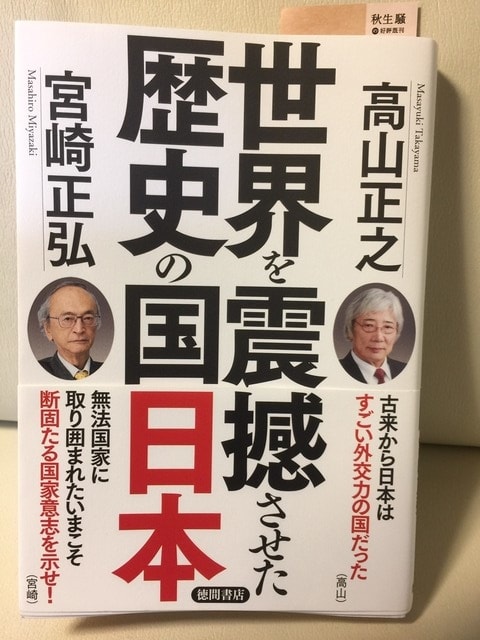
The following is from the preface to the wonderful book below, a dialogue between Masayuki Takayama, the one and only journalist in the postwar world, and Masahiro Miyazaki, one of the world’s leading experts on China.
This is a book that the Japanese people must go to their nearest bookstore and buy immediately.
It is also a book that people throughout the world must read, but I will convey that as much as I can.
Preface
Diplomacy is the cold pursuit of national interests
It was after the defeat in the war that Japan “had no diplomacy.”
In other words, this is a postwar story.
Diplomacy is foreign policy, but postwar Japan’s diplomacy has been nothing but following policy.
Proper diplomacy is established by “military power” and “intelligence power.”
Only when these two wheels begin to drive can a country become a “normal nation.”
Before the war, Japan had diplomacy based on international common sense.
From ancient times through the medieval, early modern, and modern periods, Japan’s leaders possessed the basic diplomacy to be vigorous and brave, not servile, and able to assert national interests.
That was because bushido carried a major role, but on the other hand, because Japan’s ethical standards were high, the weakness of being easily deceived was also exposed.
In Japan’s case, failures often occur in which excessive good nature obstructs diplomacy that pursues national interests.
It may also be said that a people easily deceived cannot conduct proper diplomacy.
Fanatical faith in China began with Confucian scholars in the Edo period, and continental adventurers were deceived by Sun Yat-sen, the fraudster of the century.
Moreover, Japan treated Sun Yat-sen so generously that it even arranged concubines for him, two of them, and yet in the end Sun Yat-sen casually betrayed Japan and attached himself to the Soviet Union.
Japan could not see through the character of a man who had not even a fragment of Japanese-style loyalty or humanity and justice.
Chiang Kai-shek’s moral slogan of “repaying resentment with virtue” was nothing but outrageous fraud, and he was America’s lapdog.
Nevertheless, Japan, which continued after the war to sympathize with China and provide aid, is indeed a genius-level good-natured fool to the point of idiocy.
Rhetoric, agitation, pedantry, propaganda, fabrication, fake.
In all cases, one characteristic of diplomatic documents is that they do not face the truth directly and instead carelessly line up fine-sounding phrases.
When one encounters the rhetorical expressions of someone who takes pleasure in intentionally lining up difficult vocabulary, one wonders what this person’s purpose is, what he wants to say, and why he decorates such empty content so heavily with modifiers.
And, pitifully, this is also the actual state of Japan’s forum of public debate.
According to Andrii Gurenko’s “How to Deal with the Lawless States Surrounding Japan” (Ikuhosha), “international politics is a yakuza battle without humanity and justice,” and he defined China as yakuza, North Korea as a punk, Russia as the mafia, and South Korea as a stalker.
The essence derived from this is that South Korea will not stop being anti-Japanese, North Korea will not return the abductees, and Russia will not return the Northern Territories.
He coldly predicts the near future, saying that because Japan appears to do nothing, China will gulp down the Senkaku Islands.
Perhaps Japan’s current appearance is exactly as he has pointed out.
That said, there are aspects in reality that are not so.
At the same time, as the age of globalization arrives and the IT revolution advances, the amount of information is different, and so is its speed.
Looking at recent opinion polls, 85 percent of Japanese people now answer that they dislike China.
They know the insincerity, fraudulent nature, cruelty, and heartlessness of the Chinese.
Their deep knowledge of China’s lying nature also comes from the experience of having been deceived many times.
Public opinion was strongly and angrily opposed to Xi Jinping’s visit to Japan as a state guest, was it not?
While chanting “Japan-China friendship” with its mouth, China watches with tiger-like vigilance, thinking, “If there is an opening, we will snatch away the Senkaku Islands.”
It has put a domestically produced aircraft carrier into service and has repeatedly dispatched warships and coast guard vessels into Japan’s territorial waters and surrounding seas.
Yet peace-addled Japan has gone so far as to restrict fishing by telling the fishermen of Ishigaki Island, “Do not go near the Senkaku Islands, which are our country’s territorial waters.”
Together with America, China loudly spread the story of the “Nanjing Massacre,” which never existed, and even made a film, though in the end that film was shelved.
It has diligently expanded the number of Confucius Institutes, strange propaganda organs, at Japanese universities, sought every chance to colonize Hokkaido, and on top of that, regarding the disposal of poison gas weapons that China itself had made, it told the absurd lie that Japan had made them and extracted nearly one trillion yen from the Japanese government.
When it became inconvenient, China picked a quarrel and detained four employees of the Japanese construction company that had undertaken that work.
And when their lies are about to be exposed, it is the usual tactic of the Chinese Communist Party to incite ignorant and brainwashed masses and stir up “anti-Japanese riots” under slogans such as “patriotism is no crime.”
Moreover, Japan’s enemies are inside Japan.
This is the most troublesome thing of all.
This essay continues.