The Emergence of a “Korean” National Consciousness under Japanese Rule: Junko Miyawaki on the Korean Peninsula’s Class Society, the Nation-State, Nationalism, and Anti-Japanese Sentiment
Published on August 26, 2020. Drawing on a work by East Asian historian Junko Miyawaki, this article presents her argument concerning class divisions and ethnic consciousness on the Korean Peninsula before 1910, the emergence of a “Korean” identity under Japanese rule, the rise of modern nation-states and nationalism, the Chinese concept of the “Chinese nation,” and anti-Japanese sentiment in Korea and China.
August 26, 2020
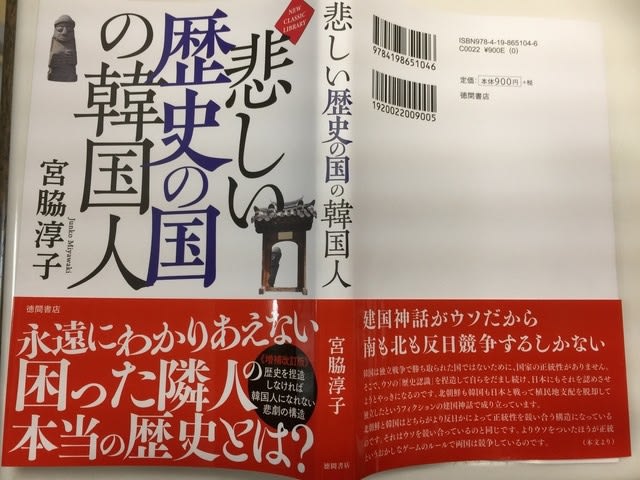
The following is from a book that a friend of mine, one of the most avid readers I know, strongly recommended that I purchase.
It is a work by Junko Miyawaki, one of the world’s leading scholars of East Asian history.
It was Masayuki Takayama, the unparalleled journalist of the postwar world, who first made me aware of her.
Her late husband, Hidehiro Okada, was one of the greatest historians in the world, as Professor Hiroshi Furuta, a great scholar whose existence the Asahi Shimbun never informed the public about, has repeatedly stated.
I also think that Junko Miyawaki is one of the people who has lived one of the happiest lives in the world.
Her extraordinary insight goes without saying.
Alexis Dudden, whom I regard as nothing other than an agent of Korea dominating the American historical establishment, and John Dower, who made a name for himself as an anti-Japanese scholar after freely playing with Japanese women in Japan immediately after the end of the war, ought to boil the dirt from beneath her fingernails and drink it.
Her clear and lucid writing, and consequently the extreme readability of her work, also prove that she is a scholar of the very highest rank.
This is a book that not only the Japanese people but people throughout the world must read.
Japanese people should immediately go to their nearest bookstore, Amazon, or elsewhere and purchase it.
All the more so because a book filled with the scholarly achievements of such a genuine scholar costs only 900 yen.
Chapter 9: Why Do Koreans Regard Japan as Their Enemy?
It Was under Japanese Rule of Korea That a Korean National Consciousness First Emerged
Before and during the war, Japan referred to the people living on the Korean Peninsula ethnically as Chosenjin, or Koreans, while in English they are called “Koreans.”
The name Korea derives from Goryeo, and Goryeo took pride in considering itself the successor to Goguryeo.
“Korea” is the English rendering of that name.
During the Yuan dynasty under Kublai Khan, Marco Polo and other Europeans who traveled to Asia transmitted the name of the country to Europe, just as they transmitted the Japanese name “Zipangu.”
For that reason, even after Goryeo disappeared, Europeans continued to call the land Korea.
Both the names Choson and Han appear in Chinese-language historical records from ancient times.
However, neither the ancient “Choson” nor “Han” referred to a unified state covering the peninsula; they were names of groups.
The South and North therefore chose different names from each other: the South called itself the Republic of Korea, abbreviated as Korea, while the North called itself the Democratic People’s Republic of Korea.
In English, however, both call their ethnic identity “Korean.”
But as I have already explained, it is simply not the case that a Korean people had existed for 5,000 years continuously creating an independent history of their own.
After the annexation of Korea, the non-Japanese people living in the territory ruled by Japan became “Koreans.”
Until Japan began ruling the peninsula in 1910, there had never been a domestic consciousness that all of its people belonged to the same ethnic group.
People of the yangban class could hardly have regarded themselves and members of the slave class as the same kind of people.
The people living on the Korean Peninsula were rigidly divided into five social classes, and because those in the lower classes were not even treated as human beings, there was no consciousness of belonging to one nation.
Through the Japanese annexation of Korea and Japanese rule of the Korean Peninsula, they came to understand that they were not Japanese.
Today we speak of “nations” and “ethnic groups” as though they had always existed, but in fact the concept of the nation basically did not exist anywhere in the world until nation-states began to be formed from the end of the eighteenth century into the nineteenth century.
The idea of nationalism likewise cannot exist without the nation-state.
The nation-state itself was a form of political organization that had existed nowhere in the world before the American War of Independence and the French Revolution.
Already here we encounter multiple layers of deception and falsehood.
To begin with, the concept of being Korean arose in opposition to Japan, and therefore regarding Japan as a rival and defeating Japan became a means by which Koreans confirmed their own existence.
Similarly, and unfortunately, the Chinese constructed the state called China by declaring themselves to be the “Chinese nation descended from the Yellow Emperor” in opposition to the “Yamato people descended from the Sun Goddess Amaterasu.”
They unite as “we Chinese” only when Japan is the enemy; when the enemy disappears, struggles for power begin within the country.
In this way, it is probably best to assume that anti-Japanese sentiment in Korea and China will continue indefinitely for as long as their countries continue to exist, or for as long as they regard themselves as nations.
To be continued.