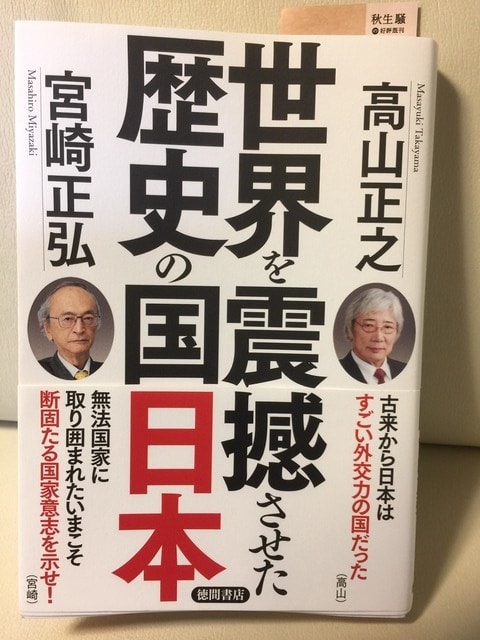
Japan’s First Postwar General Election Under the Occupation and the Remaking of Japan—A Dialogue Between Masayuki Takayama and Masahiro Miyazaki on GHQ, the MacArthur Constitution, Shizue Kato, and Family Planning
Citing a dialogue between Masayuki Takayama and Masahiro Miyazaki, this article records their historical interpretation of Japan’s first postwar general election in 1946 under the GHQ occupation, the release and candidacy of Communist Party members, the election of thirty-nine women, Shizue Kato, the MacArthur Constitution, family planning, and the Eugenic Protection Law.
The following is taken from an outstanding book containing a dialogue between Masayuki Takayama, a journalist without equal in the postwar world, and Masahiro Miyazaki, one of the world’s foremost experts on China.
This is a book that the Japanese people must immediately go to their nearest bookstore to purchase and read.
It is also essential reading for people throughout the world, and I will convey its contents as widely as I can.
The preceding passage is omitted.
Takayama:
The North Korean army suddenly crossed the 38th parallel and attacked.
Until then, because Japan had governed it, the Korean Peninsula had served as a defensive stronghold.
As soon as Japan was gone, the Korean Peninsula was divided, and half of it became communist.
The Japanese disliked Christianity, but they also detested the Communist Party and never relaxed their vigilance toward it.
The Americans did not understand this at all.
William Sebald, who served under Douglas MacArthur, wrote in his book With MacArthur in Japan: A Personal History of the Occupation that whenever he met people in Japan’s political, financial, or bureaucratic circles, he was told to be on guard against the Communist Party.
At first, the Americans occupying Japan were not particularly wary of communism or communists, and at the time of the first universal election in 1946, they released all Communist Party members from prison, allowed them to stand as candidates, and even had them elected.
Miyazaki:
Kenji Miyamoto and Kyuichi Tokuda were both released, along with all the others.
Takayama:
The first postwar general election was an irresponsible election in which GHQ actually went so far as to arrange the votes.
They also sent Shizue Kato, who called for women’s sexual freedom to be made equal to that of men, into the Diet.
They were truly MacArthur’s children, and through them the MacArthur Constitution was approved.
It is better to understand the first postwar general election, in which thirty-nine women as well as Communist Party members were elected, as an entirely staged election arranged by GHQ.
Miyazaki:
Were all of them elected?
Takayama:
Every one of them was elected.
According to Shizue Kato’s records, one day an American military officer came to her and asked her to run for office.
Miyazaki:
Shizue Kato’s husband was Kanju Kato, a Socialist Party politician.
Takayama:
The reason Shizue Kato was selected was that she had been the foremost disciple of the American Margaret Sanger, who advocated the necessity of birth control through the family-planning movement.
To destroy Japan, the Constitution would prevent it from possessing weapons, prevent it from maintaining an army, and even deny it the right of belligerency.
The best way to destroy a country after that is to reduce its population, and so they made a commotion about using condoms as a matter of women’s rights.
Margaret Sanger was a woman who said, “Only men are free to enjoy themselves. If women do the same, they become pregnant. This is unfair,” and who developed various kinds of condoms and pessaries.
Sanger sought to create a world in which women, too, could enjoy themselves.
Agnes Smedley was with her as well.
She had been toyed with by men, and after marriage found herself doing nothing but caring for babies.
Dissatisfied with that life, she abandoned her husband and child and left.
Under Sanger, Smedley and Shizue Kato worked together to create a society in which women could enjoy themselves.
Smedley later went to Shanghai.
She went to Shanghai, put this sexual freedom into practice, and asked Sanger to send her more condoms.
Shizue Kato helped with those shipments.
Miyazaki:
That is an unusually graphic story, but where is it written?
Takayama:
It is not written quite that explicitly, but in a book published by the Sankei Shimbun in 1997 titled Twentieth-Century Correspondents, a female reporter from the Osaka Sankei wrote about the strange relationship among Sanger, Shizue Kato, and Smedley in a chapter titled “A Storm of Sex.”
Miyazaki:
Smedley had relations with anyone.
She was also involved with Richard Sorge, wasn’t she?
Takayama:
She was also involved with Hotsumi Ozaki.
What they used at the time was a Sanger-brand condom. [Laughs.]
GHQ intended to eliminate the Japanese as a people.
Passage omitted.
Among the terms of surrender imposed by Scipio was a requirement that all the children of Carthaginian aristocrats be sent to Rome to study.
That was exactly the same as the postwar governance of Japan.
Miyazaki:
They are similar. You mean the Fulbright scholarship, don’t you?
Takayama:
GHQ also promoted the transformation of Japan into an agricultural country and had NHK create a radio program called The New Farming Village.
Miyazaki:
From 1963, it became The Bright Farming Village.
Even now, there is a brand of shochu called Seiko Udoku—“working the fields in fine weather and reading in rainy weather.”
Takayama:
Japan is an industrial country, so its dependence on agriculture is not particularly high.
Wasn’t the agricultural population around five percent?
Miyazaki:
It is around one percent now, although it may have been somewhat higher if primary-sector fishing and forestry were included.
Takayama:
There are now 400,000 people in fishing. Forestry is close to zero.
Officially, agriculture is said to employ eight million people, but the Ministry of Agriculture, Forestry and Fisheries counts someone as a farmer even if that person works for only one hour a year.
In reality, there may or may not be two million.
I was in my first or second year of junior high school, so it must have been around 1956 or 1957, when the Anti-Prostitution Law had been enacted but had not yet taken effect.
There was a nationwide practice examination asking what percentage of the total population worked in agriculture.
The three choices were thirty percent, fifteen percent, and five percent.
I thought it could not be that high, so I answered five percent.
I remember it well because I was the only person who received a perfect score of one hundred.
Even at that time, the agricultural population was five percent.
In short, NHK was broadcasting The Bright Farming Village on the radio in Japan even though Japan was not an agricultural country.
There were correspondents with some Western-style name such as “RPO correspondents,” and they reported on the wheat harvest.
In those days, radio was the only source of information.
Miyazaki:
There was also the Christian program The Lutheran Hour.
Programs of that kind were openly broadcast on the radio.
GHQ Sought to Reduce Japan’s Population Through Family Planning and the Eugenic Protection Law
Miyazaki:
The number of births in Japan finally fell below the 900,000 mark in 2019, declining to 860,000.
The seeds sown by GHQ—the reduction of the population for the purpose of bringing about Japan’s disappearance—are now finally bearing fruit.
Takayama:
That is right.
It was either a conspiracy by Shizue Kato and the Socialist Party or a case of their being manipulated by the United States.
Through Shizue Kato, family planning was promoted, and the American scheme of allowing only “one daughter first and then one son,” with no more children after that, finally bore fruit seventy years after the war.
In 1945, the existing Imperial Diet was made to accept the draft Constitution.
Then, in the first universal election for both men and women in April 1946, large numbers of Socialist and Communist Party members, including Shizue Kato, were elected, and Japan was transformed at once under the Peace Constitution.
In short, people endorsed by GHQ were sent into the Diet, while those who opposed it were purged one after another.
Miyazaki:
Like the Red Purge.
Takayama:
It was not a Red Purge.
At that time it was a purge of conservatives and of people associated with the Imperial Rule Assistance Association.
Anyone who would not follow GHQ policy was removed.
Then they passed that Peace Constitution.
It also incorporated the family-planning policy that has now reduced annual births to the range of 800,000.
An army physician named Crawford Sams, who headed GHQ’s Public Health and Welfare Section, took the lead in inviting Sanger to Japan repeatedly and had her tour the country with Shizue Kato to advocate family planning.
In short, it was a policy intended to stop the Japanese from having children.
They also said that large houses and estates were unsuitable for Japan, had small matchbox-like two-room-and-kitchen housing complexes built, and promoted the nuclear family.
From the beginning of the occupation, they were planning how to reduce Japan’s population.
When dealing with Native Americans, they could simply kill the women and children.
If only the men remained, the people would eventually disappear.
That was why, as in the Sand Creek Massacre, they killed all the women and children while the men were away.
This was a method of killing like that described in the Old Testament.
Once the war was over, however, they could not do that openly.
Instead, they conducted a campaign claiming that Japan’s extended-family system was undesirable, that the nuclear family was preferable, and that unwanted children could be aborted.
With nuclear families, a small two-room-and-kitchen dwelling would be sufficient, and the Asahi Shimbun, Shizue Kato, and the Socialist Party continued to lead the promotion of the value that one child—or at most two—was best.
Miyazaki:
I see.
So Japan’s housing complexes, resembling rabbit hutches, were an American plot.
They spread the idea that small dwellings were sufficient for rabbits.
After repatriation began in 1946, Japan had around 2.7 million births a year, creating the postwar baby-boom generation.
After witnessing the emergence of these baby boomers, did the United States call for population reduction?
Or is that an interpretation developed with hindsight?
Takayama:
No. GHQ began talking about family planning almost as soon as the occupation started.
GHQ promoted Shizue Kato because, during the period beginning in 1935, she had held lectures on what became the Eugenic Protection Law and had campaigned, as Hitler did, for children deemed unfit to be sterilized at an early stage or prevented from being born.
GHQ had therefore taken notice of her immediately after arriving in Japan.
In that sense, I believe the “Carthaginization of Japan” was deliberately planned.
Last year, a law was enacted providing lump-sum payments to victims who had undergone compulsory sterilization under the former Eugenic Protection Law, and Prime Minister Abe apologized to those victims.
In reality, however, it is the Socialist Party and the Asahi Shimbun that should apologize.
That is because the Eugenic Protection Law was also realized through a vigorous campaign led by Shizue Kato.
Shizue Kato was Japan’s Hitler.
Hitler also implemented eugenic policies in Germany.
Shizue Kato did the same with the support of GHQ.
The Asahi Shimbun joined in and reported that whatever GHQ said was correct.
Miyazaki:
The Asahi really ought to change its name.
Instead of “the red, red, completely red rising sun,” it could call itself “the American Asahi.”
The remainder is omitted.