The UN Human Rights Council as a Den of Hypocrisy—China’s Organ Harvesting Allegations and the Challenge from the Five Eyes
Published on February 19, 2020.
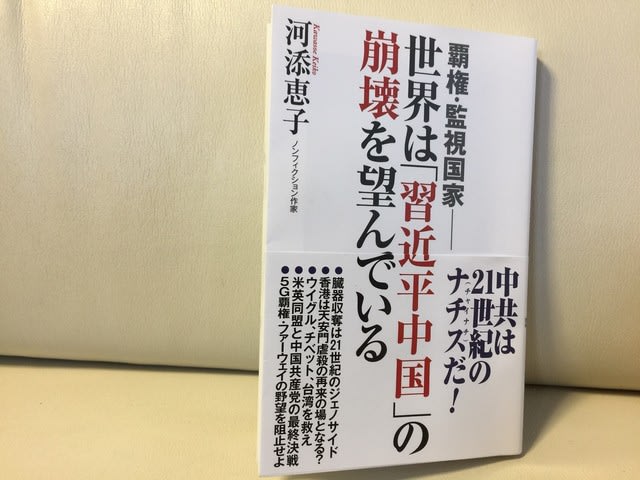
Based on a work by Keiko Kawasoe, this essay discusses allegations of organ harvesting in China and the final judgment of the China Tribunal announced in London in June 2019.
Through testimony from Falun Gong practitioners, ethnic minorities, human-rights experts, doctors, and journalists, it examines suspicions of medical genocide under the Chinese Communist Party regime, while also discussing the Trump administration’s criticism of the UN Human Rights Council as a “cesspool of political bias” and the challenge posed to the Chinese Communist Party by the Five Eyes.
2020-02-19
She criticized the UN Human Rights Council as “a cesspool of political bias” and cut it down by saying that “an organization filled with hypocrisy and self-satisfaction is making a mockery of human rights.”
The following chapter also proves that the Asahi Shimbun and NHK are completely under the influence operations of the Chinese Communist Party.
The author, Keiko Kawasoe, is one of the leading journalists of our time.
It is a book that not only the Japanese people but people all over the world must read.
In this essay, not only the preceding passage but also large portions of the middle have been omitted, but needless to say, all of those parts too are essential reading.
I urge the Japanese people to go to their nearest bookstore and purchase the book.
Those in the international community who have taken at face value the anti-Japanese propaganda of China and South Korea should recognize the truth through this essay.
The following chapter brilliantly clarifies facts that, in particular, the Japanese people and people throughout the world did not know.
Evil Far Exceeding the Mass-Killing Crimes of the Previous Century
“A little over 10,000 cases.”
This is the annual number of organ transplant surgeries carried out in Chinese medical facilities that the Chinese authorities publicly announce.
However, that number diverges greatly from the figures that multiple specialized organizations around the world, based on “justice and humanity,” have derived through long years of investigation from various angles.
They estimate that “between 60,000 and 100,000 organ transplant surgeries are performed annually in China,” or “more than 70,000 cases.”
The final judgment of the China Tribunal on the issue of organ harvesting in China, a “people’s tribunal” that presents third-party investigations and findings on crimes against humanity, was announced in London, England, on June 17, 2019.
As a result of more than 50 testimonies from ethnic minorities who had fled China, Falun Gong practitioners, human-rights experts, doctors, journalists, and others, as well as a year-long investigation, Sir Geoffrey Nice, a Queen’s Counsel—that is, a lawyer granted authority by Her Majesty Queen Elizabeth—and former prosecutor who served as chair of the people’s tribunal, concluded that “the fact that organ harvesting is taking place in China for the supply of transplant surgery is unavoidable.”
He further called on “all governments, corporations, and others to recognize the state-level crimes against humanity being committed in Communist Party-ruled China,” and urged that “governments should recognize that those who have had substantial dealings with China are dealing with a criminal state.”
The world’s “justice and conscience,” which takes “freedom and democracy,” including freedom of religion, “equality under the law,” and “human rights” as absolute value standards, thoroughly exposed and judged the allegations of medical genocide that began in the Jiang Zemin era and continue under the Xi Jinping regime.
The background to the establishment of this China Tribunal was a commission from the International Coalition to End Transplant Abuse in China, or ETAC, a nonprofit, nongovernmental international charitable organization headquartered in Australia and with committees also established in the United States, Britain, Canada, and New Zealand.
What should be added about ETAC, which consists of lawyers, academics, ethicists, medical professionals, investigators, and human-rights defenders, is that these five countries are the so-called Five Eyes, whose existence and cooperation have repeatedly been pointed out in this book.
At a public hearing in December 2018, one of the panelists, an expert, expressed the view that “because China is a permanent member of the UN Security Council, the United Nations is unwilling to accept this issue under China’s control.”
In this way, a people’s tribunal is said to be held in order to judge serious crimes that official international organizations either will not or cannot investigate.
I see this as a challenge from the Five Eyes to the “gray collusion” between the United Nations and the Chinese Communist Party.
U.S. Secretary of State Mike Pompeo had also long harshly criticized the Human Rights Council as “a poor defender of human rights.”
And Nikki Haley, who was appointed U.S. Ambassador to the United Nations under the Trump administration, announced in June 2018 that “the United States is withdrawing from the UN Human Rights Council.”
She criticized the council as “a cesspool of political bias” and cut it down by saying that “an organization filled with hypocrisy and self-satisfaction is making a mockery of human rights.”
Haley later resigned as UN Ambassador, but from her long Fox News essay on the Hong Kong demonstrations mentioned in Chapter One, it can be understood that, like Stephen Bannon, the former Chief Strategist and Senior Counselor, she remains close to the Trump administration, which “seeks UN reform.”