Japan That Shocked the White World: Masayuki Takayama on the Strength and Mercy of the Japanese People
Based on the afterword of a dialogue book by Masayuki Takayama and Masahiro Miyazaki, this article discusses Taro Aso’s remark that Japan has maintained the same people, language, and dynasty for two thousand years, criticism of the idea of the Japanese as a single people, GHQ’s alteration of history education, the denigration of Japan by figures such as John Dower, and the fear that the white world felt toward the Japanese.
March 20, 2020
Hokusai’s paintings astonished them, and so did Shibasaburo Kitasato, who solved in one week the mystery of the Black Death that they had feared for five hundred years, but the greatest shock was that the Japanese were “strong, and yet more merciful than Jesus.”
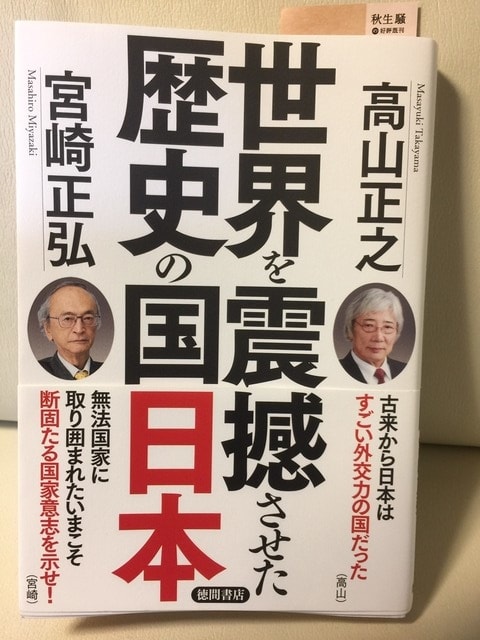
The following is from the afterword of the wonderful book below, a dialogue between Masayuki Takayama, the one and only journalist in the postwar world, and Masahiro Miyazaki, one of the world’s leading experts on China.
This is a book that the Japanese people must go to their nearest bookstore and buy immediately.
As for the people of the world, I will convey it as much as I can.
Japan that shocked the white world
Taro Aso said at a gathering in his local Fukuoka, “There is no country other than Japan that has maintained the same people, the same language, and the same dynasty for two thousand years.”
There is nothing strange about that.
It is an obvious fact.
Henry Stokes, a former correspondent for the British Times, wrote in his book that this is “a miracle of the world.”
It is truly an extraordinary thing, but Japanese people do not think about it very deeply or feel moved by it.
Indeed, one can understand it by looking at the two thousand years of other countries.
Take Russia, for example.
One day in the thirteenth century, no sooner had Mongol cavalry appeared on the horizon than Ryazan and Moscow were attacked, men were killed, women were raped, and as a result Russians acquired an Asian “Lenin face” (Professor Hiroshi Furuta of the University of Tsukuba).
The Mongols destroyed Ukraine to the west, took Poland, and went as far as the outskirts of Vienna.
However, the northern edge of Ukraine had deep marshlands, and the countries beyond them escaped being trampled.
Therefore, the people made Belarus the name of their country, meaning pure white Russians who had not been violated.
Iran, too, was violated by the Mongols.
In the streets, one sometimes sees Asian-looking faces.
That is why, when they hear that a baby has been born nearby, they first ask, “What color is it?”
Only when they hear that it has Persian skin color do they offer congratulations, and then ask whether it is a boy or a girl.
In Japan, no such calamity exists either in historical records or in traditions.
Foreign peoples came several times, but all were defeated.
Protected on all four sides by the fortress of the sea, and although there have been many natural disasters such as earthquakes, eruptions, and tsunamis, at least for these two thousand years Japan has been peaceful.
When disasters occurred, people helped one another and lived with consideration for one another.
Therefore, the language they speak is smooth, and at times even subjects and verbs are omitted.
As linguists say, this is proof that people have lived for a long time among the same companions, because meaning is conveyed without saying much.
That is why Japanese people do not speak loudly like Chinese or Americans.
However, even such loud-voiced races, when made to speak Japanese, become gentle in tone and expression as if they were completely different people.
Chinese people’s tongues become tangled when they try to say “I ask.”
Americans also say “Please” with strained faces, but in Japanese they can say “onegai” calmly and without hesitation.
Japanese has that mysterious power as well, but let us leave that aside.
The moment Taro Aso stated such an obvious fact, words of criticism attacked him: “How can it be one people when the Ainu exist?” “It is common knowledge that immigrants brought culture with them,” and “the arrogance of thinking of oneself as a special people caused the last war.”
But it is academically clear that the Ainu came from the north during the Kamakura period.
They are nothing more than predecessors of Koreans living in Japan.
Moreover, through the excavation of many Jomon cultural sites beginning with the Sannai-Maruyama site, the existence of a unique culture older than any other civilization of mankind has also become known.
Furthermore, through the clarification of Y chromosomes among all peoples, the Japanese have been proved to be a single people continuing unmistakably from the ancient Jomon period to the present, and even more pleasingly, their genetic sequence has also proved that they have nothing in common with Chinese or Koreans.
In such an age, why is it that the moment people hear “one people,” criticism erupts like a patellar tendon reflex?
When one investigates the arguments of such people, there is a considerable political stench.
Certainly, toward the end of the Meiji era, from around the anthropology research circles of the University of Tokyo, there were stories like “Japan is an immigrant nation just like America.”
That revived after the war and began to bloom proudly like ragweed.
Namio Egami spoke of the theory of horse-riding peoples coming to Japan, Ryotaro Shiba said that Japan’s homeland was Korea, and Eiji Oguma declared that “Japan being a single people is a myth.”
“Myth” here means something like a baseless lie.
Their claim is that South Sea peoples and continental peoples came to Japan in large numbers, violated the Jomon people like the Mongols in Russia, brought rice cultivation and new culture, and that people and artifacts continued to flow in from the Korean Peninsula, and so on.
Even today’s school textbooks, leaving Y chromosomes aside, teach as if Yayoi culture began after the Jomon period through immigrants.
When one traces why this happened, GHQ appears.
GHQ greatly altered Japan’s history education.
It burned many books.
Among them was Atsuo Mishima’s “A Study of the Six-Thousand-Year History of the Tenson Race.”
It argued that Japanese civilization came from the “Sumer culture” of Mesopotamia.
It argued that the Japanese have a history and lineage of several thousand years.
GHQ disliked that, burned the book, and even ordered schools to pronounce “Sumer” as “Sumeru” or “Shumeru,” because “Sumeru” was connected to “sumeramikoto,” the imperial sovereign.
Then it made schools teach that the “inferior Jomon” changed into the Yayoi culture of immigrants.
In short, it thoroughly imposed the idea that “the Japanese are not a special single people.”
This work, in fact, continues even now.
Oguma, who said that the single people idea was a myth, received many awards such as the Mainichi Publishing Culture Award, and in a corresponding way, in the United States, John Dower’s “Embracing Defeat” was praised to the skies.
It received awards from the Pulitzer Prize to school library awards, but its contents are terrible.
Dower deliberately demeans Emperor Showa as “an ordinary person who evaded responsibility” and repeatedly says that the Japanese are no different from the Chinese, a servile, vulgar, and insignificant people.
Why do they want so much to make Japan a country below ordinary level?
In fact, the main point of the dialogue with Masahiro Miyazaki lies around there.
Japan, which made its debut in international society in the latter half of the nineteenth century, shocked the white world that was then coming to dominate the world, in the half century that followed.
Hokusai’s paintings astonished them, and so did Shibasaburo Kitasato, who solved in one week the mystery of the Black Death that they had feared for five hundred years, but the greatest shock was that the Japanese were “strong, and yet more merciful than Jesus.”
To them, the yellow Japanese were an endlessly unknown people.
They could not predict their actions.
Therefore, they feared them and plotted to erase them.
That was the last war.
But it did not end there.
A country that has once perished does not rise again.
That is the common understanding of the world, but Japan rose again and still continues to teach the world many things.
That is why it is frightening.
Here lies the reason they continue to use Dower, and to use China and Korea, to demean Japan.
The Japanese possess a unique sensibility, are more hardworking, diligent, and fond of research than any other people, and yet are humble, good-natured, and assume that the other party is a good person.
They have struck at that point and have carefully plotted so that the Japanese will not notice it.
When the Japanese realize this and cease to care about the noise from the vulgar world around them, Japan can rise again.
Japan may cut off association with vulgar neighbors.
There is no need to flatter Europe and America.
Japan possesses the underlying strength to do that, and our predecessors did it.
If this dialogue helps people understand that, I will be happy.
February, Reiwa 2
Masayuki Takayama