
Masayuki Takayama and Seki Hei on China’s Nuclear Threat and Japan’s Right to Nuclear Deterrence
December 30, 2022
A long time ago, an elderly female professor at the Royal Ballet School of Monaco, deeply respected by prima ballerinas around the world, visited Japan.
During that visit, she spoke about the significance of an artist’s existence.
“Artists are important because they are the only ones who can shed light on hidden, concealed truths and give expression to them.”
No one would dispute her words.
It is no exaggeration whatsoever to say that Masayuki Takayama is not only a journalist without equal in the postwar world but also an artist without equal in the postwar world.
On the other hand, many who call themselves writers, such as Oe, Murakami, and Hirano—people who imagine themselves to be artists—do not even deserve the name.
This is because, far from shedding light on hidden, concealed truths and expressing them, they have merely given expression to lies fabricated by the Asahi Shimbun and others.
People like them surely exist not only in Japan but in countries throughout the world.
In other words, genuine artists are exceedingly rare.
This book, too, powerfully demonstrates the correctness of my assertion that no one in the world today is more deserving of the Nobel Prize in Literature than Masayuki Takayama.
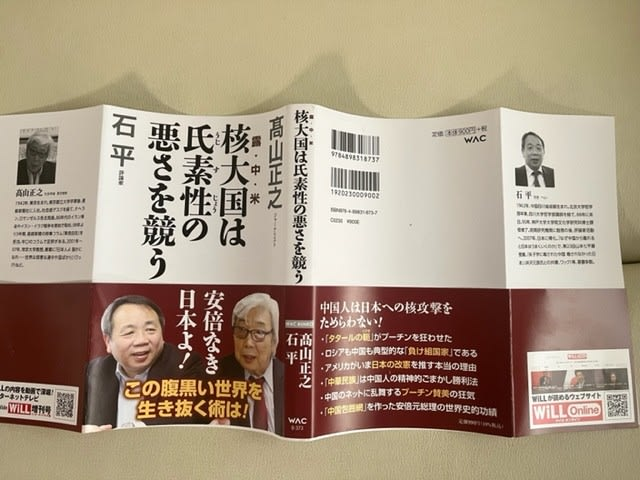
“Japan Could Be Devastated by Three Nuclear Strikes”
Takayama:
So, while China considers America strong, does it consider Japan weak?
Seki Hei:
It must consider Japan reasonably strong, but still no match for China.
From their perspective, a single nuclear strike could devastate Japan.
Japan has no capacity to strike back.
Japan has a small land area, with densely concentrated industry and population.
Keihanshin, Chukyo, and Tokyo—three nuclear strikes, and Japan would be finished.
Moreover, they have no hesitation whatsoever about using nuclear weapons against Japan.
Takayama:
That is truly frightening, but if they launched a missile at Tokyo, the U.S. military base at Yokota and the U.S. military headquarters would also be destroyed.
Many of their own people, including members of the overseas Chinese community, are there as well.
Seki Hei:
No, once they decide to do it, they will do it regardless of U.S. military bases or anything else.
They look down on Japan because it has no capacity to resist.
Unfortunately, that is the reality.
Even now, Japan is a country where nuclear weapons cannot even be discussed, is it not?
Takayama:
Indeed. What kind of country is China?
All they talk about is friendship between Japan and China, and on top of that, newspapers and those in education have no qualms about disparaging Japan.
In any case, far too many media outlets do nothing but speak ill of their own country.
Merely suggesting that we discuss nuclear weapons provokes a backlash.
Seki Hei:
If China decides to launch a nuclear attack on Japan, it will not care if Chinese people living in Japan lose their lives.
That is the kind of government China has.
Its attitude is, “You left China of your own accord and chose to live in a country like that, so if you die, it cannot be helped.”
Takayama:
When the war in Ukraine began, Chinese nationals were in Ukraine, yet China did not protect them.
Some defend this by saying that it could not have been predicted, but Xi Jinping had been informed by Putin, so one would normally have expected him to protect them.
But this is not a country that shows consideration for its own citizens.
There are approximately 300,000 Chinese permanent residents in Japan, and if Japan went to war with China, those 300,000 people would become hostages.
The Chinese government’s reasoning is, “It cannot be helped; they chose to try to make money in a country like Japan.”
China’s government is not as naive as the Japanese.
Takayama:
Even so, when you think about it, the idea that just three nuclear strikes could silence Japan is terrifying.
Seki Hei:
They genuinely believe that.
It is not some far-fetched fantasy.
In light of that, Japan, too, must possess a nuclear deterrent.
We must change the way we think about nuclear weapons.
Precisely Because Japan Is the “Only Country to Have Suffered Atomic Bombings,” It Has the Right to Possess Nuclear Weapons
Takayama:
The mantra “Japan is the only country to have suffered atomic bombings” is often repeated.
America detonated the bombs 500 meters above the urban areas of Hiroshima and Nagasaki.
It conducted a human experiment to determine how effectively it could carry out mass slaughter, presumably because Japan was a non-white nation.
Approximately 200,000 lives were lost.
Eighty percent of the victims were noncombatant women and children—a clear violation of international law.
Yet America has never apologized and continues to pile lie upon lie, claiming that it had no choice but to make Japan, an aggressor nation, cease its acts of war.
We were made victims of those nuclear bombs.
That is what being “the only country to have suffered atomic bombings” means.
Therefore, including the right to retaliate with nuclear weapons against America, which has neither apologized nor stopped lying, the proper conclusion is: “As the only country to have suffered atomic bombings, Japan has, more than any other nation, the right to possess nuclear weapons to prevent any country from ever launching another nuclear attack against it.”
Seki Hei:
That is precisely why Japan has the right to possess nuclear weapons.
Think about it.
If Japan had also possessed nuclear-armed missiles capable of reaching the American mainland in 1945, the tragedies of Hiroshima and Nagasaki would never have happened.
Because America alone possessed nuclear weapons at the time, two atomic bombs were dropped on Japan.
Takayama:
Exactly!
Yet Prime Minister Kishida says that he will “adhere to the Three Non-Nuclear Principles.”
In other words, he has effectively declared that Japan will not retaliate with nuclear weapons even if it suffers a third nuclear attack.
Seki Hei:
Prime Minister Kishida’s attitude is utterly unacceptable.
His reluctance to explicitly support nuclear weapons possession may reflect concern for his constituency, Hiroshima, the site of an atomic bombing, but such considerations cannot take precedence over the lives and property of the Japanese people.
Of course “Japan” matters more than “Hiroshima.”
Takayama:
That is right.
He may also have a political motive in wanting to hold the summit in Hiroshima next year, but we cannot have him fixating on something like that.
Seki Hei:
He should recognize the position he holds and the responsibilities it entails.
This concerns national security and the lives and property of the people; if he merely pays lip service without taking action, that is a crime.
Some say that Japan is safe because it is protected by America’s nuclear umbrella.
But even if Japan suffered a nuclear attack, would America launch a nuclear strike against China, knowing that it would face Chinese retaliation?
Surely it would not.
If it did, America itself would face retaliation.
Takayama:
We must, after all, firmly secure the right to retaliate.
Ultimately, that is what it comes down to.
That is why Mr. Abe proposed nuclear sharing, but the discussion has made no progress whatsoever.
Komeito’s election slogan was “Move Japan Forward.”
Yet it cannot move anything forward at all. (Laughs.)