
True Artists Illuminate Hidden Truths — Masayuki Takayama and Seki Hei on the Realities of War and the Nature of Communism
December 23, 2022
Many years ago, an elderly female professor from the Royal Ballet School of Monaco, who is held in tremendous esteem by prima ballerinas throughout the world, visited Japan.
These are the words she spoke at that time about the significance of artists.
“Artists are important because they are the only people capable of shedding light on concealed, hidden truths and expressing them.”
No one would dispute her words.
Masayuki Takayama is not only a journalist without equal in the postwar world, but it is also no exaggeration whatsoever to call him an artist without equal in the postwar world.
On the other hand, many of those who call themselves writers, such as Oe, Murakami, and Hirano, and who imagine themselves to be artists, are not even worthy of the name of artist.
That is because, far from shedding light on concealed, hidden truths and expressing them, they have merely expressed the falsehoods created by the Asahi Shimbun and others.
The same must surely be true of such people not only in Japan but in countries throughout the world.
In other words, genuine artists are extremely few in number.
This book, too, compellingly demonstrates the correctness of my assertion that no one in the world today is more deserving of the Nobel Prize in Literature than Masayuki Takayama.
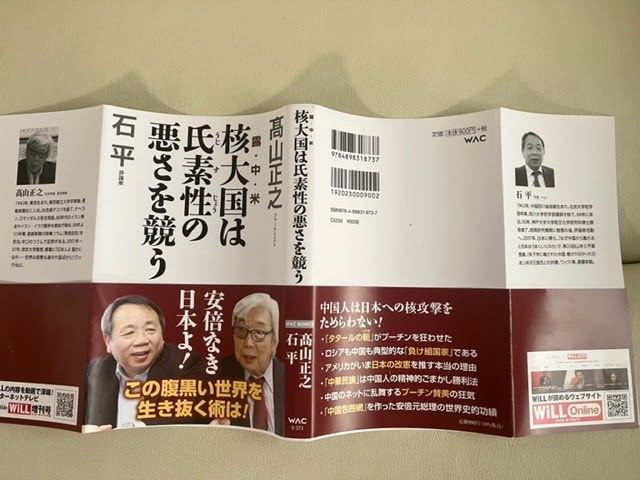
“Are the Japanese the Only Ones Who Condemn ‘Attacks on Civilian Facilities’?” (From page 98)
Seki Hei:
Incidentally, even in Putin’s current war, people in Japan have voiced condemnation of Russia for targeting civilian facilities.
In general, I believe that even in war, there are rules under which military facilities may be attacked, but civilian facilities should not be attacked so readily.
Hospitals, for example, are not supposed to be attacked.
Yet those rules have been completely disregarded, with shopping centers, schools, and even hospitals being attacked.
What do you think about that way of conducting war?
Takayama:
Mr. Seki, you even care deeply about Japan’s flowers and plants.
While doing so, it seems that your heart has become Japanese as well.
Generally speaking, the idea of not harming noncombatants is something peculiar to the Japanese.
Such Japanese sensibilities do not apply in the rest of the world.
Even during the Pacific War, American B-29 bombers repeatedly dropped bombs aimed at Nagoya Castle, which was not a munitions factory.
Without regard for civilian casualties, they burned entire cities to the ground.
Seki Hei:
Conversely, the Japanese military did not deliberately target civilian facilities.
Takayama:
There was a Hollywood film called Pearl Harbor.
It contains a scene in which Japanese military aircraft bomb a hospital.
That is a complete lie.
But Hollywood deliberately creates such scenes, thinking, “Japan is a nation of non-Christian barbarians, so they must surely have done something like this.”
Records remain of how Japanese aircraft carried out their attack on Pearl Harbor, and among the nearly 200 vessels crowded into the harbor, not even a single machine-gun bullet was fired at the vessels displaying the Red Cross emblem.
Furthermore, the Pearl Harbor memorial museum screens footage of the attack, at the end of which a caption appears saying, “More than 50 civilians died.”
When you question the basis for that statement, it turns out that the civilian deaths resulted not from Japanese aircraft but from American antiaircraft fire that fell on the streets of Honolulu, 35 kilometers away.
It is petty of them not to state that honestly.
Seki Hei:
Japan is a humane country with a tradition of bushido, and ordinary people do not directly take part in battles.
Warriors fight other warriors—combatants against combatants.
In China, however, inhabitants also live within the city walls, so naturally the people living there become targets as well.
In Japan, castles and the towns surrounding them are separate.
Takayama:
But farmers watch such events carefully, and suddenly turn into robbers known as nobuseri.
The peasants who appear so docile are actually the most frightening.
That is how Akechi Mitsuhide was killed.
Seki Hei:
That is what is known as hunting down defeated warriors.
Takayama:
The expression sounds rather elegant, but that was true of Akechi Mitsuhide, and the same thing happened when Shimazu Yoshihiro, who had sided with the Western Army at the Battle of Sekigahara, escaped by making what is called a “breakthrough through enemy lines,” crossing directly in front of Tokugawa’s positions.
Most of his soldiers managed to escape the battlefield, but afterward they were attacked by nobuseri—peasants—and suffered heavy losses.
The very fact that the hunting down of defeated warriors was so widespread means, conversely, that there was an established assumption that ordinary civilians would not be killed in battle, doesn’t it?
If warriors had fought in earnest, they would not have lost their lives so easily at the hands of those hunting down defeated soldiers.
Seki Hei:
The Red Guards in China were the same.
Once they openly believed that they were “allowed to destroy,” they gladly went on rampages.
They formed student activist organizations known as Long March groups and began denouncing everything in sight.
The government gave them extraordinarily favorable treatment, paying their train fares, accommodation expenses, and meal costs, and sent them throughout China.
In this way, they were encouraged to “destroy all Four Olds”—the four categories of old things.
At that time, the Red Guards were even granted the authority to kill people.
Even if they killed someone, as long as they declared and reported that the victim was a “counterrevolutionary,” nobody would be held criminally responsible.
Killing people became a “revolutionary act.”
In that sense, there is one difference between the Han Chinese and the Russians, or, for example, between Mao Zedong’s purges and Stalin’s.
Stalin’s purges took the form of organized executions by shooting, carried out by police units.
Mao Zedong’s purges, on the other hand, involved stirring up hatred among people and making them kill one another.
That is why, even though hundreds of thousands were killed during the Cultural Revolution, most of the actual killers were not police officers.
They were ordinary citizens and young people.
For example, it was commonplace for high school students to kill the teachers who had taught them.
In other words, compared with Stalin’s purges, Mao Zedong’s purges were even more insidious.
They unleashed the ugliest aspects of human nature in the name of “revolution.”
Takayama:
And they let it run completely unchecked.
Seki Hei:
Far from stopping it, they expanded it even further.
Everyone has moments when they think, “I hate that person,” don’t they?
If there is a pretext called “revolution,” killing can be justified, and people can even derive pleasure from it.
They can also take revenge.
But in Japan, even if people were urged to act that way, few would actually do so.
I think this may be a matter not so much of the Communist Party system as of national character itself.
Speaking of the Communist Party, another bad thing the Russians did was that Lenin took communism, which Marx and Engels had devised almost as a pastime, and seriously turned it into a social and political movement, establishing a communist dictatorship.
Following that course, the Chinese Communist Party and then the Workers’ Party of Korea came into being, creating extremely authoritarian organizations that oppress human beings.
These have also become major threats to world peace.
After all, the Korean War began when Kim Il Sung invaded South Korea, and if communist forces had not existed on the Chinese mainland, the massacres of the Cultural Revolution would never have occurred.