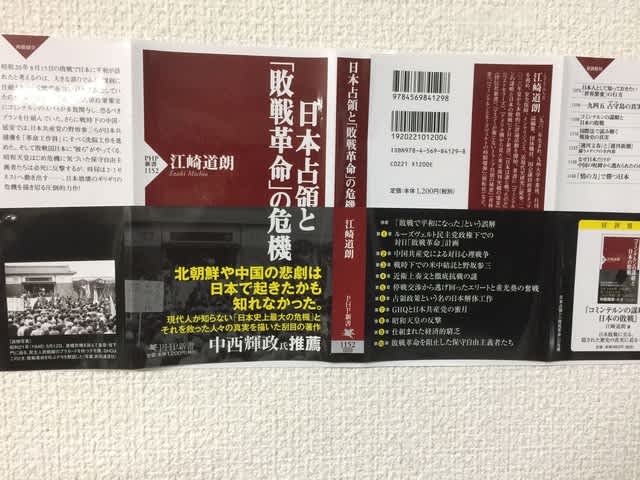
Chinese Communist Information Warfare and How the Fierce Fighting on Iwo Jima and Okinawa Pushed Back the Policy of Unconditional Surrender.
Originally published on July 8, 2019.
Based on Ezaki Michio’s historically important work, this essay discusses the “dualistic theory” at the core of Chinese Communist information warfare against Japan, a theory that divides government from the people and casts the people as right and the government as wrong, while also examining problems in Japan’s postwar media environment that follow from the same logic.
It further clarifies the historical significance of the fierce resistance by Japanese soldiers and civilians on Iwo Jima and Okinawa, arguing that it pushed back America’s policy of unconditional surrender and profoundly affected plans for the invasion of the Japanese mainland and the policy for ending the war.
2019-07-08
The core of the information warfare activities carried out by the Chinese Communist forces against Japan was the theory of division, also adopted by the United States, distinguishing between the government and the people, declaring the people right and the government wrong.
The following work by Ezaki Michio is a historically important masterpiece.
It would be no exaggeration to say that unless one reads this book, one cannot understand Japan from the postwar era down to the present day.
The core of the information warfare activities carried out by the Chinese Communist forces against Japan was the theory of division, also adopted by the United States, distinguishing between the government and the people, declaring the people right and the government wrong.
This morning, when I said to a friend who is one of the most voracious readers I know, “The behavior of media such as Asahi and NHK means that this brainwashing is still continuing even now,” he replied, “No, it means they are now specializing in it.”
The following is from page 216, but unless I introduce the previous chapter as well, the full meaning of what this chapter makes clear may not be fully understood, so please do purchase it at your nearest bookstore.
This chapter is required reading for the Japanese people, and especially for the people of Okinawa Prefecture.
The Fierce Fighting on Iwo Jima and Okinawa Pushed Back the Policy of Unconditional Surrender.
Had things continued in this way, in opposition to the United States, which insisted on maintaining the policy of unconditional surrender, Japan too might have clung to total resistance and cooperation with the Soviet Union, moving in the direction of Soviet entry into the war against Japan and then a defeat revolution in Japan.
What broke through this crisis was precisely the fierce fighting of Japan’s soldiers and civilians on Iwo Jima, Okinawa, and elsewhere.
Iwo Jima and Okinawa were crucial objectives whose capture would determine the success or failure of the U.S. plan to invade the Japanese mainland, scheduled for the autumn of 1945.
Yet in these two battles the U.S. military encountered the stubborn resistance of the Japanese forces, continued desperate fighting over every inch of ground, and was forced to suffer enormous casualties.
On Iwo Jima, where U.S. landings began on February 19, immediately after the Yalta Conference, the Japanese forces led by Lieutenant General Kuribayashi Tadamichi met them after fortifying the entire island of Iwo Jima, about 22 square kilometers in area.
It is said that even U.S. Marine commanders famed for their toughness were struck with amazement when they saw the thorough preparations of the Japanese military in aerial reconnaissance photographs.
The U.S. military, which had planned to occupy the island within five days of the start of the operation, ended up fighting a deadly battle for more than a month.
The approximately twenty thousand Japanese troops on the defensive side were almost completely annihilated, but the number of U.S. casualties on the attacking side exceeded those of the Japanese.
The Japanese military thoroughly forced the U.S. military to bleed.
The Battle of Okinawa too was a fierce battle that British Prime Minister Winston Churchill described as “the fiercest and most famous battle in military history,” and fighting continued for nearly four months, from April 1, when U.S. forces landed on Okinawa’s main island, with the landing on the Kerama Islands having taken place on March 26, until June 22.
During that time, Lieutenant General Simon B. Buckner, the supreme Allied commander in the Battle of Okinawa, was also killed in action.
Among other things, it is said that the number of U.S. officers killed in action was so great that there was not even time to remember the names of newly assigned officers.
In particular, the “Battle of Kakazu,” a fight in the early stage of the battle for Shuri, was a battle in which the Japanese army held the hilly ground called Kakazu Heights near Futenma for sixteen days beginning on April 8, and according to one theory inflicted about 24,000 casualties on the U.S. side, though there are various views.
In the battles of Iwo Jima, Okinawa, and elsewhere, facing the brave and stubborn resistance of the Japanese forces and suffering many casualties, stronger voices emerged among U.S. military leaders calling for a “review of the demand for unconditional surrender.”
“The battle of Okinawa ended once again in an overwhelming American victory.
Japan’s army units were annihilated, and hundreds of aircraft and even giant battleships of the Imperial Navy were destroyed.
But when the operation ended, there were hardly any Americans who had taken part in the fighting who felt even the slightest elation.
Before the mission that still lay ahead of them, what they felt above all was anxiety and fear.
If it is this difficult to secure a single base in the Ryukyus, then how ferocious will an invasion of the Japanese mainland be?”
Particularly in Okinawa, because the military, officials, and civilians, that is, not only soldiers but also bureaucrats and civilians, resisted as one, it came to be expected that in the mainland landing operation there would be fierce resistance not only from the Japanese military but from civilians as well.
Shōji Junichirō, a specialist in war history research, also pointed out the following at the Fiscal Year 2015 International Forum on War History, hosted by the National Institute for Defense Studies of the Ministry of Defense.
“For the United States, despite the fact that Japan’s preparations for the decisive battle on the mainland were incomplete and poor in this way, as the invasion of the Japanese mainland, Operation Downfall, drew near, the greatest problem became the human losses that might arise.
That is, the enormous remaining forces and the anticipated gyokusai attacks were a threat, and in addition, the experience of having been forced into difficult fighting by Japanese resistance on Iwo Jima and Okinawa, in both of which it is said that around 35 percent of the U.S. forces committed became casualties, was of great weight.
For example, on June 18, 1945, President Harry S. Truman convened a meeting at the White House to consider the implementation of the mainland invasion operation and its human losses.
At the meeting, views were divided particularly over the estimate of casualties from the landing operation.
William D. Leahy, Chief of Staff to the Commander in Chief of the Army and Navy, and others estimated that the casualty rate in the Battle of Okinawa had been about 35 percent, and that roughly similar sacrifices would arise in an invasion of the mainland, and therefore they were not enthusiastic about the landing operation and argued for easing the terms of unconditional surrender in order to reduce the sacrifices.”
As of February 1945, within the U.S. government the “Weak Japan faction,” which insisted on unconditional surrender to the very end, had been dominant, but as a result of Japan’s desperate fighting at Iwo Jima and in the Battle of Okinawa, it is said that voices calling for easing unconditional surrender became dominant among U.S. military leaders.
In present-day Japan, there are commentators who coldly declare that Japanese soldiers who died in the battles of Okinawa, Iwo Jima, Peleliu, and so on died “meaningless deaths.”
But if one looks at the influence these battles had on the U.S. military and on the Truman administration, that is completely mistaken.
As the American side itself has acknowledged, the brave and gallant fighting on Okinawa and Iwo Jima greatly pushed back America’s policy of unconditional surrender.
To be continued.