The Pathology of the Asahi Shimbun | Suppression of Speech and False Reporting by a Newspaper Eager to Portray the Japanese as Ugly
Published on October 17, 2019.
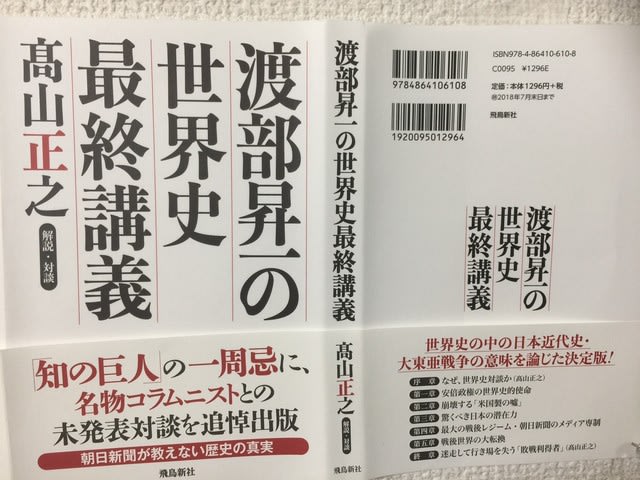
This article introduces the final chapter of a dialogue between Masayuki Takayama and Shoichi Watanabe, criticizing the postwar media structure of GHQ, the Asahi Shimbun, NHK, the foreign press club, suppression of speech, false reporting on poison gas, Moritomo coverage, the coral graffiti incident, and the “oshibori” advertisement controversy as symptoms of the pathology of Japan’s postwar media and the “beneficiaries of defeat.”
October 17, 2019.
If it were a newspaper company, the common-sense reaction would be to write that this was a great mistake and that there is no Japanese person who would not understand what an oshibori is.
Do they want so badly to portray the Japanese as ugly?
This, too, is the pathology of the Asahi.
I am republishing the chapter I sent out on May 17, 2019, under the title: Instead of correcting the story by saying, “It was not poison gas,” they escaped with an evasive correction, saying, “The location of the operation was wrong.”
I reread the following book because I thought there must have been parts I had left unread, and this is a book that not only the Japanese people but people all over the world must read.
It is no exaggeration to say that without reading this book, we cannot understand the facts of the prewar, wartime, and postwar periods at all.
This is an astonishing book.
Masayuki Takayama, the one and only journalist in the postwar world, held a dialogue one year before the passing of Shoichi Watanabe, who was the finest and greatest genuine scholar and intellectual in postwar Japan.
It is no exaggeration to say that the content and weight of that dialogue make this the greatest book of the postwar period.
In Masayuki Takayama’s commentary in the final chapter below… for example… he shows that the suspicions I have repeatedly expressed about the organization called the Foreign Correspondents’ Club were entirely correct… and at the same time… he explains the origin of this organization.
Masayuki Takayama teaches the Japanese people, for the first time, clearly and perfectly.
He also makes perfectly clear and teaches us the correctness of my criticism of NHK and the reason for NHK’s behavior.
I think deeply and repeatedly.
Masayuki Takayama, in every possible sense, is worthy of the Nobel Prize in Literature or the Nobel Peace Prize.
To respond to the work of this one and only figure in the postwar world… that, I am convinced, is our natural courtesy.
Readers will think, in many places, that Masayuki Takayama and I are like twins.
Final Chapter: The “Beneficiaries of Defeat” Who Wander Aimlessly and Lose Their Way — Masayuki Takayama.
“You dare defy the Asahi? We will crush you.”
Now that the dialogue is over, there is something I must explain.
Why do the mainstream media, with the Asahi at their head, behave as if they were censors of speech and try to bury thinkers who are an eyesore to them?
At the origin of that arrogance and conceit lies the fact that, after the war, they were given by the United States the role of pursuing the guilt of Japan’s war of aggression and atrocities.
As long as they treated Japan as unconditionally evil, it was the same as being given great power to write history however they pleased.
Shoichi Watanabe’s early choice of historical views as his main battlefield, and his nearly half-century-long struggle against the “beneficiaries of defeat,” was truly farsighted.
Immediately after the defeat, even the Asahi was decent.
It had Ichiro Hatoyama write an essay pointing out the inhumanity of the atomic bomb, but GHQ banned publication of the Asahi and threatened it, saying that the next time would mean its abolition, and the Asahi easily gave in.
GHQ made the Asahi its foremost underling.
At the time, GHQ had no interest in other newspapers.
In order to make newspapers write tall tales such as massacres by the Japanese Army and the Bataan Death March, there was first the precedent of restricting paper allocations to newspaper companies.
When Britain ruled Burma, it first made paper a monopoly and allowed it to be sold only through Christian churches.
As a result, the Burmese, most of whom were Buddhists, could no longer obtain paper, and resistance activities also stagnated.
Controlling the means of communication is a basic principle of colonial rule.
In postwar Japan as well, newspapers were allowed only a single sheet, but when GHQ had them run the serial “The Pacific War” and used them for propaganda, only then were extra pages permitted, meaning two sheets and four pages.
That is how newspapers were controlled.
Just as it did with the Asahi, GHQ also made NHK into a tool for deceiving the Japanese people.
Many GHQ staff members entered the NHK building in Tamuracho, now Uchisaiwaicho, and gave orders.
Because it was too cramped, GHQ planned to move NHK to the former site of the Azabu Third Infantry Regiment, now the National Art Center, Tokyo, have the Stars and Stripes newspaper company occupy the same site, and turn it into a Japanese-language broadcasting station directly run by GHQ.
However, the Korean War broke out, the plan was suspended, and NHK moved to Yoyogi.
The reason the United States valued the Asahi so highly, as touched upon in the dialogue, was its close relationship with Allen Dulles, a founding member of the OSS, which later became the CIA.
Both Taketora Ogata, a former vice president and chief editorial writer of the Asahi who had entered politics, and Shintaro Ryu, the chief editorial writer, had deep connections with Dulles.
As shown by the example of the 1960 Security Treaty protests, a system had been established to control newspapers and public opinion by using the Asahi.
GHQ also created a foreign correspondents’ club in order to manipulate Japanese public opinion.
When a politician GHQ disliked appeared, this club would create “international public opinion” and have the Asahi and NHK purge him.
In Mark Gayn’s Japan Diary, there is a passage describing how, at GHQ’s direction, Ichiro Hatoyama was summoned to a luncheon of the foreign correspondents’ club and was subjected to a denunciation by the correspondents.
The Asahi took this up, attacked Ichiro Hatoyama, and politically buried him.
Even after GHQ disappeared, this system survived.
In the money scandal involving Kakuei Tanaka, the foreign correspondents’ club invited Tanaka to a luncheon and launched a full-scale attack on him.
Seeing this, the Japanese newspapers, which until then had not taken up the matter even though Bungei Shunju had reported it, all followed at once, and Tanaka was driven to resign.
The following Lockheed scandal had exactly the same structure.
Because this postwar system existed, the authority of the Asahi appeared unshakable.
Thus pressure came to be applied to censor the claims of writers the Asahi disliked and to crush them with the power of the Asahi.
As touched upon in the dialogue, Professor Watanabe’s long battle with the Asahi began when the newspaper created pages based on a fictitious dispute with Kyojin Onishi.
Why was Professor Watanabe targeted?
Because he argued things the Asahi Shimbun did not want to hear.
There had been similar cases even before that.
For example, Michio Takeyama, known for The Burmese Harp, was the only one among five intellectuals whose opinions were introduced on the Asahi’s society page in 1968 regarding the visit of the U.S. aircraft carrier Enterprise to Sasebo to express support for the visit.
In response, emotional letters of denunciation, incited by the Asahi, flooded in and were published one after another in the “Voices” column.
While more than 250 letters of criticism arrived at the Tokyo head office alone, the Asahi rejected Takeyama’s counter-rebuttal and ended the dispute in a way that cut off dialogue.
The editor of the Asahi’s “Voices” column insisted in the magazine Shokun! at the time that it was common everywhere for those in charge to choose which letters to publish according to their judgment.
By beating down Michio Takeyama, the Asahi exuded the arrogance of saying, “We will make you understand what happens if you do not listen to the Asahi.”
The Asahi Shimbun has a mindset that does not permit anyone to defy it.
That characteristic has continued unchanged to the present.
Speaking personally, the beginning of my connection with the Asahi was when I raised an objection in 1981 regarding the All Nippon Airways crash off Haneda that occurred in 1966.
That accident had been almost settled as pilot error, but the Asahi supported the theory of a structural defect in the aircraft and made a fuss, and in the end the accident investigation committee was overwhelmed by the Asahi and declared the cause unknown.
However, when I became the aviation reporter and listened to various accounts, most of the veteran pilots said that it was pilot error caused by the pilot’s inability to master the performance of the Boeing 727.
When I wrote an article to that effect in an ANA-related magazine, a reporter from the Asahi came to interview me and then, in the top article on the general news page, attacked me and the ANA people I had interviewed by name, saying that we had insolently offered an opinion denying the aircraft defect theory asserted by the Asahi.
What is wrong with telling the truth?
I was astonished by the Asahi’s attitude of not permitting dissent, but ANA also found it unbearable to be attacked by the Asahi.
Several people in responsible positions connected with the matter were punished with salary cuts, showing submission to the Asahi.
The Asahi has no hesitation in using its pages to show its attitude: “I will not permit anyone to object to what I have written.”
I was surprised that even ANA apologized and imposed salary-cut reprimands.
Why on earth is it not permitted even to advocate a theory different from the Asahi’s?
This, too, is the same structure of speech suppression as the one in which Professor Shoichi Watanabe was targeted.
A little later, I became a desk editor in the society section.
Then the Asahi’s front-page poison gas article, which we also discussed in the dialogue, appeared.
At that time, society reporter Mizuho Ishikawa brought me a manuscript saying, “That was not poison gas but smoke screen,” so I published it prominently as the top article on the society page.
The next day, the Asahi department manager in charge came storming in and shouted at us, and I was surprised again.
Normally, when an error in an article is pointed out, the attitude of a reporter or editor should be to thoroughly reinvestigate, thinking that there may have been a mistake.
Even by common sense, poison gas does not rise up into the sky.
The first poison gas used was called yperite.
It is another name for mustard gas, first used near the village of Ypres in Belgium.
On the deadlocked Western Front, when the wind was blowing toward the Allied side, the lid of the cylinder was opened, and this yperite crawled along the ground and flowed into the trenches of the enemy position.
That is how the soldiers inside the enemy trenches died.
It is called mustard gas because its smell resembles mustard and because its color is somewhat yellow.
As I also touched upon in the dialogue, in 1986, when I was Tehran bureau chief, I actually saw such wounded soldiers in an Iranian field hospital, and I thought it was a ghastly sight.
I told Department Manager Satake, who was in charge, that a newspaper reporter should at least know that poison gas crawls along the ground, and should realize that it does not drift through the air and that killing crows would make no sense.
Then he came back with, “You, a mere Sankei man, dare defy the Asahi?” and “We will crush Sankei.”
Who on earth did he think he was?
Apparently, one must not question the Asahi’s reporting, and one must not go against the thinking of “the great Asahi.”
I was astonished by his extremely conceited attitude.
After that, Mizuho Ishikawa also found the source of the photograph and reported it, and in the end, several days later, the Asahi was forced to publish a correction.
But instead of correcting the story by saying, “It was not poison gas,” it escaped with an evasive correction, saying, “The location of the operation was wrong.”
This way of escaping is exactly like the excuse the Asahi recently gave in its Moritomo Gakuen reporting when it reported “Kaisei Elementary School” as “Shinzo Abe Elementary School.”
“Because the school name and other details were initially blacked out, the Asahi Shimbun reported in its morning edition of May 9, based on interviews with Mr. Kagoike, that Mr. Kagoike had submitted a statement of purpose bearing the school name ‘Shinzo Abe Memorial Elementary School’ to the Kinki Local Finance Bureau of the Ministry of Finance.” November 25, 2017.
Although it had made a mistake, it neither corrected nor apologized.
No matter what false report there may be, pointing out an error in what the Asahi has written is not permitted, and the Asahi flies into a rage.
It is arrogance and a sense of privilege that would normally be unthinkable.
Come to think of it, there was a reporter who had joined the company at the same time as I did and who, before I knew it, had moved to the Asahi.
Around the time I moved from a local bureau to the society section, I met him at some scene and called out to him.
He glared at me and said, “I am now a reporter for the Asahi Shimbun. Address me with ‘san.’”
He spoke as if to say that he was now of a different rank from me.
Asahi people openly displayed this sense of privilege even among newspaper companies, as if to say that Asahi people were chosen journalists and different from the rest of us.
The pathology of wanting to write endlessly about how hopeless Japan is.
What the Asahi Shimbun has actually done is to emphasize the ugliness of the Japanese and write that this people is rotten at its very core.
As typically shown in the coral graffiti incident, after writing graffiti itself, it wrote, “It will surely become a monument to the Japanese. The poverty of spirit, the desolate heart that can instantly damage something that has grown over centuries and feel no shame…”
It gleefully criticized how hopeless the Japanese were, as a people poor in spirit and shameless.
There is a commercial called “The Japanese,” created by Norway’s Braathens Airline, now Scandinavian Airlines, which won a gold award at the 1999 Cannes International Advertising Festival.
The content shows Japanese passengers nervously boarding an airplane, picking up something wrapped in a plastic bag from the in-flight meal, thinking it is an oshibori, wiping their faces with it, and ending up smeared with peanut butter.
The scene changes, and when a real oshibori is served next, they mistakenly assume it is a sweet and decline it, saying, “I am full now.”
It is a story in which Japanese passengers, unused to flying, look around at the people around them and ultimately fail.
The oshibori used in in-flight service is a Japanese custom.
Norwegians and others did not even know to wipe their hands.
An airline company of Norwegians who, when given an oshibori, seemed to wonder whether they should wipe their shoes with it, had recently begun offering oshibori themselves.
They were so pleased with this that they created the work thinking that Japanese people would not yet know about it.
The Asahi writes, full of masochistic taste, that Japanese people are viewed by foreigners in this shameful way.
If it were a newspaper company, the common-sense reaction would be to write that this was a great mistake and that there is no Japanese person who would not understand what an oshibori is.
Do they want so badly to portray the Japanese as ugly?
This, too, is the pathology of the Asahi.