China’s Thousand Talents Plan and the Struggle for Technological Supremacy—ECRA, Secret Patents, the Semiconductor Industry, and Japan’s Failure to Protect Intellectual Property
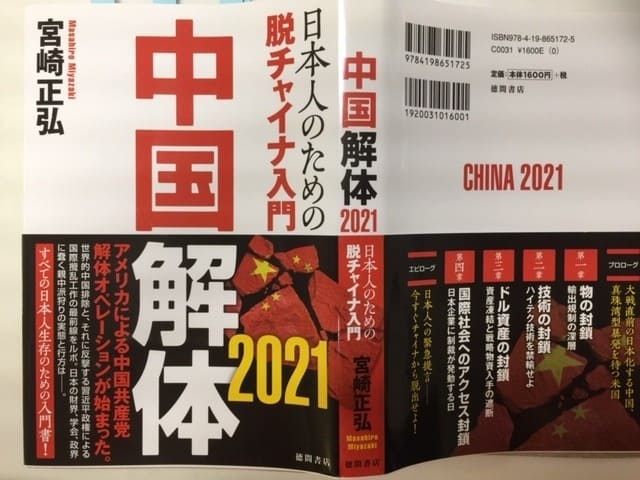
This article presents an excerpt from the prologue to Masahiro Miyazaki’s China’s Disintegration 2021: A Guide for Japanese People to Decoupling from China, examining China’s Thousand Talents Plan, ECRA, the U.S.–China struggle over 5G and AI, Japan’s lack of an anti-espionage law and secret-patent system, and the decline of Japan’s semiconductor industry.
December 31, 2020
The following is an excerpt from the prologue to the book named below.
It is essential reading not only for the Japanese people but for people throughout the world.
The “Thousand Talents Plan”—A Technology-Theft Program
COCOM was a system of controls that prohibited the export of military technology to the Soviet Union during the Cold War.
It did not simply disappear with the collapse of the Soviet Union.
Strictly speaking, there was also CHINCOM—the China Committee—which was established in 1952 to control exports to China, although it had become ineffective.
Under ECRA, which emerged as a “second COCOM,” China became the principal adversary.
Japanese companies remained complacent and took no countermeasures.
Approximately 800 Japanese companies conduct business with Chinese corporations included on the blacklist.
Sooner or later, an incident comparable to a “second Toshiba–COCOM scandal” will probably occur.
The Trump administration’s publicly stated purpose was to protect intellectual property, eliminate industrial espionage, and thwart China’s Thousand Talents Plan, through which China recruited talented people—primarily those of Chinese origin—from Silicon Valley, Harvard University, and elsewhere.
The greatest motivation behind ECRA was the anxiety and urgency produced by the reality that the United States was falling behind China in the development of 5G—the fifth-generation mobile communications system—and AI, which would become core technologies of the next high-tech era.
If 5G communications networks were established under Chinese leadership, the United States could lose its technological supremacy.
While focusing on China’s lead in 5G development, the United States announced the development of the next generation beyond it, 6G, and excluded Huawei from international standardization meetings.
At the same time, it strengthened covert investigations and began full-scale operations to prevent Chinese spies from stealing advanced technology.
A symbolic incident concerning the Thousand Talents Plan occurred on December 1, 2018, when the United States had the Canadian authorities detain Huawei CFO Meng Wanzhou on the grounds that she had been involved in unlawful exports to Iran.
On January 28, 2020, Harvard University professor Charles Lieber was arrested and charged over conduct described as serving China’s interests as its agent.
Professor Lieber had entered into a secret contract with the Wuhan University of Technology and was separately receiving a monthly payment of 50,000 dollars.
He was deeply involved in China’s Thousand Talents Plan.
Shoucheng Zhang, a Stanford University professor who had reportedly been under investigation, died in what was described as a mysterious “suicide” in San Francisco on the same day that Huawei’s CFO was arrested.
These two incidents revealed the overall structure of China’s Thousand Talents Plan.
The Thousand Talents Plan recruits people with specialist knowledge from overseas so that they can be used in Chinese research projects.
Officials associated with the FBI and other U.S. agencies described it as a “technology-theft program” and continued their investigations.
The targets of the Thousand Talents Plan included researchers employed by overseas companies and universities, research personnel, and executives responsible for patents.
There were two programs, one for Chinese nationals and another for foreign nationals.
Universities, research institutes, laboratories, and other organizations conducting joint research and development projects with the U.S. National Institutes of Health were located in 59 American cities and had been allocated 164 million dollars in research-and-development funding.
It was reported that 399 researchers were involved in vaccine development and other fields, of whom 133 were under investigation by the authorities (“Asia Times,” June 20, 2020).
Some people expressed regret, saying that conducting joint research with China had itself been a mistake.
In reality, however, many laboratory personnel were cooperating with China without fully understanding what they were doing.
Could this be described as a “hunt for brains,” comparable to the “organ harvesting” at which the Chinese government is said to excel?
Japan’s Intellectual-Property Protection Is Full of Loopholes
Japan is a particularly serious problem.
Unlike the United States and European countries, Japan has no comprehensive anti-espionage law.
[Addition by Mikio Kisara on December 31, 2020]
When an attempt was made in an earlier year to enact legislation modeled on such a law, it was the Asahi Shimbun and other left-wing figures who called for opposition to an anti-espionage law.
The fact that Shinsugok was one of the leading opponents and moved to Germany at about the same time as the legislation was enacted was, in the author’s opinion at the time, almost as though she had demonstrated by her own actions that she was a spy for the Korean Peninsula.
Her name was also said to have appeared in connection with the installation of the comfort-women statue in Berlin’s Mitte district.
The Asahi Shimbun and others gave prominence to such a person, while Shukan Kinyobi, whose president was Takashi Uemura, appointed her as an officer.
In the United States, the author argued, all of them would have been prosecuted.
In China, which they admire, the author argued that their conduct would have been regarded as deserving the death penalty.
[End of addition]
Consequently, the outflow of information from Japan is even more serious than that from the United States.
After accurately interpreting the direction of U.S. policy, members of Japan’s Liberal Democratic Party began discussing the absence of secrecy provisions as a defect in the patent system.
On July 28, 2020, the Liberal Democratic Party’s Parliamentary League for Rule-Making Strategy, chaired by Akira Amari, began considering whether Japan could regulate TikTok, the Chinese short-video posting application.
Following India, the United States also moved to prohibit the application because of concerns that personal information could be leaked to China.
There is also the problem of Japan’s patent system.
In Japan, the complete contents of a patent application are published in the Patent Gazette eighteen months after the application is filed.
Because the Patent Gazette is a public document, translating it into Chinese on the very day of publication is not illegal.
Under U.S. patent law, military technology classified at the highest level of secrecy can be treated as a secret patent.
It is also commonly referred to here as a “submarine patent.”
The relevant LDP committee also began discussing a secrecy system for patents.
It was already more than thirty-five years ago that the author wrote Japan–U.S. Advanced Patent War, published by Diamond, Inc.
When part of the draft was published in the magazine Jiyu, it was immediately translated into English.
A technical officer from the U.S. Embassy then requested a meeting, carrying a copy of the translation.
Japan’s civilian technologies have broad applications.
For example, autofocus technology developed by Nikon and others, as well as CD-reading technology, became the eyes of cruise missiles.
Sony’s video-camera technology served as a guidance mechanism for precision-guided bombs, while coatings developed by TDK, a manufacturer of magnetic tape for recorders, were adapted for use in stealth aircraft.
The author therefore argued that secrecy provisions should be restored to Japan’s patent system, as they had existed before the war.
Patent-division managers from Ricoh, Mitsubishi Electric, Sanyo Electric, and other companies willingly cooperated with his research.
Immediately after the book was published, he also received requests to lecture from Toyota’s patent headquarters and other organizations.
At Japan–U.S. defense symposiums, the author also repeatedly participated as a panelist and called for the restoration of secrecy provisions to the patent system.
Thirty-five years passed, but no fundamental change occurred.
Japan continued the unrestricted publication of patent information.
What happened during that period?
The United States imposed sanctions on Toshiba for violating COCOM regulations by supplying the Soviet Union with technology that reduced the noise produced by submarine propellers.
The United States supplied next-generation semiconductor technology to South Korea over Japan’s head.
Japan’s semiconductor industry clearly fell behind.
Only a small number of companies, including Renesas Electronics, remained, while the factories producing the most advanced technology shifted to Taiwan and South Korea, represented by TSMC and Samsung.
Until then, the U.S. company Intel had led the field in cutting-edge semiconductors capable of military applications.
Intel constructed a major plant in Israel.
At the strong request of the Trump administration, TSMC announced that it would construct a new factory in Arizona in the United States.
The effort to regain supremacy in semiconductors had begun in earnest.
Why was Japan left behind?
In addition to the vulnerability of its disease-control system, did the answer not also lie in defects within its patent system?
To be continued.
Source: Masahiro Miyazaki, China’s Disintegration 2021: A Guide for Japanese People to Decoupling from China, Tokuma Shoten, 2020.