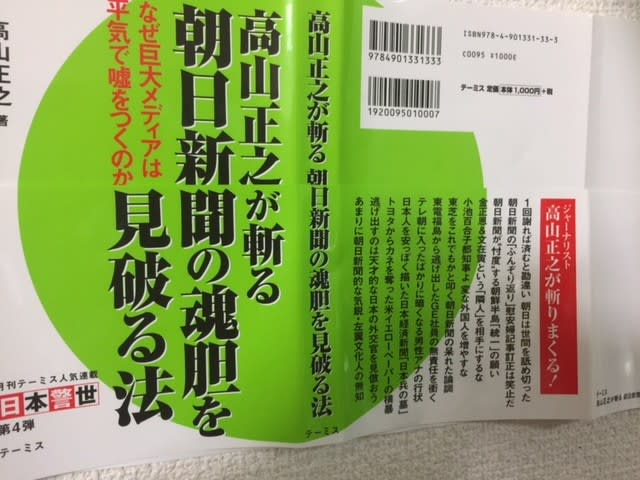
Why Does Japan Still Tolerate Pachinko When Even South Korea Banned It?—Masayuki Takayama’s Scathing Indictment of The Asahi Shimbun, Naoto Kan, and Zainichi Interests—
Written on June 5, 2019, this piece draws on an excerpt from Masayuki Takayama’s book How to See Through The Asahi Shimbun’s Schemes to expose the absurdity of Japan’s continued tolerance of pachinko, even though South Korea itself imposed a sweeping ban.
It sharply indicts The Asahi Shimbun’s coverage, the foreign donation scandal involving Naoto Kan, the financial interests tied to Zainichi operators and the Korean Peninsula, and the social reality seen in Japan immediately after 3/11.
2019-06-05
In June 2008, because the harmful effects had become far too great, Roh Moo-hyun issued a ban on pachinko and took the drastic measure of shutting down 15,000 parlors across the country.
Readers who, in response to my recommendation, purchased at their nearest bookstore Masayuki Takayama’s book Takayama Masayuki Strikes: How to See Through The Asahi Shimbun’s Schemes have likely offered the author the deepest possible gratitude, and probably feel at least some gratitude toward me as the one who recommended it as well.
All emphasis in the text, except for the headings, is mine.
Arrest Naoto Kan for bribery for defending “pachinko parlors”
The Asahi Shimbun swapped out the foreign donation scandal that had already been exposed just before 3/11
Mahjong tables and hanafuda in the press club
For some reason, hanafuda tends to carry a negative image.
But in fact, it has a rather elegant charm.
The images of pine for January and plum blossoms for February have deep meanings behind them.
Take April, for example.
It depicts irises and a bridge crossing a pond.
This refers to the iris pond at Yatsuhashi in Chiryu City, Aichi Prefecture, where a princess who had pursued Ariwara no Narihira threw herself in, and where kakitsubata irises, preserving her beautiful form, bloom luxuriantly in spring.
Narihira also composed a poem weaving in the word kakitsubata: “Karakoromo / kitsutsu narenishi / tsuma shi areba…”
September is chrysanthemums and a sake cup.
This comes from the Choyo banquet on September 9, when chrysanthemum flowers were floated in cups in prayer for longevity.
October is maple leaves and a deer.
It depicts Sarumaru Dayu’s poem, “Okuyama ni / momiji fumiwake / naku shika no…,” but from the design in which the deer looks away, shikato became more famous than the poem itself.
November shows a rain-soaked willow, a frog, and Ono no Michikaze.
When still young, Ono no Michikaze, who would later become one of the Three Great Calligraphers, was on the verge of giving up.
At that time, he was inspired by the sight of a frog striving with all its might to leap onto a willow branch.
There are many expressions derived from hanafuda, like shikato.
Calling venison “momiji” is one of them, and calling horse meat “sakura meat” is said to come from the dodoitsu verse, “Why tie a horse to blooming cherry blossoms? / If the horse grows lively, the blossoms will scatter.”
Based on such designs, people enjoy koi-koi by collecting red poetry ribbons, blue ribbons, boar-deer-butterfly, and bright cards such as pine, cherry blossom, pampas grass, and paulownia.
It has now faded away, but in old press clubs, mahjong tables, hanafuda cards, and rice bowls were naturally kept on hand as a matter of course.
If only one person was idle, he would read the newspaper.
If there were two, they would put a cushion between them and scatter hanafuda cards.
That was the scenery of the club.
Nintendo’s hanafuda became a hit in South Korea
It was perhaps two generations ago that I learned that those hanafuda cards had an international reach.
When Nintendo’s Wii became a worldwide hit, a Korean newspaper wrote, “We Koreans raised Nintendo into what it is today.”
At first, I thought this was one of those absurd boasts of the “We made Japanese swords” variety.
But it was not.
In its early days, Nintendo exported hanafuda cards to Korea, and they became an explosive hit there.
They call them “Hwatu,” and now they have arbitrarily rewritten the red poetry ribbon’s “aka yoroshi” in Hangul, replaced the plum blossom’s bush warbler with a magpie, and dressed Ono no Michikaze in their own unsightly clothes.
In other words, the point of the article was that hanafuda spread in Korea both in homes and in workplaces, making Nintendo a great deal of money.
The claim is that thanks to those sales, the foundation was laid for the Nintendo that is now a global video game company.
The tone is patronizing, but apparently it is not an exaggeration.
Once they start playing, they wear the cards out in a single night, and unable to wait until dawn, they go buy new ones at a 24-hour convenience store.
Even now, that still amounts to fairly substantial sales, it seems.
As can be seen from the current anti-Japan agitation as well, they pursue everything to the very end.
About half of them are Christians, and even their Masses are pursued to the extreme.
The words of prayer eventually become screams that shake the church like rumbling earth, and they fall into fainting and frenzy.
There are countless sects, including branches such as the Unification Church, and among them are groups that actually train in the mountains.
And yet it was South Korea that banned pachinko
Believers cling to standing trees and pray, losing themselves, and in the end they shake down trees so large they can barely be encircled by the arms.
One reason the mountains of Korea, which Japan planted with trees, are becoming barren again is that these churches are partly to blame.
Into such a people, so obsessive by nature, there came from Japan pachinko, which has even more of a gambling character than hanafuda.
Even Japanese, who are still more restrained than they are, have not ceased producing tragedies of family collapse, such as locking their own children in the house and starving them to death, leaving them behind in sweltering cars to roast to death, or falling into a debt hell and driving housewives into prostitution.
There is no way a people so given to obsession that they shake down standing trees would not become addicted to it.
Because of pachinko alone, simply because they had run out of money, people commit murder and commit robbery.
In June 2008, because the harmful effects had become far too great, Roh Moo-hyun issued a ban on pachinko and took the drastic measure of shutting down 15,000 parlors across the country.
This too was a fact that we, who had subscribed to The Asahi Shimbun and watched its television stations and NHK, knew absolutely nothing about.
He was that president who had undergone that eye-popping cosmetic surgery.
Even so, there are people who still cannot forget pachinko.
“Five hundred thousand Koreans come to Fukuoka every year for that purpose,” The Asahi Shimbun reported on March 3 of last year.
Of Japan’s pachinko parlors, 90 percent are run by Zainichi Koreans, and the remaining 10 percent by naturalized former Zainichi, generating annual sales of 20 trillion yen, with some percentage sent through Mindan and Chongryon to Park Geun-hye and Kim Jong-un.
Pachinko is not officially gambling on the surface, but cash can be obtained through prize exchange shops.
It is open gambling, and on top of that it creates addiction, ruins lives, and breeds crime.
It is hard to accept that Japan leaves pachinko untouched when even sloppy South Korea banned it, and that it enriches Zainichi interests as well as North and South Korea.
Then 3/11 happened.
While all of Japan was conserving electricity and mourning, in front of train stations flashy illuminations blazed on, and loud public gambling continued openly.
The Asahi Shimbun defends pachinko
At that point, Shintaro Ishihara said that pachinko should be crushed.
The only ones who would be troubled by that were loafers living off welfare and addicted Koreans flying in from Seoul.
It was truly the perfect chance to crush it.
And yet the Kan administration at the time rejected that proposal.
It had been exposed just before 3/11 that Kan had been receiving political donations from Korean pachinko operators.
Out of gratitude for that, Kan turned to defending pachinko.
This is what is called bribery, and yet the prosecutors did not even indict him.
The Asahi Shimbun, too, immediately gave a full page to a trade paper reporter and had him lie that “pachinko parlors were closed in Korea because of corruption.”
Furthermore, it had Professor Naoko Takiguchi of Otani University say that since it was an industry employing 300,000 people, “a ban would be difficult from the standpoint of employment.”
Scholars who speak to suit The Asahi’s convenience are as ugly as they look.
Does The Asahi defend it this far because its president Kimura Nobukazu has received even more than Kan?
(March 2014 issue)