Why Does the Mass Media’s Absurd Uproar Keep Repeating? — From Prewar War Agitation to Nanjing and the Textbook Misreporting
Published on January 18, 2020.
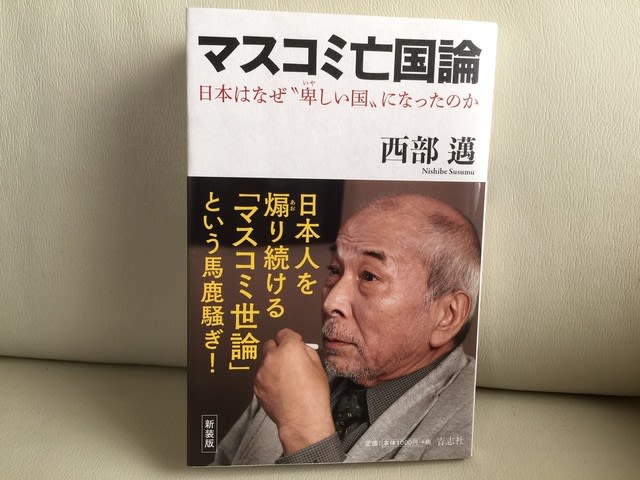
Drawing from the late Susumu Nishibe’s Mass Media Ruins the Nation, this article discusses the history of excessive reporting, distorted reporting, and false reporting by the mass media. Through the Manchurian Incident, Saitō Takao’s anti-military speech, the 1960 U.S.-Japan Security Treaty protests, the Nanjing Massacre reporting, and the textbook controversy, it criticizes the structure by which the media fails to reflect on its own agitation and misinformation and repeatedly creates the same absurd uproars.
January 18, 2020
However, while some major newspapers carried out campaigns criticizing the “massacre,” they have never clearly admitted that it was their own excessive reporting.
The following is from the late Susumu Nishibe’s book Mass Media Ruins the Nation.
Every Japanese citizen who can read printed text must immediately go to the nearest bookstore and purchase it.
People around the world will learn, through my translation, that the mass media in your own countries are the same.
Why Does the Mass Media’s Tremendous Absurd Uproar Keep Repeating?
If a rule-breaking absurd uproar by the mass media had occurred for the first time, then one would have to say that it was unavoidable for the public to get swept along with it.
However, if one looks even briefly into Japan’s modern history, one finds that absurd uproars by the mass media, and uproars that, after only a short time, left everyone at a complete loss as to what the commotion had been for, have occurred again and again.
For example, at the time of the Manchurian Incident, every newspaper cheered the advance of the Japanese Army.
I am neither an “antiwar” nor an “anti-militarist” ideologue, so I do not mean to say that war is generally evil.
In any case, however, it is an undeniable fact that the mass media stirred up war.
Or, when Representative Saitō Takao delivered his anti-military speech while standing completely alone, it was also the mass media that joined the military in clamoring to drive him out of the Diet.
Thus, even a brief look at prewar history makes it impossible to think that the war was brought about merely by the arrogance or schemes of some military men.
There are countless cases in which the mass media played an important role as a group that incited war, and then subjected liberal-minded people who opposed it to collective lynching one after another, burying them.
The mass media has almost completely wiped its mouth clean regarding that fact.
The postwar period is no exception.
To use my own case as an example, when I was around twenty, as the youngest leader among the left-wing radicals who opposed the 1960 revision of the U.S.-Japan Security Treaty, I was arrested by the police and went to court.
After that, by thinking and judging for myself, I reached the conclusion that the revision of the U.S.-Japan Security Treaty was legitimate from Japan’s standpoint, and that neither left-wing theory nor left-wing action possessed legitimacy.
I also expressed that in writing.
At that time, the mass media, to a greater or lesser extent, also carried out campaigns criticizing the 1960 Security Treaty.
However, even after the historical assessment that the 1960 Security Treaty was, rather, beneficial to the Japanese state and the Japanese people had become established in Japanese society, the mass media showed no sign of reflecting on its own words and actions.
There is no end to examples of excessive reporting or distorted reporting by the mass media in the postwar period.
There are also many books that have criticized this.
For example, the so-called Nanjing Massacre, in which the Japanese Army is said to have massacred 300,000 Chinese people, now appears to have been fabricated, or at the very least, it can no longer be denied that this possibility is strong.
However, while some major newspapers carried out campaigns criticizing the “massacre,” they have never clearly admitted that it was their own excessive reporting.
They do not even make that a subject of discussion.
A recent example is the so-called textbook issue.
The mass media reported that in Japanese textbooks, the expression “invasion” had been rewritten as “advance.”
That triggered criticism of Japan by the Chinese government, and in response, a Japanese minister apologized.
Immediately afterward, when the matter was carefully investigated, it became clear that there had been no fact of “invasion” being rewritten as “advance.”
Nevertheless, except for some newspapers, the mass media refuses to admit that it was their own false report.
In many other cases as well, the mass media made a great uproar, but when the uproar was over, it became clear that it had been nothing more than an absurd commotion, and moreover, one that even included the fabrication of information.
Such cases have accumulated.
This article continues.