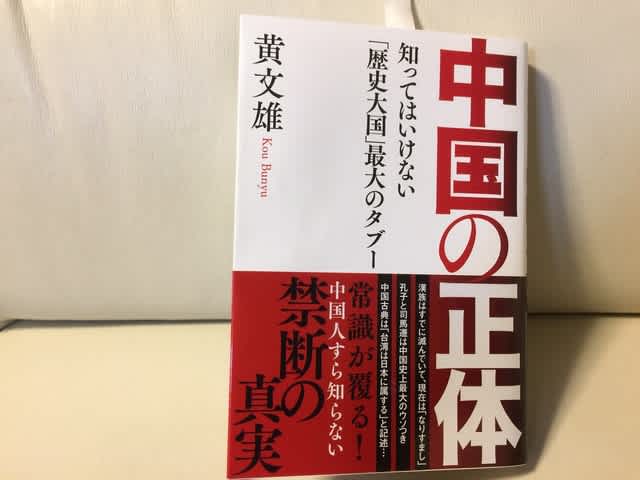
The Chinese World That Expelled Buddhism and a China That Can Rely Only on Physical Force
Published on February 14, 2020.
Based on a work by Kō Bun’yū, this essay discusses how Buddhism was expelled from the Chinese world and how the secular, materialistic teachings of Confucianism and Taoism shaped Chinese civilization.
It further contrasts the values of freedom, democracy, and the rule of law shared by Japan and Taiwan with China’s tendency to rely on “physical force” rather than international order or international law.
2020-02-14
Thus Buddhism was expelled from the Chinese world, secular Taoism spread, and the Chinese, the most secularized people in the world, came into being.
The following is from the work below by Kō Bun’yū, one of the world’s foremost scholars thoroughly versed in China.
It is a book that not only the Japanese people but people all over the world must read.
The preceding passage is omitted.
Thus Buddhism was expelled from the Chinese world, secular Taoism spread, and the Chinese, the most secularized people in the world, came into being.
Of course, behind the spread of Taoism in China lay the existence of Confucianism.
That is because Confucianism, too, is an extremely secular teaching.
As symbolized by the words of Confucius, the founder of Confucianism, who said, “Respect ghosts and spirits, but keep them at a distance,” the Chinese are concerned not with the heart or spirit but only with material things.
Confucians are the most materialistic human group.
That is why, in China, throughout history, a culture and civilization of killing one another was born, in which people fought for life and death over finite resources, to the point that it has been said there was “not a single year without war.”
It may also be said that the spread of such secular and materialistic Confucianism and Taoism became the background that enabled China to accept communism, which is likewise materialist.
On the other hand, as for Buddhism, everyone surely knows that even today China continues to persecute it, beginning with Tibetan Buddhism.
A China That Can Rely Only on “Physical Force”
From a geopolitical standpoint, the “sharing of values” between Japan and Taiwan has as its background the climate born from the unique culture and civilization of island and maritime Asia, the Asia of the sea; furthermore, it also includes the sharing of the values of “modernization” and “freedom and democracy.”
If we gather together the claims made by Chinese opinion leaders in recent years, they can mainly be summarized in the following three points.
① China has already become strong, so China will decide the world.
② International order and international law were arbitrarily decided by Westerners, so the Chinese will never recognize them.
③ Chinese should be used as the international language instead of English.
As for these three claims, they mostly come from Sinocentrism, and one can only say that they are truly self-centered.
The fact that the modern Western value system became the mainstream thought of the modern and contemporary age and established Western superiority was the result of a long historical current, and was not something uniquely created only by modern and contemporary Westerners.
There was the Renaissance going back to ancient Greece, there was also the influence of Islamic science and other currents, and, in addition to the adventurous and enterprising spirit of Westerners after the Age of Discovery, there were also the efforts and sacrifices involved in a series of changes and evolutions, from the Scientific Revolution to religious, industrial, and civic revolutions.
From an age in which there was no international law to the arrival of a “society governed by law,” there were also the efforts and sacrifices of all nations.
The recognition of citizens is also indispensable.
Prime Minister Shinzo Abe has often argued at international conferences, with China’s military expansion in the East China Sea and the South China Sea in mind, that “disputes should be resolved not by force, but based on law”; and indeed, for Chinese people who have nothing to rely on except force—and not even “appeal” or soft power, but “physical force”—this must surely be irritating.