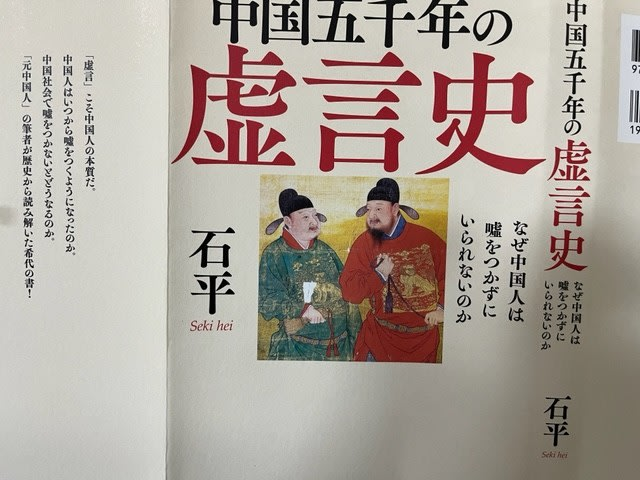
“It Is True That Chinese People Today Lie Without Hesitation, and for Thousands of Years They Have Lied Everywhere and in Every Situation”
The following is from the Preface to the book cited below.
This book is essential reading not only for the Japanese people but also for people throughout the world.
It is no exaggeration whatsoever to say that without reading this book, one cannot understand China or the Chinese people.
From the perspective of people in other countries, the Chinese have long been routinely described as “liars.”
The Chinese are said to be a people who constantly lie and deceive others.
Westerners who once visited China also left written records of this.
Arthur Smith, an American missionary who conducted missionary work in China for twenty-two years from the end of the nineteenth century to the beginning of the twentieth century, stated in his book Chinese Characteristics, translated by Munetaka Ishii and Nako Iwasaki and published by Chuko Sosho, that the Chinese were extremely dishonest and frequently told lies, resulting in mutual distrust both throughout society and within families.
Ralph Townsend, an American who served as vice-consul in Shanghai and Fujian Province for two years beginning in 1931, wrote in his book Ways That Are Dark: The Truth About China, translated by Hideo Tanaka and Kenkichiji Sakita and published by Fuyo Shobo Publishing, “If you asked British and American people who have lived in China for a long time to name the characteristic of the Chinese that differs most from ours, I believe almost all of them would answer without hesitation, ‘They are liars.’”
He further lamented, “They tell lies merely to conceal other lies, and even trivial cases take months or years to resolve.”
Both Smith and Townsend were also astonished that Chinese people did not feel insulted or become angry when they were called “liars.”
I am a former Chinese national who became a naturalized Japanese citizen, and I do not believe that what they said was mistaken.
It is true that Chinese people today lie without hesitation, and for thousands of years the Chinese have lied everywhere and in every situation.
Fundamentally, under the influence of Confucianism, the Chinese are family-centered and regard everyone outside their blood relatives and pseudo-families formed through geographical ties or shared interests—known as “quan-zi”—as people who cannot be trusted.
Even within the family, husbands and wives do not trust each other completely.
Therefore, whenever interests are involved, they invariably lie.
Even when a lie is exposed, they continue trying to maintain it at all costs.
Chinese people acknowledge their own lies only when the other party holds an overwhelmingly superior position and persisting in the lie would no longer serve their own interests.
Because everyone behaves in this way, society becomes filled with lies and mutual distrust.
China has a saying, “中国什么都是假的、只有观众是真的” (“In China, everything is fake; only the swindlers are genuine”), and Zhu Rongji, who served as premier during the Jiang Zemin administration, also uttered those words.
Therefore, for Chinese people, being called a “liar” is not an insult at all.
That is because everyone is the same.
In this book, I have examined why Chinese people lie, investigated its history and origins, and added my own explanation.
Having compiled the material in this way, I myself was honestly astonished by how important a keyword lying has been throughout Chinese history.
China today is in conflict with various countries by claiming that the South China Sea and the Senkaku Islands have been “Chinese territory since ancient times,” but all such claims are lies.
The extent to which China lies in diplomatic negotiations is evident from its history.
Through this book, I sincerely hope that readers will understand that “China lies as naturally as it breathes.”
The title of this book contains the phrase “five thousand years of China,” and Chinese people frequently boast about the length of their history.
However, the Chinese heartland has undergone repeated dynastic changes and was sometimes ruled by foreign peoples for hundreds of years.
The period under Mongol rule should be considered part of “Mongol history” rather than “Chinese history.”
Nevertheless, China has turned Genghis Khan into one of its own national heroes and forcibly fabricated a history claiming that he was “Chinese.”
It is doubtful in the first place whether China truly has five thousand years of history.
I used the phrase “five thousand years of China” precisely to convey that the claim itself is also a “lie.”
I hope this book will help readers understand the true nature of China and the Chinese people.
Mid-July 2018
Seki Hei